

You have an idea that could change your market. But every agency quote says six months and $100K. Every technical cofounder wants 40% equity. Meanwhile, your competitors are shipping. This guide shows you how AI and no-code platforms let non-technical founders build and validate MVPs in days, not months, without burning cash or diluting ownership.
Table of Contents
Key takeaways
| Point | Details |
| Speed wins | AI and no-code tools compress MVP timelines from months to days or hours |
| Focus matters | Test one critical assumption instead of building a feature bloated product |
| Cost control | Launch functional MVPs for under $100/month without agency overhead |
| Iteration cycles | Rapid user feedback loops validate or pivot your idea before major investment |
| Exit strategy | Choose platforms with code export to avoid permanent vendor lock-in |
Understanding the MVP problem and why speed matters
Most founders misunderstand what an MVP actually is. It’s not a stripped down version of your dream product. An MVP is the smallest version of your product that allows you to test one critical assumption. That assumption might be “Do busy parents actually want meal planning automation?” or “Will freelancers pay for invoice tracking?” Your MVP exists to answer that question fast.
The data is brutal. 87% of MVPs fail to validate properly because founders try to do too much. They build authentication, payment processing, admin dashboards, mobile apps, and email notifications before testing if anyone wants the core value. Six months later, they launch to crickets. The problem wasn’t execution quality. The problem was building the wrong thing slowly.
Speed to market changes everything. When you can build and test an idea in a week instead of six months, you compress risk. You learn what users actually do instead of what they say they’ll do. You iterate based on behavior, not assumptions. For non-technical founders who need to validate SaaS idea before investing serious money, this speed advantage is the difference between survival and shutdown.
Pro Tip: Write down the single question your MVP must answer. If you have more than one critical assumption, you’re building too much. Pick the riskiest assumption first.
Traditional development paths trap you in a false choice. Hire an agency and wait months while burning $50K to $200K. Find a technical cofounder and give away equity you’ll regret later. Learn to code yourself and spend a year on tutorials instead of customers. For most founders who want to validate an idea fast, AI app builders are the better choice because they eliminate the technical bottleneck entirely.
“The goal of an MVP is not to build a product. The goal is to learn whether you should build a product.”
This mindset shift matters because it changes what you build and how fast you ship. Stop optimizing for completeness. Start optimizing for learning speed. The fastest path to a validated business is testing your riskiest assumption with the minimum viable experiment, then iterating based on what real users actually do when they interact with your solution.
Preparing to build: choosing the right tools and setting expectations
Not all no-code platforms are created equal. Some focus only on landing pages. Others handle databases but not authentication. You need full-stack capability to build a real MVP that users can actually use. No-code MVP builders enable rapid deployment, with some tools allowing launch in hours, but only if they cover the complete stack.
Full-stack capability is crucial for MVPs: frontend UI, backend logic, database, authentication, payment. Your platform choice should handle all of these without requiring you to stitch together five different services. Integration complexity kills speed. Every additional tool adds friction, learning curve, and points of failure.

Comparison of popular MVP platforms
| Platform | Speed | Full-stack | Code export | Best for |
| Bubble | Medium | Yes | Limited | Complex workflows |
| Webflow | Fast | No | Yes | Content sites |
| FlutterFlow | Medium | Yes | Yes | Mobile first |
| Bolt.new | Very fast | Yes | Yes | AI generated apps |
| Softr | Fast | Partial | No | Database frontends |
Code export and ownership are important for future customization and avoiding vendor lock-in. When your MVP gains traction, you’ll want the option to hire developers for custom features the platform can’t handle. Platforms that trap your data or logic in proprietary systems force you to rebuild from scratch when you outgrow them.
Cost control matters for bootstrapped founders. No-code platforms allow non-technical founders to build MVPs for under $100/month, which is 100x cheaper than agency builds. Most platforms offer free tiers for development and testing. You only pay when you launch to real users. This cost structure lets you experiment without financial pressure.
Pro Tip: Choose easier platforms that let you ship in days over complex tools with month-long learning curves. Your goal is validation, not mastering a new technology stack.
Platform selection should match your MVP’s key SaaS features and technical requirements. If you need real-time collaboration, ensure the platform handles websockets. If you’re building a marketplace, verify it supports multi-user roles and permissions. If mobile matters, pick a platform with native app export or responsive web design.
Set realistic expectations on what no-code can and cannot do. These platforms excel at standard CRUD operations, user management, payment processing, and typical business logic. They struggle with complex algorithms, real-time video processing, or highly custom user interfaces. For 80% of MVP ideas, no-code handles everything you need. For the other 20%, you’ll know quickly and can make informed decisions about custom development.
The SaaS development insights blog covers platform-specific guidance and trade-offs in depth. The key principle remains consistent across all tools: pick the platform that removes the most friction between your idea and a working product users can test.
Executing your MVP build with AI and no-code: step-by-step
Building your MVP follows a clear sequence that minimizes wasted effort and maximizes learning speed. The most common mistake non-technical founders make is jumping straight into features without defining what they’re testing. Avoid this trap by following a structured approach.
-
Define your critical assumption. Write one sentence describing what must be true for your business to work. “Freelancers will pay $20/month for automated invoice tracking” is a testable assumption. “Build a better invoicing tool” is not.
-
Outline minimal features. List only the features required to test your assumption. For the invoicing example, that’s create invoice, send invoice, track payment status. Everything else (recurring invoices, expense tracking, reports) is noise until you validate the core.
-
Select your platform and start building. Pick an AI or no-code platform with full-stack support. AI app builders can generate a fully working web app with authentication, database, task management, and deployment in minutes. Start with a template if available. Templates handle the boring infrastructure so you focus on your unique value.
-
Use AI capabilities to accelerate setup. Modern platforms let you describe features in plain English and generate working code. “Add a button that creates a new invoice and saves it to the database” becomes functional UI and backend logic without writing code. This speed lets you test interface ideas rapidly.
-
Test internally before launching. Run through your core user flow yourself. Create an account, perform the main action, verify data saves correctly. Fix obvious breaks. Don’t obsess over polish. You’re validating assumptions, not winning design awards.
-
Launch to real users quickly. Get your MVP in front of 10 to 50 target users within a week of starting development. Real user behavior teaches you more in one day than six months of planning. Watch what they do, not what they say they’ll do.
Pro Tip: Set a hard deadline of seven days from start to first user. This constraint forces you to cut ruthlessly and focus on core value. Every feature you defer is a feature that won’t distract from learning.
The iteration cycle matters as much as the initial build. After launch, you’ll discover users ignore features you thought were critical and obsess over details you barely implemented. This is normal and valuable. Your job is to launch SaaS MVP fast, observe behavior, and adjust based on data instead of opinions.
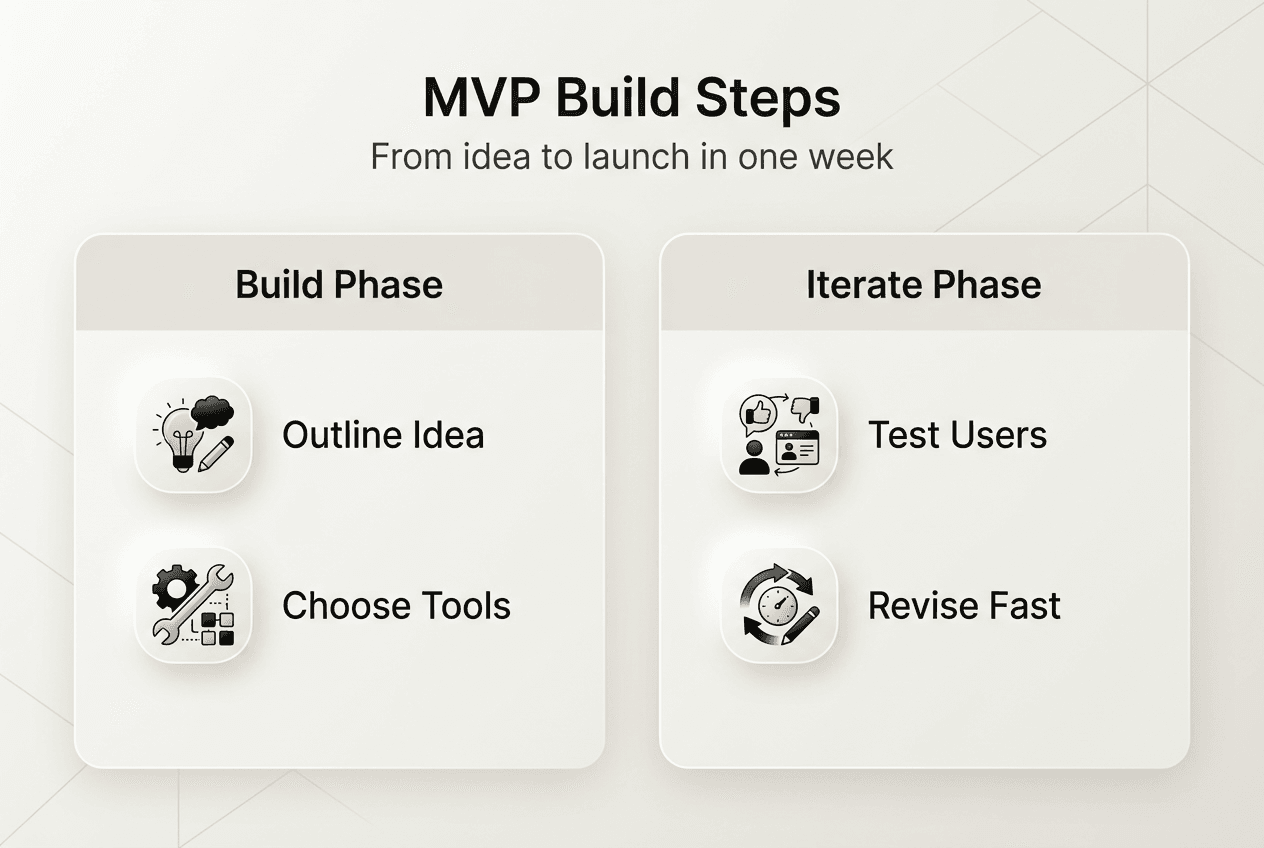
Most founders waste weeks perfecting features users never wanted. The no-code advantage is you can change direction in hours instead of months. User feedback says they need export to PDF instead of email delivery? You can ship that change today. This rapid iteration loop is how you find product-market fit before running out of runway.
Verifying and iterating your MVP for success
Validation means testing your assumption with real user behavior, not surveys or feedback calls. Users lie, often unintentionally. They say they’ll pay $50/month, then ghost when you ask for a credit card. They claim they need 20 features, then only use two. No-code MVPs compress feedback cycles, allowing for rapid iteration based on user behavior instead of stated preferences.
Track actions, not opinions. How many users complete your core workflow? What percentage return the next day? Where do they drop off? These behavioral metrics reveal truth. If users sign up but never create their first invoice, your onboarding is broken or your value proposition is unclear. If they create one invoice then disappear, the tool isn’t solving a frequent enough problem.
Key validation metrics to track
| Metric | Target | What it reveals |
| Signup to activation | >40% | Onboarding clarity |
| Day 1 to Day 7 retention | >25% | Core value delivery |
| Feature usage rate | >60% for core feature | Problem-solution fit |
| Conversion to paid | >2% for B2B | Willingness to pay |
Avoid feature creep during validation. Every new feature adds complexity and dilutes your learning. You’re testing one assumption. Adding features tests multiple assumptions simultaneously, which makes it impossible to know what’s working. If your invoice MVP isn’t getting traction, adding expense tracking won’t fix the core problem. It just makes debugging harder.
Successful validation can happen fast with the right approach. Gift My Book reached $1M ARR in just 3 months by using Base44, a no-code platform. They didn’t build a complex product. They validated demand quickly and scaled what worked. Gift My Book validated demand with $100 in Meta ads and achieved 6–8% conversion rates, proving you don’t need massive marketing budgets to test assumptions.
Pro Tip: Spend $100 on targeted ads to drive traffic to your MVP. If you can’t get 100 visitors to try your solution for $100, your targeting or value proposition needs work before you build more features.
Iteration speed determines how fast you find product-market fit. No-code platforms let you ship changes in hours. Use this advantage ruthlessly. See users dropping off at a specific step? Fix it today and measure tomorrow. This tight feedback loop compounds learning velocity in ways traditional development can’t match.
The goal isn’t to build the perfect product. The goal is to validate SaaS idea before investing serious time and money into custom development. Once you’ve proven users will pay for your core value, you can decide whether to scale on no-code or rebuild with custom code. Both paths are valid. The difference is you’re making that decision with data instead of hope.
How Hanad Kubat helps founders build their MVPs faster
If you’re done planning and ready to ship, I help non-technical founders turn ideas into working MVPs in 4 to 12 weeks. No equity. No agency overhead. Just direct technical execution from someone who’s built and scaled SaaS products myself.
I’ve worked with Fortune 500 companies and built my own products, so I know what founders need: speed, focus, and code that doesn’t fall apart at scale. Whether you’re validating an idea or need to quick SaaS MVP launch to beat competitors, I cut scope ruthlessly and ship what matters. You work directly with me. No project managers. No telephone game. Just React, Next.js, Node.js, and production-ready code.
Visit Hanad Kubat MVP development to see how I help founders avoid the common pitfalls that kill MVPs and get to market before their runway runs out.
Frequently asked questions
What is the fastest way for non-technical founders to build an MVP?
AI app builders like Bolt.new or Lovable can generate working MVPs in hours by describing features in plain English. These platforms handle frontend, backend, database, and authentication automatically. For slightly more control with similar speed, no-code platforms like Bubble or FlutterFlow let you build full-stack applications in days without writing code.
How much does it cost to build an MVP without coding?
Most no-code platforms cost under $100/month for a live MVP with real users. Free tiers work for development and testing. This is 500x cheaper than agency builds that start at $50K. The main cost is your time learning the platform, which typically takes a few days for simple MVPs.
Should I focus on one feature or build multiple features for my MVP?
Focus on testing one critical assumption with the minimum features required. Most MVPs fail because they try to do too much. Building multiple features makes it impossible to know what’s working. Start with one core workflow, validate it works, then add features based on user behavior instead of assumptions.
How do I know if my MVP is successful?
Track behavioral metrics, not opinions. Successful MVPs show users completing the core action repeatedly, returning day after day, and converting to paid at rates above 2% for B2B or 1% for B2C. If users sign up but don’t activate, or activate once then disappear, your MVP hasn’t proven the core value yet.
Can I customize my MVP later if I use no-code tools?
Platforms with code export like FlutterFlow, Bolt.new, or Webflow let you download source code for custom development later. This prevents vendor lock-in. Even without export, you can rebuild validated features in custom code once you’ve proven demand. The key SaaS features you validated guide what to build, making custom development faster and lower risk.
How long should I spend validating my MVP before scaling?
Most founders know within 2 to 4 weeks if their core assumption is valid. If you’re seeing strong activation, retention, and conversion signals, you can start scaling. If metrics are weak after a month of iteration, the idea likely needs a major pivot or different target market. Speed matters because every week of validation costs runway.