

Most startup founders assume off-the-shelf software is the fastest path to launch. It’s a safe bet, right? Plug in, pay monthly, and move on. But here’s the reality: generic tools rarely fit your unique workflow. They force you to adapt your business to their features instead of building something that works exactly how you need it to. Custom app development flips that equation. It creates software tailored to your specific goals, workflows, and competitive edge. This guide breaks down what custom app development actually means, when it makes sense for your startup, and how to approach it without burning cash or accumulating technical debt.
Table of Contents
- Key takeaways
- Understanding custom app development
- Benefits and challenges of custom app development
- Choosing the right approach for your startup MVP
- How custom app development drives startup success
- Explore expert MVP development support
- FAQ
Key Takeaways
| Point | Details |
|---|---|
| Custom fit advantage | Custom apps align software with your unique workflows and competitive edge, avoiding compromises built into off the shelf solutions. |
| ROI and TCO | Although upfront costs are higher, tailored apps can deliver greater ROI and lower total cost of ownership over time. |
| Agile discipline | Successful custom development relies on disciplined Agile and Lean practices to minimize technical debt and keep the project adaptable. |
| MVP trade offs | Startups should understand trade offs to build efficient minimum viable products that validate goals without overbuilding. |
Understanding custom app development
Custom app development is creating software tailored specifically to your business’s unique needs, workflows, and requirements. Unlike off-the-shelf products designed for broad audiences, custom apps solve your exact problems. Think of it like buying a suit off the rack versus getting one tailored. The tailored version fits perfectly because it’s built for your measurements.
Off-the-shelf software works for common use cases. Tools like Shopify or QuickBooks serve thousands of businesses because they address universal needs. But when your startup has unique workflows, integrations, or competitive differentiators, generic software becomes a constraint. You end up paying for features you don’t use while missing the ones you actually need.
Custom apps shine when your business model demands something different. Maybe you need specific data integrations that standard tools don’t support. Or your user experience requires workflows that generic platforms can’t deliver. Perhaps your competitive advantage depends on features no existing product offers. These scenarios justify custom development.
For startups building MVPs, custom development lets you test hypotheses without compromise. You’re not forcing your product vision into someone else’s framework. You build exactly what validates your market assumptions. This matters when key features define your SaaS differentiation and generic tools can’t deliver them.
Custom development means owning your technology stack completely. You control the roadmap, the features, and the user experience without waiting for a vendor to prioritize your needs.
The technical terms matter here. An MVP means minimum viable product, the simplest version that tests your core hypothesis. Workflows describe how users move through your app to accomplish tasks. Scalable means your software handles growth without breaking. Understanding these concepts helps you communicate with developers and make informed decisions about what to build first.
Custom app development isn’t about building everything from scratch. Modern frameworks like React, Next.js, and Node.js provide proven foundations. You’re not reinventing the wheel. You’re assembling components in a way that serves your specific business logic and user needs.
Benefits and challenges of custom app development
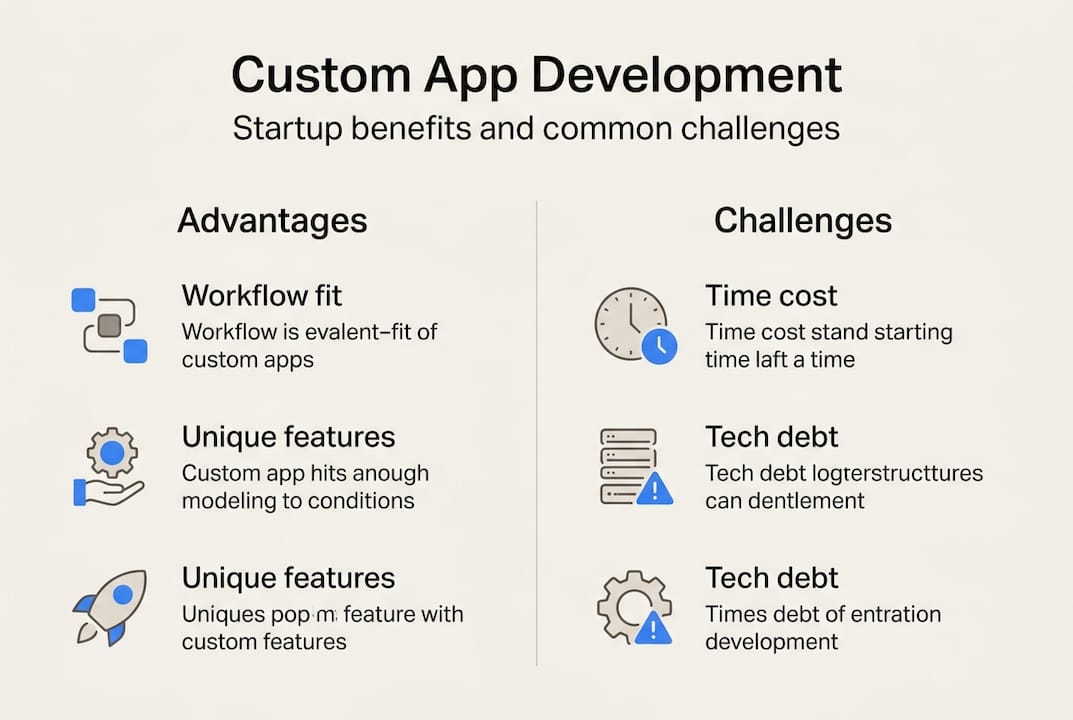
Custom apps deliver four major advantages over off-the-shelf solutions. First, they fit your exact workflows without forcing compromises. Second, they scale with your business instead of hitting arbitrary limits. Third, they create competitive differentiation that generic tools can’t provide. Fourth, they reduce long-term costs despite higher upfront investment.
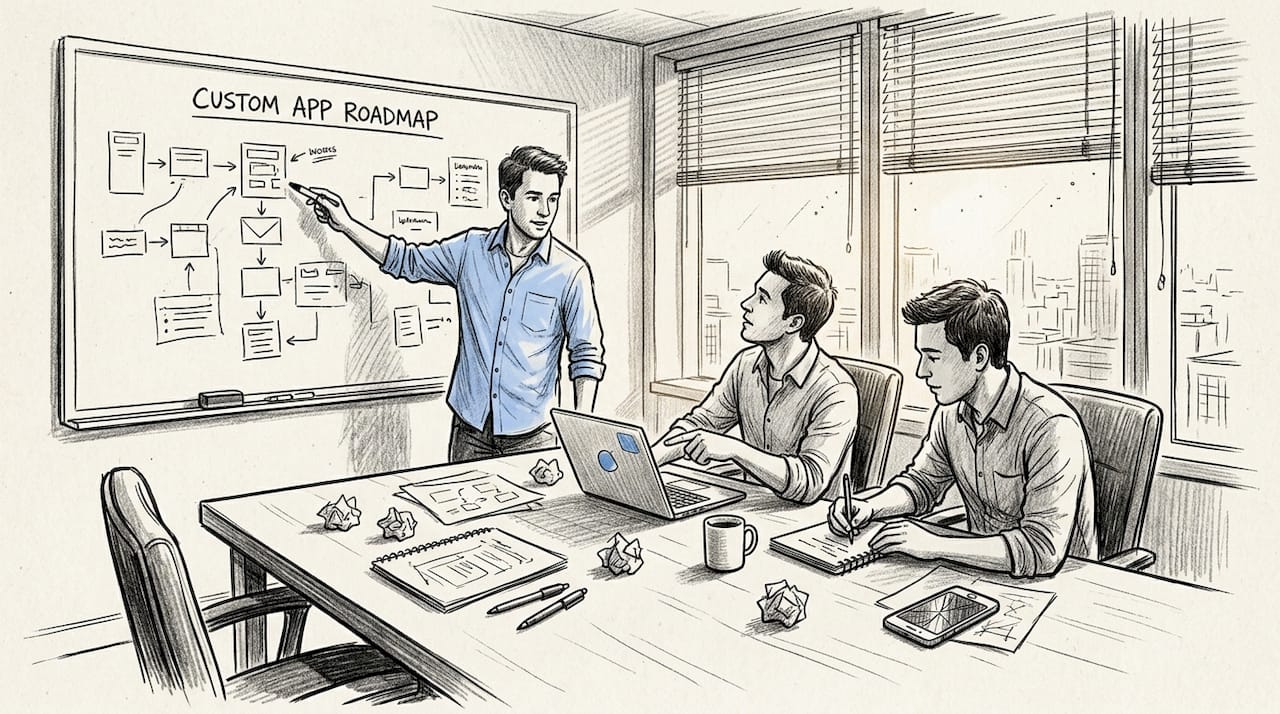
The custom app market is projected to reach $120-146 billion by 2029-2030, growing at 22.6% annually. That growth reflects a clear trend: 89% of enterprises report gaps in off-the-shelf solutions. When you scale, custom apps can achieve 300% ROI while lowering total cost of ownership compared to escalating subscription fees.
Here’s the reality check. Custom development takes longer and costs more upfront. Off-the-shelf tools deploy in days or weeks. Custom builds take months. Initial investment for custom work starts higher because you’re paying for design, development, testing, and deployment tailored to your needs. But subscription costs compound over time while custom apps become assets you own.
| Factor | Off-the-shelf | Custom development |
|---|---|---|
| Time to deploy | Days to weeks | Months |
| Upfront cost | Low (subscription model) | High (development investment) |
| Long-term cost | Escalating subscriptions | Lower total ownership cost |
| Scalability | Limited by vendor | Built for your growth |
| Differentiation | Minimal (everyone uses same tools) | High (unique features) |
| ROI potential | Moderate | 300% when scaled |
The biggest risk in custom development is technical debt. Without disciplined Agile and Lean practices, custom code becomes a maintenance nightmare. Rushed builds create brittle systems that break under growth. Poor architecture makes adding features exponentially harder over time. This is why methodology matters as much as coding skill.
Pro Tip: Balance speed and quality by adopting two-week sprint cycles with clear feature priorities. Ship working software every sprint to validate assumptions early. This Agile approach prevents over-engineering while maintaining code quality.
Custom development pays off when you need specific integrations, unique user experiences, or features that define your competitive position. It makes less sense when standard tools already solve your problem adequately. The key is knowing which category your startup falls into and understanding the financial impacts before committing resources.
Choosing the right approach for your startup MVP
Deciding between off-the-shelf and custom development for your MVP requires systematic evaluation. Here’s a step-by-step approach that cuts through the confusion.
-
Validate market demand first. Before building anything, confirm people will pay for your solution. Use landing pages, surveys, or manual processes to test demand. No amount of custom development saves a product nobody wants.
-
Assess your budget realistically. Custom MVPs typically start at €15,000 and scale based on complexity. If you have limited runway, off-the-shelf tools let you test faster with less capital at risk.
-
Define your timeline constraints. Need to launch in 30 days? Off-the-shelf wins. Have 3-4 months and need specific features? Custom becomes viable.
-
Identify scalability requirements. Will you serve 100 users or 100,000? Generic tools often hit limits that custom solutions avoid by design.
-
Evaluate technical support needs. Off-the-shelf comes with vendor support. Custom requires either in-house expertise or ongoing developer relationships.
Product-market fit matters more than technology choices early on. PMF means your product solves a real problem people will pay to fix. Until you achieve PMF, optimize for learning speed over perfect implementation. Off-the-shelf solutions deploy 60% faster than custom builds, making them ideal for pre-PMF validation.
Once you’ve validated demand and achieved initial PMF, custom development becomes strategic. You know what features matter because users told you. You understand which workflows create value and which are nice-to-have. This knowledge prevents the classic mistake of building features nobody uses.
Pro Tip: Start with a 4-week discovery phase before committing to full custom development. Map user journeys, define core features, and create technical specifications. This upfront work prevents costly pivots mid-build and ensures everyone agrees on what success looks like.
Technical debt poses the biggest long-term risk in custom development. Without disciplined Agile and Lean practices, rushed code creates maintenance nightmares. Every shortcut taken early compounds into hours of debugging later. Choosing developers who follow structured methodologies protects your investment.
The decision framework is simple: use off-the-shelf for validation, switch to custom when differentiation and scale demand it. Don’t build custom too early, but don’t wait so long that technical limitations kill your growth. Launching your SaaS MVP fast means finding this balance based on your specific constraints and goals. More strategic insights are available through SaaS development resources that help founders navigate these trade-offs.
How custom app development drives startup success
Custom apps create tangible business advantages that generic software can’t match. Here’s what successful startups achieve with tailored development:
- Automation of unique workflows that off-the-shelf tools don’t support, reducing manual work by 40-60%
- User experiences designed specifically for your target audience, increasing conversion rates and retention
- Integrations with existing systems and tools that generic platforms can’t accommodate
- Competitive features that differentiate your product in crowded markets
- Data ownership and control without vendor lock-in or arbitrary usage limits
- Faster iteration cycles once the foundation is built, because you control the entire stack
The financial case for custom development strengthens as you scale. While off-the-shelf subscriptions increase with usage, custom apps become more cost-effective over time.
| Metric | Year 1 | Year 3 | Year 5 |
|---|---|---|---|
| Custom app total cost | €25,000 | €35,000 | €50,000 |
| Off-the-shelf subscriptions | €12,000 | €42,000 | €78,000 |
| Efficiency gains (hours saved) | 500 | 2,000 | 4,500 |
| ROI from custom investment | 80% | 240% | 380% |
These numbers reflect real patterns. Custom apps achieve 300% ROI when scaled properly, and total cost of ownership drops significantly compared to subscription escalation. The key is reaching sufficient scale where the economics flip in your favor.
The strategic advantage of custom development isn’t just features. It’s the ability to iterate on your exact business logic without waiting for vendors or working around platform limitations. You move at your speed, not theirs.
Maintaining these benefits requires ongoing discipline. Agile and Lean methodologies prevent the technical debt that erodes custom app value over time. Regular refactoring, automated testing, and clear documentation keep your codebase healthy as it grows. Without these practices, custom apps become liabilities instead of assets.
The entrepreneurial mindset shift matters here. View custom development as building a technology asset, not just buying software. Assets appreciate when maintained properly. They compound advantages over time. This perspective changes how you budget and prioritize technical investment. Real-world MVP development demonstrates these principles in action across different startup contexts.
Explore expert MVP development support
You’ve seen how custom app development creates competitive advantages when done right. The challenge is executing without burning cash or accumulating technical debt. That’s where specialized expertise makes the difference.
I’m Hanad Kubat, a senior full-stack engineer who builds production-ready MVPs in 4-12 weeks. No agency overhead, no project managers, no game of telephone. You work directly with the person writing your code. My background includes Fortune 500 engineering discipline at BMW, Deutsche Bahn, and IBM, combined with founder speed from building my own SaaS products.
The approach is simple: disciplined Agile development that ships working software every two weeks. We cut scope ruthlessly, kill features that don’t serve the business, and focus on validating your core hypothesis fast. Starting at €15,000, you get senior technical execution without equity dilution.
If you’re ready to move from planning to building, explore MVP development services designed for non-technical founders who need technical partners they can trust. For deeper technical context, review comprehensive development resources that outline methodologies and frameworks used in successful startup builds.
FAQ
What is the difference between custom app development and off-the-shelf software?
Custom apps are built specifically for your business workflows, requirements, and competitive needs. Off-the-shelf software serves broad audiences with generic features designed for common use cases. The custom approach fits your exact specifications while off-the-shelf requires you to adapt your processes to their features.
How can non-technical founders validate if they need a custom app?
Start by testing your core hypothesis with an MVP that focuses on essential features only. Use off-the-shelf tools initially if they can validate demand without major compromises. Assess whether unique workflow gaps exist that generic apps can’t fill easily. When differentiation depends on features no existing product offers, custom development becomes necessary. Validation frameworks help founders make this determination systematically.
What development methodologies help avoid technical debt in custom apps?
Agile and Lean development methods emphasize iterative learning, continuous improvement, and regular code reviews. These frameworks prevent unnecessary complexity by shipping working software in short cycles and incorporating feedback early. Disciplined practices like automated testing, clear documentation, and regular refactoring keep custom codebases maintainable as they grow. Without structured methodology, custom builds quickly become maintenance nightmares that drain resources. Agile and Lean practices provide the discipline needed for sustainable custom development.
What is the typical ROI timeline for custom app development in startups?
While upfront costs are higher than off-the-shelf alternatives, many startups see significant ROI within 1-3 years when scaling properly. Custom apps achieve 300% ROI for scaled use cases, and long-term total cost of ownership is lower despite higher initial investment. The timeline depends on how quickly you reach scale where efficiency gains and reduced subscription costs outweigh development expenses. Startups that validate product-market fit before building custom typically see faster ROI because they build features users actually need.