

You’re a non-technical founder ready to build your SaaS MVP, but every tech decision feels like a minefield. Should you go no-code or hire a developer? Which cloud platform scales without breaking your budget? How do you move fast without sacrificing quality or giving up equity? This founder tech checklist cuts through the noise with clear criteria, proven options, and actionable comparisons to help you launch your MVP in 2026 with confidence and speed.
Table of Contents
- Key takeaways
- Establish core criteria for your founder tech checklist
- Explore top tech options for non-technical SaaS founders in 2026
- Compare and contrast your founder tech checklist options
- Choose the best tech approach for your SaaS MVP launch in 2026
- Get expert MVP development and tech support without equity
- Frequently asked questions
Key Takeaways
| Point | Details |
|---|---|
| Core MVP criteria | Define scalability, speed, cost efficiency, and iteration flexibility as your top criteria before choosing tools. |
| Equity free technical help | Seek arrangements that provide hands on technical help without equity sacrifice to keep control while gaining essential execution. |
| Cloud and framework choices | Compare cloud platforms like AWS, Google Cloud, and Vercel for deployment speed and cost predictability, and choose frameworks such as Nextjs or React Native to balance customization with velocity. |
| Scorecard decision method | Create a simple weighted scorecard of your top five criteria and rate each option to remove emotion from the decision. |
Establish core criteria for your founder tech checklist
Before you pick a single tool or hire anyone, define what matters most for your MVP. Start with scalability. Your tech stack must handle growth without a complete rebuild six months in. Speed comes next because every week you delay launch is a week your competitors gain ground. Cost efficiency matters when you’re bootstrapping or working with limited runway. Finally, prioritize iteration flexibility so you can pivot based on user feedback without starting over.
Access to hands-on technical expertise without equity sacrifice is critical. The technical co-founder role drives 160% higher startup funding, but not every founder can or should give up equity to get technical help. You need someone who can execute, not just advise. Evaluate cloud platforms like AWS, Google Cloud, or Vercel for deployment speed and cost predictability. Consider frameworks that balance customization with development velocity, like Next.js for web apps or React Native for mobile.
Balance founder control with technical complexity. You want enough visibility into the codebase to make informed decisions, but you don’t need to become a developer overnight. Choose tools and partners that explain trade-offs clearly and keep you in the driver’s seat. Roadmap flexibility is non-negotiable because your first product hypothesis will change after user feedback. Build for validation, not perfection.
Pro Tip: Create a simple scorecard with your top five criteria weighted by importance. Rate each tech option against this scorecard to remove emotion from your decision and focus on what actually moves your business forward.
Explore top tech options for non-technical SaaS founders in 2026
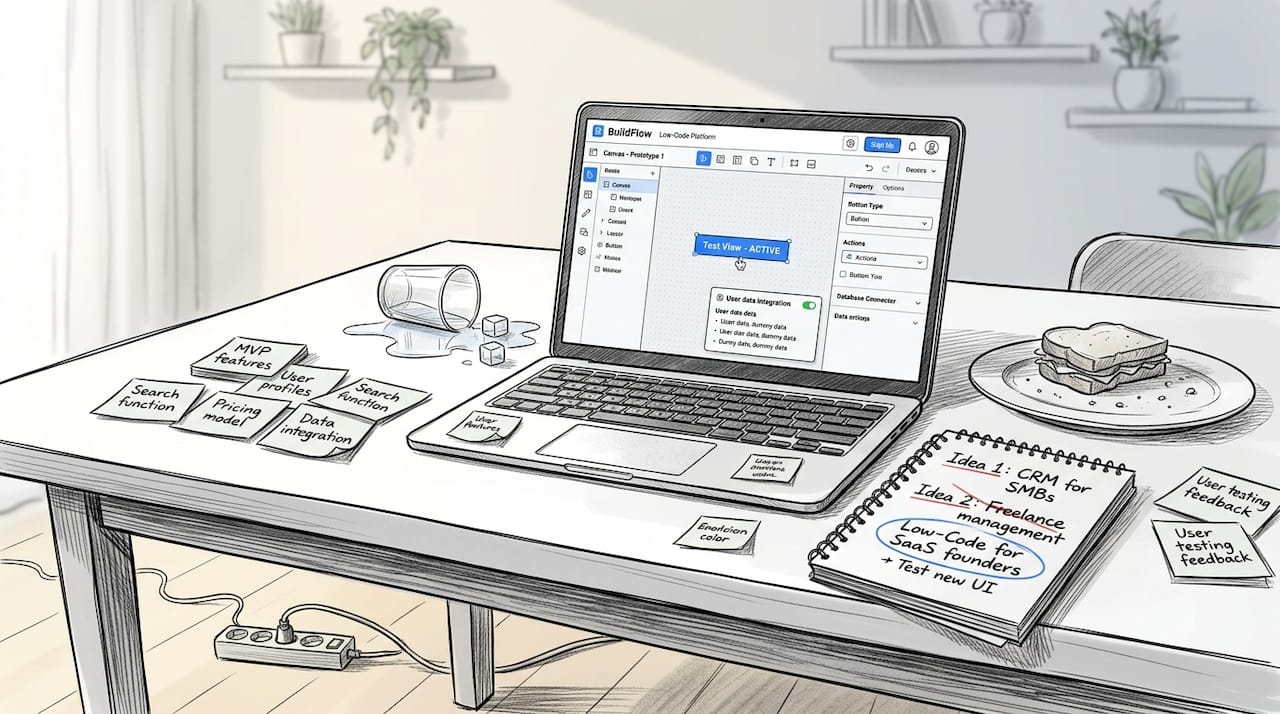
No-code and low-code platforms like Bubble, Webflow, and Airtable let you build mvp fast without coding 2026 founder guide and ship functional prototypes in days. These tools are perfect for testing core assumptions before investing in custom development. The downside is hitting platform limits as you scale, especially with complex workflows or integrations. You’ll also face higher long-term costs and potential vendor lock-in.
Hiring freelance engineers gives you more control and customization. Platforms like Upwork and Toptal connect you with developers who can build exactly what you need. The challenge is managing quality, communication, and continuity. Freelancers juggle multiple clients, so your project might not get consistent attention. You’ll also need technical judgment to evaluate their work, which most non-technical founders lack.
Dedicated technical consultants offer a middle path. You work directly with a senior engineer who owns your entire technical roadmap, from architecture decisions to deployment. This model eliminates the coordination overhead of agencies while maintaining the accountability and expertise you need. The investment is higher than freelancers but lower than hiring a full-time CTO or giving up equity.
Open-source frameworks like Next.js, Node.js, and PostgreSQL provide enterprise-grade foundations without licensing fees. They’re battle-tested by companies like Netflix and Airbnb, so you know they scale. The trade-off is needing someone skilled enough to implement and maintain them properly. Cloud providers matter too. AWS offers the most features but has a steep learning curve. Vercel optimizes for speed and simplicity with Next.js projects. Google Cloud balances cost and performance for data-heavy applications.
Pro Tip: Start with a no-code prototype to validate demand, then transition to custom development once you have paying customers. This two-phase approach minimizes risk and maximizes learning before you commit serious capital.
Compare and contrast your founder tech checklist options
Here’s how the main approaches stack up across the criteria that matter most for SaaS MVPs:
| Approach | Speed | Cost | Control | Scalability | Technical Debt Risk |
|---|---|---|---|---|---|
| No-code platforms | Very fast (days) | Low upfront, high long-term | Limited | Moderate | High |
| Freelance developers | Moderate (weeks) | Variable | High | High | Moderate to high |
| Dedicated engineer | Fast (weeks) | Medium upfront | Very high | Very high | Low |
| Agency | Slow (months) | Very high | Low | High | Moderate |
No-code platforms win on speed and initial cost but lose on control and scalability. You’ll ship fast, but you’ll hit walls with custom features, integrations, and performance optimization. Technical debt accumulates quickly because you’re building on someone else’s abstraction layer. When you need to migrate to custom code, you’re essentially starting over.
Freelancers offer flexibility and cost control but introduce coordination overhead and quality variance. You’re responsible for defining requirements, reviewing code, and managing timelines. Without technical expertise, you can’t evaluate whether the work is solid or a future liability. Projects often take longer than quoted because freelancers underestimate complexity or juggle competing priorities.
A dedicated engineer provides the best balance for most SaaS founders. You get senior-level expertise, direct communication, and full ownership of your technical roadmap. The mvp validation checklist product market fit 2026 becomes easier to execute because you have someone who can rapidly iterate based on user feedback. Technical debt stays low because decisions are made with long-term scale in mind. The investment is higher than freelancers but delivers significantly better outcomes.
Agencies sound appealing but rarely work for early-stage MVPs. You pay for project managers, designers, and developers when you only need execution. Communication goes through layers, slowing decisions and diluting your vision. Agencies optimize for billable hours, not your success.
Consider your go-to-market strategy too. If you’re planning aggressive digital marketing for SaaS companies, your tech stack needs to support fast iteration on landing pages, analytics integration, and conversion optimization. No-code tools excel here initially but become bottlenecks as your marketing sophistication grows.
Choose the best tech approach for your SaaS MVP launch in 2026
Here’s how to decide based on your specific situation:
-
Assess your MVP complexity. If your product is a simple workflow automation or content platform, no-code might suffice. If you need custom logic, complex integrations, or mobile apps, you need custom development.
-
Evaluate your budget and timeline. With under $10K and a 4-week deadline, no-code is your only realistic option. With $15K-$30K and 8-12 weeks, a dedicated engineer delivers far better long-term value.
-
Consider your technical comfort level. If you can’t evaluate code quality or technical trade-offs, avoid freelancers. You’ll waste money fixing problems you can’t identify until it’s too late.
-
Map your validation plan. If you’re pre-revenue and testing assumptions, build the minimum viable feature set with no-code. If you have early customers and proven demand, invest in scalable custom development.
-
Secure equity-free technical support. You don’t need a co-founder if you can access senior engineering expertise on demand. The key is finding someone who’s built SaaS products themselves and understands founder constraints.
Pro Tip: Launch saas mvp fast by cutting scope ruthlessly. Your first version should solve one specific problem exceptionally well, not five problems poorly. Ship in weeks, not months, then iterate based on real user behavior.
Test your chosen platform or partner with a small pilot project before committing fully. Build one feature or workflow to evaluate speed, quality, and communication. This de-risks your decision and reveals problems early when they’re cheap to fix.
Align iteration cycles with market feedback loops. Plan to ship updates weekly or bi-weekly based on user data, not quarterly based on arbitrary roadmaps. Your tech approach must support this velocity without breaking.
Get expert MVP development and tech support without equity
If you’re ready to move from planning to execution, you need a technical partner who’s been in your shoes. I’m Hanad Kubat, a senior full-stack engineer who’s built SaaS products for Fortune 500 companies and launched my own startups. I help non-technical founders ship production-ready MVPs in 4-12 weeks using React, Next.js, Node.js, and React Native. No equity required. No agency overhead. You work directly with me, the person writing your code.
I’ve tested every framework and tool I recommend on my own products first. You get Fortune 500 engineering discipline at founder speed. Services start at €15K for MVP builds, with options for rescue work and technical strategy consulting. If you’re done talking and ready to ship, check out my MVP development for founders services or explore my technical MVP development resources to see how I approach scope, timelines, and validation.
Frequently asked questions
What is a founder tech checklist and why does it matter?
A founder tech checklist is a structured framework for evaluating technology options, tools, and support models when building your SaaS MVP. It matters because non-technical founders face dozens of technical decisions that can make or break their startup. A clear checklist helps you avoid costly mistakes, move faster, and maintain control without needing to become a developer yourself.
When should I use no-code platforms versus hiring a developer?
Use no-code platforms when you’re pre-revenue, testing core assumptions, or need to ship a prototype in days. Hire a developer when you have validated demand, need custom features, or plan to scale beyond 1,000 users. No-code works for simple workflows and MVPs under $10K budget, while custom development makes sense for $15K+ budgets and products requiring complex logic or integrations.
How do I get technical support without giving up equity?
Work with a dedicated technical consultant or senior engineer who charges project fees instead of taking equity. This model gives you access to expertise without diluting ownership or adding a co-founder. Look for someone who’s built SaaS products themselves and can execute your entire technical roadmap, not just advise. Services typically start around €15K for MVP builds.
What should I validate before investing in technical development?
Validate that real users have the problem you’re solving and will pay for your solution. Run customer interviews, build landing pages to test demand, and offer manual or semi-automated versions of your product before writing code. Validate your SaaS idea with at least 10 target customers who express willingness to pay. This reduces the risk of building something nobody wants.
Which cloud platform is best for SaaS MVPs in 2026?
Vercel works best for Next.js and React applications because it optimizes deployment speed and handles scaling automatically. AWS offers the most features and flexibility but requires more technical expertise to configure properly. Google Cloud balances cost and performance for data-intensive applications. Choose based on your tech stack and whether you have someone who can manage infrastructure, not just based on brand recognition.