

You have an idea that could work. You know you need to move fast, test assumptions, and iterate based on real feedback. But somewhere between reading about agile frameworks and actually building your MVP, things get messy. Sprints turn into marathons. Features multiply. Your timeline stretches from weeks to months. The problem is not agile itself but how founders misunderstand and misapply it. This guide cuts through the noise, explaining exactly how agile frameworks drive fast, validated MVP launches, what pitfalls to avoid, and how to combine agile with Lean Startup principles for maximum impact.
Table of Contents
- Key takeaways
- Understanding key agile frameworks for MVP development
- Common pitfalls non-technical founders face with agile MVPs and how to avoid them
- Agile versus Waterfall: choosing the right approach for your MVP
- Practical strategies to apply agile frameworks effectively for your MVP
- Partner with expert MVP development support
- FAQ
Key Takeaways
| Point | Details |
|---|---|
| Iterative MVP speed | Agile methods organize work into short iterations that test assumptions quickly and validate learning. |
| Guard against scope creep | Non technical founders often add features beyond the core hypothesis, which stalls MVPs and inflates timelines. |
| Lean and Agile fusion | Combining Agile with Lean Startup principles accelerates validation and learning from real user feedback. |
| Start with Scrum | If you are new to agile, start with Scrum to establish guardrails that prevent common mistakes. |
Understanding key agile frameworks for MVP development
Two agile frameworks dominate MVP development: Scrum and Kanban. Both enable fast iteration, but they work differently. Scrum organizes work into fixed-length sprints, typically two weeks. Each sprint includes planning, daily standups, development work, a sprint review, and a retrospective. The Product Owner prioritizes the backlog, the Scrum Master facilitates the process, and the development team executes. This structure aligns perfectly with MVP validation cycles because sprint reviews create natural checkpoints to assess what is working and what needs adjustment.
Kanban takes a different approach. Instead of fixed sprints, Kanban emphasizes continuous flow. Work moves through visual stages on a board: backlog, in progress, review, done. You limit work in progress to prevent bottlenecks and maintain focus. Kanban works well for teams that need flexibility or face unpredictable interruptions. For MVP development, Kanban lets you respond immediately to user feedback without waiting for a sprint to end.
Both frameworks prevent wasted effort by forcing prioritization. In Scrum, the Product Owner ranks backlog items by value. In Kanban, work-in-progress limits force hard choices about what matters most. Scrum adoption reaches 87% in agile teams, making it the default choice for many startups. But the framework matters less than how you apply it. The goal is not perfect agile compliance but rapid learning.
Pro Tip: Start with Scrum if you are new to agile. The structured ceremonies provide guardrails that prevent common mistakes. Once you understand the principles, you can adapt or switch to Kanban if continuous flow suits your team better.
Key practices that support fast MVP creation include:
- Daily standups keep communication tight and surface blockers immediately
- Sprint reviews create forcing functions to demonstrate working software
- Retrospectives identify process improvements before bad habits solidify
- Backlog refinement ensures the team always knows what comes next
- Time-boxed sprints prevent endless polishing and force shipping decisions
If you are building an MVP fast without coding, agile frameworks still apply. No-code tools benefit from iterative cycles and regular validation checkpoints just like custom development.
Common pitfalls non-technical founders face with agile MVPs and how to avoid them
The biggest mistake is treating your MVP like a full product. You add features because they seem important, not because they serve your validation goals. This is scope creep, and it kills MVPs. Feature bloat ranks as the top issue, causing 25% of MVPs to stall post-launch. Every feature you add increases complexity, extends timelines, and dilutes focus. Your MVP should test one core hypothesis, not solve every possible user problem.

Another trap is agile theater. You run standups, plan sprints, and track velocity, but you ignore the purpose behind these practices. Agile is not about following rituals. It is about learning fast and adapting based on evidence. If your sprint reviews do not include real user feedback, you are just building in circles. If your retrospectives do not change how you work, you are wasting time. Velocity means nothing if you are building the wrong things.
Ignoring user feedback undermines the entire point of iterative development. Some founders collect feedback but do not act on it because it conflicts with their vision. Others wait until they have a complete product before testing with users. Both approaches waste the primary advantage of agile: the ability to course-correct before investing months in the wrong direction.
Common mistakes that derail agile MVPs:
- Adding features based on internal opinions instead of user validation
- Skipping sprint reviews or treating them as internal demos only
- Measuring success by velocity or story points instead of learning
- Refusing to cut features even when timelines slip
- Building for scale before proving the core value proposition
Pro Tip: Use prioritization frameworks like MoSCoW (Must have, Should have, Could have, Will not have) or RICE (Reach, Impact, Confidence, Effort) to make objective decisions about what stays and what gets cut. These frameworks force you to defend every feature with data, not feelings.
“The biggest risk is not building the wrong product. It is building the right product too slowly and running out of runway before you can prove it works.”
If you are evaluating whether you need a technical co-founder to drive startup funding, understanding these pitfalls becomes even more critical. A technical partner who understands agile principles can prevent these mistakes before they compound. For more insights on avoiding common traps, explore the SaaS development blog for practical guidance.
Another tool that helps maintain focus is a project prioritization matrix, which provides a visual framework for evaluating features against effort and impact.
Agile versus Waterfall: choosing the right approach for your MVP
Waterfall development follows a linear sequence: requirements, design, implementation, testing, deployment. Each phase must complete before the next begins. Changes are expensive because they require revisiting earlier phases. For stable, well-understood projects with fixed requirements, Waterfall works. For MVPs, it rarely does.
Agile inverts this model. You build in small increments, test each one, and adjust based on what you learn. Requirements evolve as you gather feedback. Design decisions stay flexible until evidence forces a choice. This approach fits MVP development because your primary goal is learning, not executing a predetermined plan.
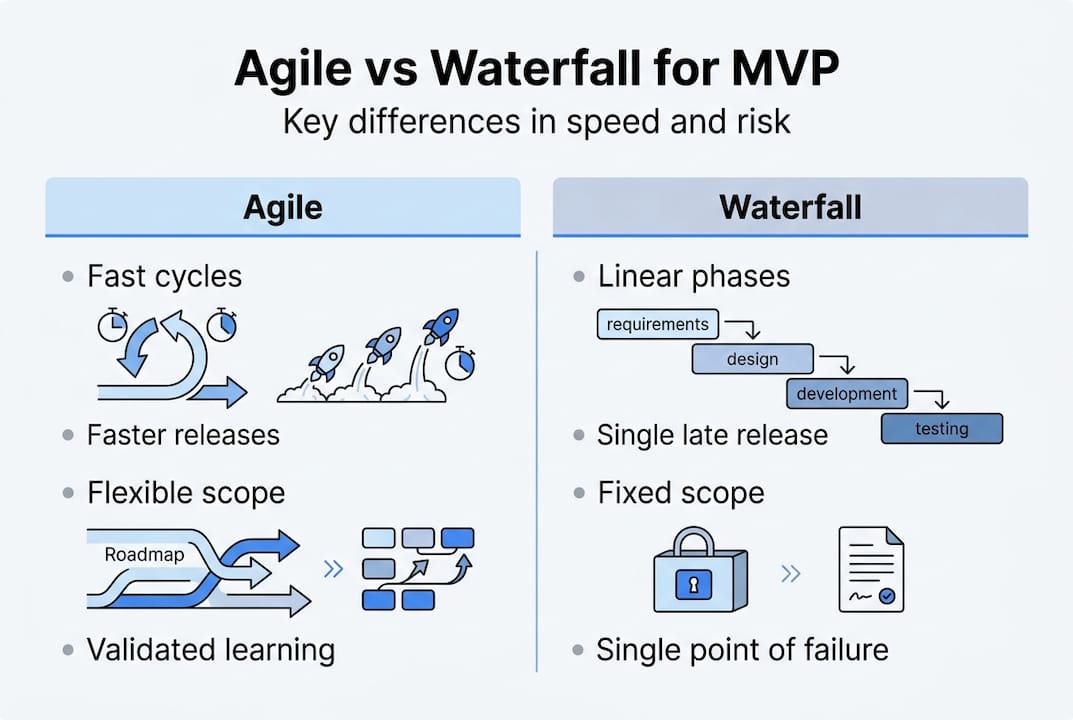
The speed difference is measurable. Agile delivers MVPs approximately 30% faster than Waterfall in most startup contexts. The advantage comes from eliminating waste. Waterfall requires extensive upfront planning, much of which becomes irrelevant once users interact with the product. Agile lets you skip the guesswork and build based on real feedback.
Hybrid approaches exist for specific situations. Regulated industries like healthcare or finance may require documentation and approval gates that resemble Waterfall. In these cases, you can combine agile development cycles with Waterfall governance. The development team works in sprints, but major releases pass through formal review processes. This compromise preserves agile’s learning benefits while meeting compliance requirements.
| Approach | Best For | MVP Timeline | Flexibility | Risk |
|---|---|---|---|---|
| Agile | Uncertain requirements, rapid learning needed | 4-12 weeks | High | Lower (early validation) |
| Waterfall | Stable requirements, regulated environments | 6-18 months | Low | Higher (late validation) |
| Hybrid | Compliance needs with iterative development | 8-16 weeks | Medium | Medium (balanced) |
For most startups, agile is the obvious choice. Your requirements are uncertain. Your market is unproven. Your biggest risk is building something nobody wants. Agile addresses all three problems by keeping cycles short and validation frequent.
If your goal is to launch a SaaS MVP fast, agile frameworks provide the structure to move quickly without sacrificing quality. The key is maintaining discipline around scope and validation criteria.
Practical strategies to apply agile frameworks effectively for your MVP
Applying agile frameworks successfully requires more than adopting ceremonies. You need clear prioritization methods, strict validation criteria, and a commitment to cutting features that do not serve your core hypothesis. Start with these steps:
-
Define your MVP validation criteria before writing any code. What specific question are you trying to answer? What user behavior would prove your hypothesis? What metrics will you track? These answers become your north star.
-
Apply a prioritization framework to every feature request. MoSCoW forces you to categorize features as must have, should have, could have, or will not have. RICE scores features by reach, impact, confidence, and effort. Both frameworks prevent emotional attachment from overriding business logic.
-
Set up regular validation checkpoints aligned with sprint reviews. Every two weeks, demonstrate working software to real users. Collect feedback. Measure behavior. Adjust your backlog based on what you learn.
-
Use visual management tools like Kanban boards to maintain transparency. Everyone should see what is in progress, what is blocked, and what comes next. This visibility prevents miscommunication and keeps priorities aligned.
-
Integrate Lean Startup principles with your agile framework. Key methodologies like Scrum and Kanban work best when integrated with Lean Startup validation. Build, measure, learn becomes the rhythm that drives your sprints.
Pro Tip: Create a one-page MVP charter that defines your core hypothesis, success metrics, must-have features, and timeline. Review it at the start of every sprint. If a feature does not directly support the charter, cut it.
Prioritization techniques that keep your MVP focused:
- MoSCoW method for binary feature decisions
- RICE scoring for comparing multiple feature options
- Value versus effort matrices for visual prioritization
- User story mapping to identify the minimum viable journey
- Impact mapping to connect features to business outcomes
Validation does not end at launch. Your first release is just the beginning of the learning cycle. Use sprint retrospectives to assess what worked, what failed, and what assumptions need testing next. Each iteration should make your product more aligned with real user needs, not just more feature-rich.
| Framework Element | MVP Application | Success Indicator |
|---|---|---|
| Sprint Planning | Define validation goals for next cycle | Clear hypothesis per sprint |
| Daily Standup | Surface blockers immediately | Issues resolved within 24 hours |
| Sprint Review | Demo to real users, collect feedback | Qualitative and quantitative data |
| Retrospective | Identify process improvements | Faster cycle times, fewer bugs |
| Backlog Refinement | Prioritize based on learning | Features tied to validation goals |
For detailed validation frameworks, see the MVP validation checklist for product-market fit. Before building anything, validate your SaaS idea before investing in development to ensure you are solving a real problem.
Additional resources like a feature prioritization matrix guide provide structured approaches to making objective feature decisions under time pressure.
Partner with expert MVP development support
Understanding agile frameworks is one thing. Applying them under startup pressure while managing technical execution is another. Most non-technical founders hit a wall when theory meets reality. You know what to build, but translating that into working software while maintaining agile discipline requires experience you may not have on your team yet.
Professional MVP development services bridge this gap. An experienced technical partner who has built MVPs using agile frameworks can accelerate your timeline, prevent costly mistakes, and increase your validation success rate. You get Fortune 500 engineering discipline applied at startup speed, without equity dilution or agency overhead. If you are ready to move from planning to shipping, explore MVP development services designed specifically for founders who need technical execution, not more advice.
FAQ
What agile framework is best for MVP development?
Scrum offers structured sprints, defined roles, and regular ceremonies that provide guardrails for teams new to agile. Kanban emphasizes continuous flow and works well when flexibility matters more than structure. The best choice depends on your team’s experience and how predictable your work is. Most startups start with Scrum because the structure prevents common mistakes.
How can non-technical founders avoid scope creep using agile?
Use prioritization methods like MoSCoW or RICE to make objective feature decisions. Maintain regular review cycles with real user feedback to validate assumptions before adding features. Create a one-page MVP charter that defines your core hypothesis and success metrics, then review it at every sprint planning session. If a feature does not directly support your validation goals, cut it.
Can agile and Lean Startup be combined for better MVP results?
Agile frameworks and Lean Startup principles complement each other perfectly. Agile provides the development structure while Lean Startup defines the validation logic. Together, they create a system for rapid experimentation and informed iteration. Use agile ceremonies like sprint reviews as validation checkpoints and retrospectives as learning sessions to assess which hypotheses to test next.
Is agile always faster than Waterfall for MVP launches?
Agile typically delivers MVPs 30% faster than Waterfall because it eliminates waste from upfront planning and enables early course correction. However, Waterfall may suit projects with fixed, stable requirements in regulated industries. For most startups facing uncertainty and needing rapid validation, agile provides clear speed and risk advantages. The key is matching the approach to your specific context and constraints.