

Most founders think a minimal viable product is just a quick prototype to show investors. That’s wrong. An MVP is a validation engine that proves whether your idea has legs before you burn time and money building the wrong thing. For non-technical founders, MVPs offer a strategic path to test market demand, gather real user feedback, and attract smarter funding without giving away equity too early. This article walks you through how MVPs validate startup ideas, common pitfalls to avoid, and practical steps you can take today to test your concept effectively.
Table of Contents
- Key takeaways
- What is a minimal viable product and why it matters
- How MVP facilitates idea validation without equity dilution
- Common pitfalls and challenges when using MVPs for validation
- Applying MVP validation: practical steps for non-technical founders
- Discover expert MVP development support
- FAQ
Key Takeaways
| Point | Details |
|---|---|
| MVP validation engine | An MVP validates core hypotheses with real users to prove market viability before heavy development. |
| Equity preservation | Building early traction with real users helps negotiate from strength and reduces premature equity dilution. |
| No code MVPs | Nontechnical founders can test demand, gather feedback, and attract early funding without coding. |
| One core problem | Focus on solving a single key problem to keep the MVP lean and actionable. |
What is a minimal viable product and why it matters
A minimal viable product is a development approach that produces the simplest version of your product to test core hypotheses with real users. It’s not a prototype sitting in a design file. It’s not a half-baked demo you show at pitch meetings. An MVP is a working product with just enough features to solve one specific problem for early adopters and generate actionable feedback.
The difference between an MVP, a prototype, and your final product comes down to purpose. A prototype demonstrates feasibility. Your final product delivers the complete vision. An MVP sits in between, designed exclusively to validate whether people actually want what you’re building. It tests market interest before you scale, conserving resources and time when both are scarce.
For founders, MVPs matter because they answer the only question that counts early on: will anyone pay for this? You can run surveys, conduct interviews, and analyze competitor gaps all day. None of that compares to putting a real solution in front of real users and watching what they do. An MVP forces you to prioritize ruthlessly, stripping away nice-to-haves and focusing on the core value proposition.
Pro Tip: Focus on one main problem your target users face to keep your MVP lean. If you try solving three problems at once, you’ll learn nothing useful about any of them.
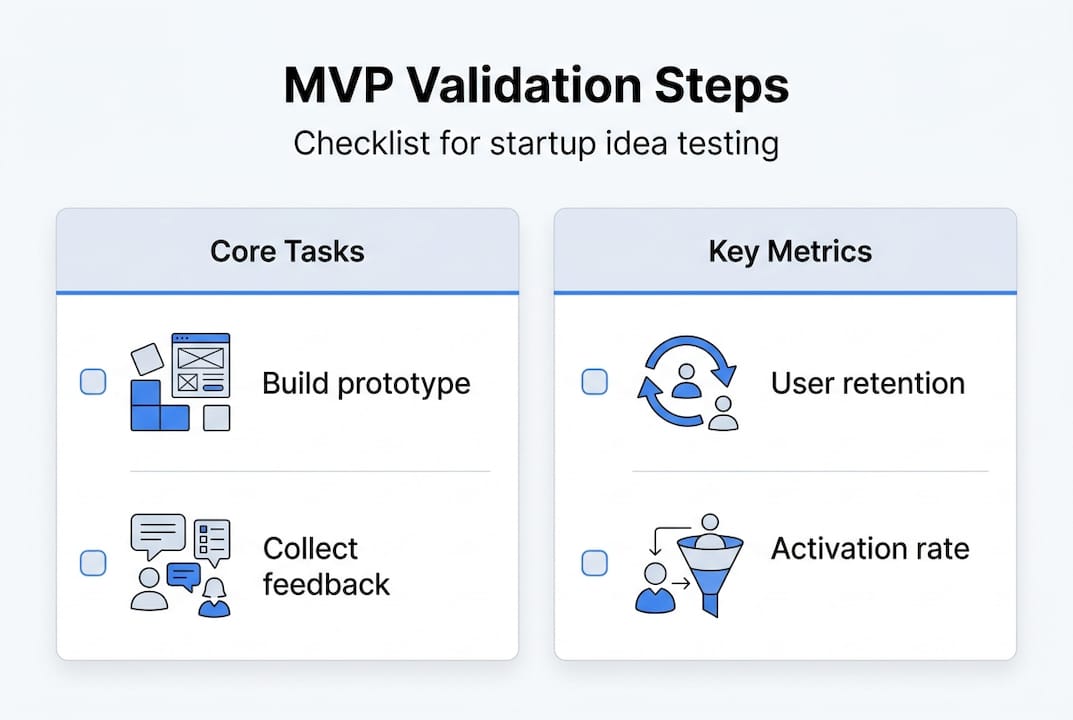
Using an MVP validation checklist helps you stay disciplined during this process. The checklist keeps you honest about what features truly matter versus what you personally think would be cool. Most founders fail because they build what they want, not what users need. An MVP flips that script by putting user needs first and your assumptions second.
How MVP facilitates idea validation without equity dilution
MVPs generate real user data that validates market demand in ways pitch decks and business plans never can. When you launch an MVP, you’re not asking hypothetical questions. You’re observing actual behavior: do people sign up, do they use the product, do they come back, and most importantly, do they pay? This data becomes your proof of concept, showing investors and partners that your idea has traction.

Validation through an MVP reduces the risk of overvaluation and premature dilution because you enter funding conversations with evidence, not just enthusiasm. Founders who prove concept viability and demonstrate early traction negotiate from strength. Instead of giving away 25% of your company for seed funding based on a slide deck, you can show user growth, engagement metrics, and revenue potential. That shifts the conversation entirely.
Here’s how founders use MVPs to validate ideas while preserving equity:
- Build the simplest version that solves your core problem for early adopters
- Launch to a small, targeted user group and track engagement closely
- Gather qualitative feedback through user interviews and support conversations
- Analyze quantitative metrics like activation rates, retention, and conversion
- Iterate based on data, not opinions or assumptions
- Use validated traction to attract funding on better terms
The role of an MVP in attracting smarter funding terms can’t be overstated. Investors see hundreds of pitches. Most are ideas with no proof. When you walk in with an MVP that has real users, paying customers, or clear product-market fit signals, you’re no longer selling a dream. You’re offering a calculated bet with evidence behind it. That evidence lets you retain more equity because the risk profile changes completely.
“An MVP isn’t just a product. It’s a founder’s best tool for proving value and protecting ownership before dilution becomes inevitable.”
This approach works especially well for non-technical founders who might otherwise feel pressured to bring on a technical co-founder and immediately split equity. With the right startup funding strategy, you can validate first, then decide whether you need a co-founder or can hire technical talent once you’ve proven demand.
Common pitfalls and challenges when using MVPs for validation
Too much feature scope harms MVP clarity and defeats the entire purpose of building one. Founders get excited and start adding features they think users might want, turning a focused validation tool into a bloated mini-product. When your MVP tries to do everything, you can’t tell which parts users actually value. The feedback becomes muddied, and you waste time building features nobody asked for.
Ignoring user feedback leads to false validation and sends you down expensive dead ends. Some founders launch an MVP, see a few sign-ups, and declare victory without digging into the data. Are users actually using the product? Are they coming back? What are they saying in support tickets or feedback forms? If you’re not listening, you’re just guessing with extra steps.
Not understanding the difference between an MVP and your final product creates unrealistic expectations. Users will complain about missing features. Some will churn because the MVP doesn’t do everything they want. That’s normal. The point isn’t to retain every user at this stage. The point is to validate core assumptions and learn what matters most. If you treat your MVP like a finished product, you’ll either over-invest too early or get discouraged by inevitable churn.
| Effective MVP validation | Ineffective MVP approaches |
|---|---|
| Focuses on one core problem | Tries to solve multiple problems at once |
| Launches quickly to gather data | Delays launch to add more features |
| Prioritizes real user feedback | Relies on founder assumptions |
| Iterates based on evidence | Builds based on personal preferences |
| Accepts early churn as learning | Treats churn as product failure |
Pro Tip: Engage real target users early for honest feedback, not friends and family who will tell you everything looks great.
Many founders also make the mistake of building overly complex MVPs because they ignore proven frameworks for validation. They reinvent the wheel instead of following structured approaches that separate signal from noise. This wastes time and money on features that don’t move the validation needle.
Another common challenge is choosing the wrong validation metrics. Vanity metrics like total sign-ups or page views feel good but tell you nothing about whether your idea actually works. Focus on activation rates, retention, and qualitative feedback from users who match your target profile. Those metrics reveal whether you’re solving a real problem or just attracting tire kickers.
If you’re a non-technical founder, you might also struggle with knowing when to build an MVP without coding versus when to invest in custom development. No-code tools are powerful, but they have limits. Understanding those limits helps you avoid building an MVP that can’t scale or pivot when you learn something new. Similarly, knowing how to validate your SaaS idea before committing to development saves you from building the wrong thing beautifully.
Applying MVP validation: practical steps for non-technical founders
Here’s how to create and validate an MVP without writing a single line of code:
- Define the single biggest problem your target users face and articulate it clearly in one sentence
- Identify the simplest solution that addresses that problem without bells and whistles
- Choose a no-code or low-code platform that matches your MVP’s technical requirements
- Build the core feature set, ruthlessly cutting anything that doesn’t directly solve the problem
- Launch to a small group of target users, ideally 10 to 50 people who fit your ideal customer profile
- Set up basic analytics to track user behavior, focusing on activation and retention
- Schedule user interviews within the first week to gather qualitative feedback
- Analyze both quantitative data and qualitative insights to identify patterns
- Prioritize one or two changes based on what you learned, then iterate quickly
- Repeat the cycle until you see clear signals of product-market fit
Choosing no-code or low-code platforms accelerates this process dramatically. Tools like Bubble, Webflow, Airtable, and Zapier let you build functional MVPs in days, not months. The key is matching the platform to your needs. If you’re testing a marketplace, Bubble works well. If you’re validating a content-driven product, Webflow might be better. For workflow automation, Zapier combined with Airtable can validate complex ideas without custom code.
Gathering and analyzing user feedback effectively requires discipline. Don’t just collect feedback and file it away. Create a simple system: tag feedback by theme, prioritize based on frequency and impact, and tie it back to your core hypothesis. Are users confirming your assumptions or revealing something unexpected? Both outcomes are valuable, but you need to know which one you’re seeing.
The iterative approach means you improve your MVP based on data, not gut feelings. After each cycle, ask yourself: what did we learn, what surprised us, and what should we test next? This keeps you focused on validation rather than feature creep. Non-technical founders often worry they can’t compete without technical skills, but validation doesn’t require code. It requires curiosity, discipline, and willingness to be wrong.
Tools and resources to accelerate MVP validation:
- No-code platforms: Bubble, Webflow, Softr, Glide
- Analytics: Google Analytics, Mixpanel, Amplitude
- User feedback: Typeform, Hotjar, UserTesting
- Project management: Notion, Trello, Asana
- Communication: Slack, Intercom, plain email
For founders who want to move faster, building your MVP without coding is entirely possible with the right approach. You can validate most ideas using existing tools and platforms, reserving custom development for after you’ve proven demand. This strategy conserves cash and keeps you flexible as you learn what users actually want.
Using an MVP validation checklist ensures you don’t skip critical steps. The checklist acts as your validation roadmap, keeping you honest about what you’ve tested versus what you’ve assumed. It’s easy to convince yourself you’ve validated something when you’ve really just talked to a few friendly users. A structured checklist prevents that self-deception.
Discover expert MVP development support
Validating your startup idea with an MVP doesn’t mean you have to figure everything out alone. Working with an experienced engineer who understands both the technical and strategic sides of MVP development can save you months of trial and error. That’s where expert support makes the difference.
Hanad Kubat specializes in MVP development for non-technical founders who need to validate ideas quickly without giving away equity or dealing with agency overhead. You work directly with a senior engineer who’s built his own SaaS products and knows what actually matters at the MVP stage. No project managers, no miscommunication, no feature bloat. Just focused execution that gets your MVP in front of users fast so you can start learning whether your idea has legs.
FAQ
What is the main purpose of a minimal viable product?
An MVP tests your core assumptions with minimal features to gather real user feedback. It helps startups validate ideas before committing to full development, reducing the risk of building something nobody wants. The goal is learning, not perfection.
How can non-technical founders build an MVP without coding?
Use no-code platforms like Bubble or Webflow to create functional MVPs quickly. Focus on core features that solve one specific problem for your target users. This approach lets you build an MVP without coding and validate demand before investing in custom development.
How does MVP validation help preserve startup equity?
Validating with an MVP reduces the need for large early investments and equity dilution. When you demonstrate traction through real user data, you attract better funding terms because investors see proof, not just potential. This lets founders negotiate from strength and retain more ownership.
What metrics should founders track during MVP validation?
Track activation rates, retention, and user engagement rather than vanity metrics like total sign-ups. Focus on qualitative feedback from target users who match your ideal customer profile. These metrics reveal whether you’re solving a real problem or just attracting curiosity.
How long should MVP validation take before pivoting or scaling?
Most founders need 8 to 12 weeks of active validation to gather meaningful data. This includes building the MVP, launching to early users, collecting feedback, and iterating at least twice. If you’re not seeing clear signals of interest after three months, it’s time to pivot or reconsider the idea.