

You’ve got a killer SaaS idea, but no code to show for it. You’re stuck between expensive agencies that treat you like a ticket number and technical co-founders who want half your company. Most non-technical founders waste months chasing the wrong solution while competitors ship. This guide cuts through the noise with a clear roadmap to prepare, build, and validate your SaaS MVP in weeks, not years, without giving up equity or control.
Table of Contents
- Key takeaways
- Understanding what you need before launching your SaaS app
- Step-by-step guide to rapidly developing your SaaS MVP
- Common launch pitfalls and how to avoid them
- Measuring success and iterating post-launch
- Partner with a Fortune 500 engineer to launch your SaaS MVP
- FAQ
Key Takeaways
| Point | Details |
|---|---|
| Early validation | Talk to potential users, run surveys, and build a waitlist to validate demand before coding or hiring. |
| Define MVP scope | Define a ruthlessly scoped MVP by removing non essential features until only a single workflow and one user type remain. |
| Right partner | Choose a technical partner who understands startup speed and outcomes to avoid long communication cycles and misaligned priorities. |
| Agile sprint process | Structure development into two week sprints with daily standups and regular reviews to speed learning and delivery. |
Understanding what you need before launching your SaaS app
Before you write a single line of code or hire anyone, you need three things locked down: proof people want what you’re building, a ruthlessly scoped MVP, and the right technical partner. Skip any of these and you’ll burn cash fixing avoidable mistakes.
Early SaaS MVP validation prevents costly development mistakes and clarifies market fit. Talk to potential users. Run surveys. Build a landing page with a waitlist. If you can’t get 50 people interested before you build, you won’t get 500 after launch. This isn’t theory. I’ve seen founders spend €30K building features nobody asked for because they skipped this step.
Defining your MVP means cutting everything that doesn’t directly solve the core problem. Your first version should feel almost embarrassingly simple. One workflow. One user type. One clear outcome. Write down every feature you think you need, then delete half of them. Then delete half again. What’s left is your MVP.
Non-technical founders face a choice: equity dilution with a technical co-founder, agency overhead with slow communication, or direct partnership with a senior engineer. The third option gets you Fortune 500 discipline without the Fortune 500 timeline. You work with the person writing the code. No project managers. No telephone game. Decisions happen in hours, not weeks.
Pro Tip: Before talking to any technical partner, write a one-page document: what problem you’re solving, who has this problem, what the MVP does, and what success looks like in 90 days. If you can’t explain it in one page, you’re not ready to build.
Choosing a partner with startup and SaaS expertise reduces risks because they’ve seen what kills products. They know which corners you can cut and which ones will break you later. They’ve shipped their own products and felt the pain of supporting bad architectural decisions at 2 AM. That experience is worth more than a lower hourly rate.
- Validate market demand with real user conversations and waitlist signups
- Define MVP scope by eliminating all non-essential features
- Choose technical partners who understand startup speed and constraints
- Prioritize partners who have built and launched their own SaaS products
Step-by-step guide to rapidly developing your SaaS MVP
Once you’ve validated demand and found the right technical partner, execution becomes a series of focused sprints. Agile frameworks are key to accelerating MVP success by enabling iterative progress and fast feedback loops. Here’s how to structure development for maximum speed without chaos.
-
Sprint planning: Break your MVP into 2-week sprints with specific deliverables. Sprint one might be user authentication and database setup. Sprint two adds the core workflow. Sprint three builds the dashboard. Each sprint ends with working software you can test.
-
Daily standups: 15-minute calls to surface blockers immediately. What got done yesterday? What’s happening today? What’s stuck? This keeps communication tight and prevents surprises.
-
Sprint reviews: Demo working features at the end of each sprint. Invite potential users if possible. Get feedback while there’s still time to adjust course cheaply.
-
Retrospectives: Spend 30 minutes after each sprint asking what worked and what didn’t. Adjust the process, not just the product.
Prioritize key SaaS features that address core user problems efficiently. Your MVP needs user authentication, the primary workflow that solves the problem, basic analytics to track usage, and simple onboarding. Everything else is version two.

Manage scope tightly to avoid delays and cost overruns. When new ideas emerge mid-sprint, write them down and park them. Finish what you started. Scope creep kills more MVPs than bad code. Every time someone says “wouldn’t it be cool if,” the answer is “yes, for version two.”
| Development Phase | Timeline | Key Deliverables |
|---|---|---|
| Sprint 1 | Weeks 1-2 | Authentication, database schema, basic UI framework |
| Sprint 2 | Weeks 3-4 | Core workflow implementation, API endpoints |
| Sprint 3 | Weeks 5-6 | Dashboard, analytics integration, user onboarding |
| Sprint 4 | Weeks 7-8 | Testing, bug fixes, deployment preparation |
Pro Tip: Use feature flags to deploy incomplete features to production without showing them to users. This lets you integrate code continuously without waiting for everything to be perfect. When a feature is ready, flip the flag. This approach prevents massive merge conflicts and keeps deployment risk low.
The goal is working software every two weeks. Not perfect software. Not feature-complete software. Working software that moves you closer to launch. Perfect is the enemy of shipped.
Common launch pitfalls and how to avoid them
Many early SaaS founders launch without proper validation or technical guidance, resulting in wasted resources and slow growth. Here are the mistakes that kill momentum and how to sidestep them.
Building a full product before validating key assumptions is the most expensive mistake. You convince yourself users need 15 features when they only care about three. You spend six months building a Cadillac when they wanted a bicycle. Validate the core value proposition first with the simplest possible version. Add features only after users prove they’ll pay for what you have.
Neglecting to select experienced technical partners early creates technical debt that haunts you for years. Cheap developers who’ve never shipped a SaaS product will build what you ask for, not what you need. They’ll use technologies they know instead of technologies that scale. They’ll skip security basics because they’ve never been hacked. By the time you realize the foundation is wrong, rebuilding costs more than doing it right the first time.
- Avoid building features nobody asked for by validating with real user feedback first
- Don’t hire the cheapest developer; hire someone who’s launched successful products
- Beware scope creep by documenting all new ideas for post-launch consideration
- Prepare basic support and monitoring tools before launch to catch issues immediately
Scope creep happens when you can’t say no. A potential customer suggests a feature. An advisor mentions what competitors have. Your co-founder gets excited about an integration. Suddenly your 8-week MVP becomes a 6-month project. Combat this by writing down the original scope and referring to it constantly. New ideas go in the backlog, not the current sprint.
“The biggest risk isn’t building the wrong thing. It’s building the right thing too slowly. Speed is your competitive advantage as a startup. Protect it ruthlessly.”
Over-engineering is the technical version of scope creep. Your developer wants to build a microservices architecture that handles a million users when you have zero. They want to implement complex caching strategies before you know what needs caching. They want perfect test coverage before you know if anyone will use the product. Push back. Build for 100 users first. Scale when scaling becomes the problem.
Preparing basic support and monitoring tools before launch means you can respond when things break. Set up error tracking so you know when the app crashes. Add basic logging so you can debug issues. Create a simple support email or chat widget. You don’t need a full helpdesk system, but you need a way to hear when users are stuck.
| Pitfall | Cost | Prevention |
|---|---|---|
| Building without validation | 3-6 months wasted, €20K-50K | Test demand with landing pages and interviews first |
| Wrong technical partner | Technical debt, slow development | Vet for SaaS experience and startup understanding |
| Scope creep | 2-3x timeline, budget overruns | Document scope, defer new ideas to post-launch |
| Over-engineering | Delayed launch, unnecessary complexity | Build for current scale, not imagined future scale |
Measuring success and iterating post-launch
Launching is the beginning, not the end. Rapid iteration based on user data is vital to SaaS growth after MVP launch. You need to know what’s working, what’s broken, and what to build next.
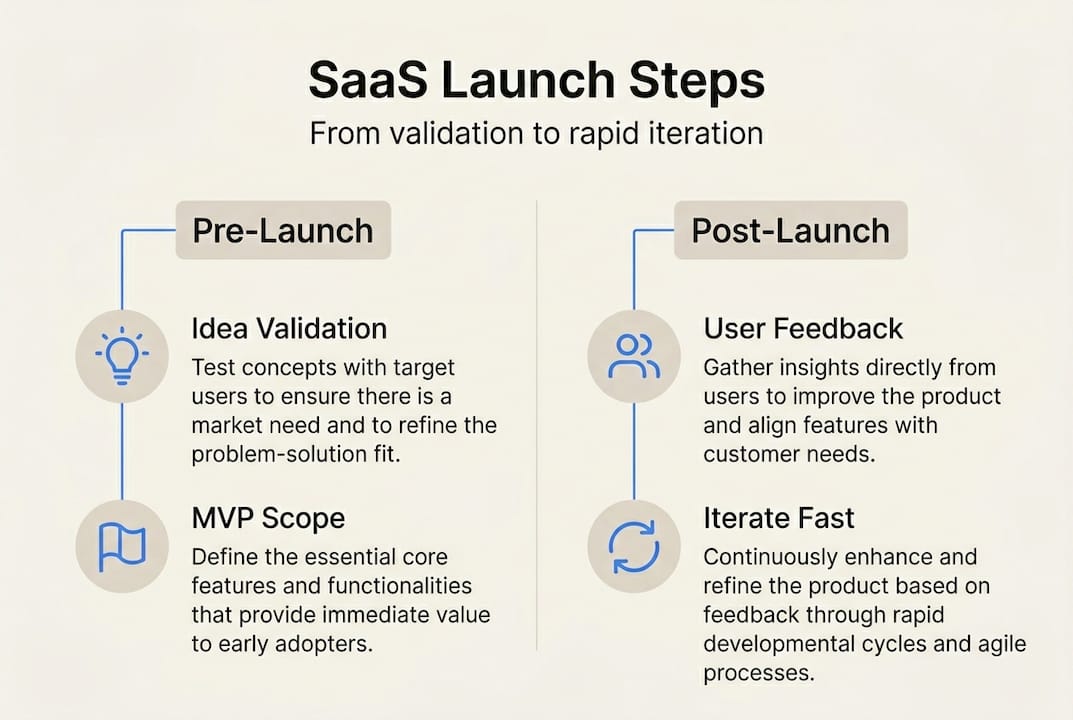
Track KPIs like user engagement, churn, and conversion rates from day one. User engagement tells you if people find value. Are they logging in daily or did they try it once and leave? Churn shows you who’s leaving and when. If everyone cancels after two weeks, something breaks at the two-week mark. Conversion rates reveal where your funnel leaks. Do people sign up but never complete onboarding? Fix onboarding before adding features.
Collect and prioritize user feedback for planned feature enhancements. Add a simple feedback widget. Send surveys after key actions. Jump on calls with active users. Ask what’s frustrating them and what they wish existed. Then rank requests by how many people ask for them and how aligned they are with your vision. Build what the most users need that also moves your business forward.
- Monitor daily active users and session length to gauge product stickiness
- Track where users drop off in key workflows to identify friction points
- Measure conversion from free trial to paid to optimize pricing and positioning
- Survey churned users to understand why they left and how to prevent future churn
Use data to guide agile development and roadmap planning. Every sprint should target a metric you want to improve. If onboarding completion is low, sprint on improving the onboarding flow. If engagement drops after week one, build features that drive repeat usage. Let the numbers tell you what matters instead of guessing.
Plan iterative releases to improve usability and add value gradually. Ship small improvements weekly instead of massive updates quarterly. Users appreciate steady progress more than long silences followed by overwhelming changes. Each release should make one thing noticeably better. Fix the slowest page. Simplify the most confusing workflow. Add the most requested small feature.
- Set up analytics and error tracking before launch day
- Define 3-5 key metrics that indicate product-market fit
- Review metrics weekly and identify the biggest problem
- Plan the next sprint to directly address that problem
- Ship the improvement and measure the impact
- Repeat
This cycle of measure, prioritize, build, ship, measure keeps you focused on what actually moves the business. It prevents you from building features that feel important but don’t change user behavior. It gives you concrete evidence when talking to investors or hiring your first employees.
Success isn’t launching with every feature you imagined. Success is launching with the minimum that proves value, then systematically making it better based on what users do, not what they say. Behavior beats opinions every time.
Partner with a Fortune 500 engineer to launch your SaaS MVP
You’ve read the roadmap. You know what needs to happen. The question is whether you want to figure it out alone or work with someone who’s done it before.
I’m Hanad Kubat. I build production-ready MVPs in 8-12 weeks for non-technical founders who are done talking and ready to ship. No equity. No agency overhead. No project managers playing telephone. You work directly with me, the person writing your code.
I’ve shipped SaaS products for Fortune 500 companies and built my own. Everything I recommend, I’ve tested on myself first. React, Next.js, Node.js, React Native. The stack that lets you move fast without breaking things later.
MVP builds start at €15K. You get senior engineering discipline at founder speed. We cut scope ruthlessly, ship iteratively, and validate continuously. If you’re ready to stop planning and start building, explore MVP development services or dive into more SaaS development insights blog articles on validation, architecture, and growth.
FAQ
How long does it typically take to launch a SaaS MVP?
Typical MVP launch time varies from 8 to 16 weeks depending on scope and resources. A tightly scoped MVP with one core workflow and experienced technical partnership can ship in 8 weeks. More complex products with multiple user types or integrations may need 12-16 weeks. Working with experienced partners who understand startup constraints can shorten this timeline significantly by avoiding common mistakes and architectural dead ends.
Can non-technical founders successfully launch a SaaS app without coding skills?
Non-technical founders can absolutely succeed by partnering with skilled engineers who understand startups. Your job is validating the market, defining the vision, and talking to users. The technical partner handles architecture, development, and deployment. Focusing on tight MVP scope and continuous validation improves chances of success more than learning to code. Many successful SaaS founders never wrote a line of production code.
What are the top features to include in a SaaS MVP?
Successful SaaS MVPs focus on 5 key features to validate and attract users. User authentication and role management let people sign up and log in securely. The core workflow that solves your target problem is the main value delivery. Basic analytics and reporting show users their progress and give you data. User onboarding guides new users to their first win. Simple support tools like chat or email let users get help when stuck. Everything else is version two.
How can I validate my SaaS idea before building?
Use surveys, landing pages, and interviews to test interest before investing in development. Create a landing page explaining your solution and collect email signups. If you can’t get 50-100 signups, you haven’t found product-market fit yet. Interview 20-30 people in your target market about their current solutions and pain points. Start small with clickable prototypes or no-code tools before investing in full development. Validation should cost hundreds, not thousands.