

Most startups skip the MVP phase and dive straight into building a full product, only to discover months later that nobody wants what they built. This costly mistake burns through cash, time, and team morale before founders realize they solved the wrong problem. An MVP, or minimum viable product, is your safety net against this nightmare scenario. It lets you test your core idea with real users fast, collect feedback that actually matters, and pivot before you waste resources on features nobody asked for. In this article, you’ll learn exactly what an MVP is, why it’s non-negotiable for startup success, and how to build one even if you can’t code.
Table of Contents
- Key takeaways
- What is an MVP and why does it matter for startups?
- Core reasons why startups need an MVP
- How MVP accelerates your startup’s path to product-market fit
- Common MVP development methods and tools for non-technical founders
- Explore expert MVP development services for your startup
- FAQ
Key Takeaways
| Point | Details |
|---|---|
| Core idea validation | An MVP lets you test a single core problem with real users to learn whether there is true demand. |
| Early user feedback | Fast user feedback guides product market fit and tells you which features matter. |
| Faster time to market | MVPs reduce time to market by validating concepts early and avoiding unnecessary work. |
| Focused feature scope | They force ruthless feature selection and keep development focused on essential functionality. |
What is an MVP and why does it matter for startups?
An MVP is the simplest version of your product that solves one core problem for your target customer. It’s not a prototype or a demo. It’s a real, working product stripped down to essential features only. You launch it, real people use it, and you learn whether your idea has legs before you build anything else. Building a minimum viable product is crucial for technology-focused startups because it forces you to answer the hardest question first: does anyone actually want this?
For non-technical founders, MVPs are your secret weapon against expensive mistakes. You don’t need to understand code to validate your idea. You need to understand your customer’s problem and test whether your solution works. MVPs let you do exactly that without hiring a full development team or spending six months building features users might ignore.
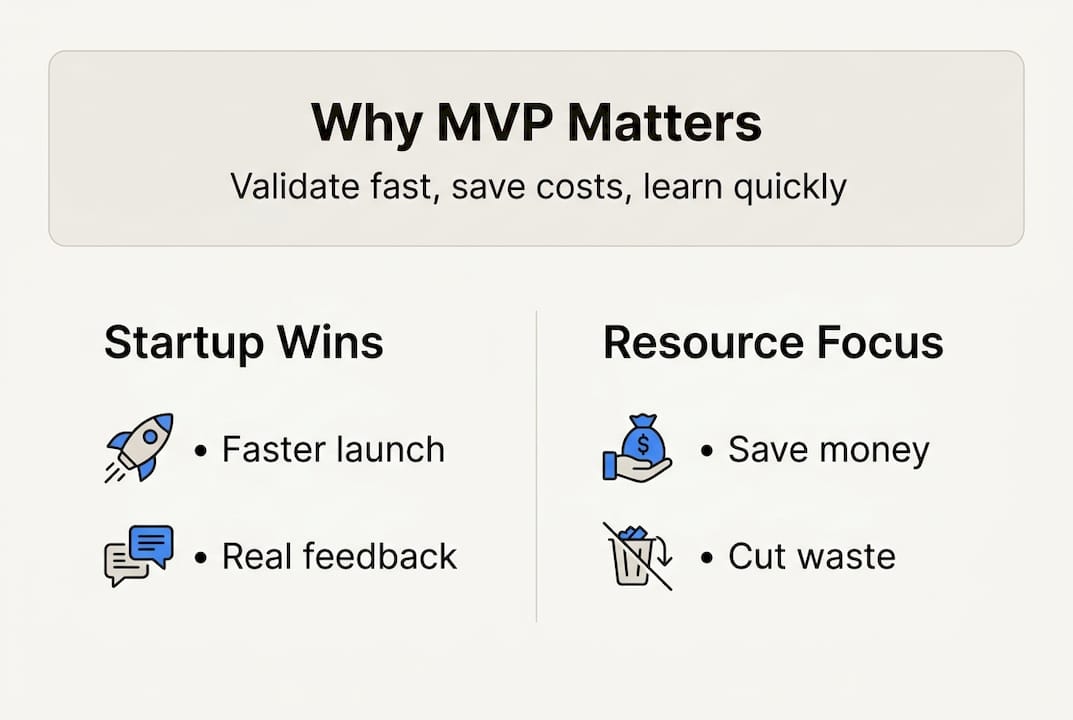
The biggest advantage of an MVP is the feedback loop. You ship fast, users react, you learn what matters, and you adjust. This cycle repeats until you find product-market fit. Compare that to building in secret for a year, launching to crickets, and realizing you missed the mark entirely. Here’s what MVPs give you:
- Direct validation of your core value proposition
- Real user behavior data instead of survey promises
- Proof of concept that attracts investors and partners
- Focus on solving one problem exceptionally well
- Room to pivot without rewriting everything
MVPs matter because startups operate under extreme uncertainty. You’re making bets with limited information, tight budgets, and pressure to show progress. An MVP reduces that uncertainty faster and cheaper than any other method. It turns assumptions into evidence and guesses into decisions backed by real customer behavior.
Core reasons why startups need an MVP
Startups fail when they build what founders think customers want instead of what customers actually need. An MVP forces you to test assumptions before they become expensive mistakes. You validate demand, confirm willingness to pay, and discover which features truly matter to your target users. This early validation saves months of development time and prevents you from scaling a product nobody wants.
Money and time are your scarcest resources as a founder. MVPs protect both by focusing your efforts on core functionality only. You skip the nice-to-have features, the polished UI tweaks, and the integrations you think might be useful someday. Instead, you build the minimum that proves your concept works. Validating SaaS ideas with MVP strategy minimizes risk for startups launching new technology products by ensuring you only invest in features users will actually use.
The iterative learning cycle MVPs enable is where real product development happens. You launch, collect feedback, analyze behavior, and adjust your roadmap based on evidence. Users tell you which features they need next, which parts confuse them, and what would make them pay more. This feedback is gold because it comes from people using your product in real scenarios, not hypothetical survey responses.

MVPs also help you prioritize ruthlessly. When you’re forced to choose only essential features, you learn what your product is really about. You cut scope, kill features that don’t serve the business, and focus on delivering one core value exceptionally well. This clarity carries through your entire product roadmap and prevents feature bloat later.
Early adopters and investors care about traction, not promises. An MVP gives you something tangible to show. You can demonstrate real users solving real problems with your product. This proof of concept attracts the first customers who will tolerate rough edges in exchange for solving their pain point. It also makes investor conversations easier because you’re discussing validated demand instead of hypothetical market size.
Product-market fit is the holy grail for startups, and MVPs are your fastest path there. You learn whether your solution resonates with your target market before you’ve committed to a specific product direction. If it doesn’t work, you pivot quickly. If it does, you double down on what’s working and expand from a position of strength.
Pro Tip: Track one metric that proves your MVP solves a real problem. For most products, that’s either daily active users or revenue. If neither grows after launch, your MVP is telling you to pivot.
How MVP accelerates your startup’s path to product-market fit
Product-market fit means your product solves a real problem for a defined market segment so well that users actively seek it out and recommend it to others. Most startups never achieve it because they build in isolation instead of testing with real users early. MVP validation checklist helps confirm the viability of innovative tech startup concepts by providing a framework for measuring whether you’re getting closer to fit or spinning your wheels.
MVP feedback loops give you the insights you need to adjust features, pricing, and positioning based on actual user behavior. You watch how people use your product, where they get stuck, and what makes them come back. This data tells you which features to build next and which assumptions were wrong. You’re not guessing anymore. You’re responding to evidence.
Here’s what you should track during your MVP phase to measure progress toward product-market fit:
| Metric | Why it matters | Target range |
|---|---|---|
| User retention (day 7) | Shows if users find ongoing value | 20-40% for early MVP |
| Feature engagement | Reveals which features users actually need | 60%+ for core features |
| Customer acquisition cost | Validates sustainable growth potential | Below lifetime value |
| Time to first value | Measures how quickly users see benefits | Under 5 minutes ideal |
The path from MVP launch to scaling follows predictable stages. First, you launch to a small group of early adopters who tolerate bugs in exchange for solving their problem. You collect feedback obsessively and ship improvements weekly. Second, you refine your core value proposition based on what users actually do versus what they say they’ll do. Third, you expand your feature set only after core functionality proves valuable. Finally, you scale marketing and sales once retention metrics confirm you’ve built something people want.
Common pitfalls in MVP testing include asking users what they want instead of watching what they do, adding features before validating core value, and mistaking early adopter enthusiasm for product-market fit. Avoid these by focusing on behavior metrics over survey responses, resisting feature requests until core metrics improve, and testing with users who represent your actual target market, not just friendly supporters.
Using customer data to refine your product direction means analyzing patterns in how different user segments interact with your MVP. You segment users by behavior, identify which groups get the most value, and double down on serving those segments better. You kill features that don’t move retention or engagement metrics. You test pricing with real customers to find what they’ll actually pay, not what they claim they’d pay.
Pro Tip: Set a deadline to achieve specific retention metrics with your MVP. If you don’t hit those targets within 90 days, pivot your approach. Stubbornly building features on a weak foundation wastes time you don’t have.
Common MVP development methods and tools for non-technical founders
Non-technical founders have more MVP options today than ever before. You can build functional products without writing code, hire developers to execute your vision, or combine both approaches depending on your needs. Each method has tradeoffs in speed, control, cost, and learning curve. Building MVP without coding highlights common pitfalls technology startups encounter when developing an MVP and shows you how to avoid them.
No-code platforms let you build MVPs yourself using visual interfaces and pre-built components. Tools like Webflow handle landing pages and simple web apps, Bubble creates more complex web applications, and Adalo or Flutterflow build mobile apps. The advantage is speed and cost. You control everything and iterate as fast as you can click. The downside is hitting platform limitations when you need custom functionality or want to scale beyond what the tool supports.
Outsourcing to freelancers or agencies gives you access to professional development skills without hiring full-time. You define requirements, hand them off, and receive a working product. This works well when you know exactly what you need and can communicate it clearly. The risk is miscommunication, scope creep, and ending up with code you can’t maintain or modify yourself. Choose this route when your MVP requires custom functionality that no-code tools can’t handle.
Hybrid approaches combine no-code tools for frontend and user experience with custom code for backend logic or integrations. You might use Webflow for your marketing site and landing pages, then hire a developer to build the core product functionality. This balances speed with flexibility and lets you iterate on design and messaging quickly while building solid technical foundations.
Here’s how these methods compare:
| Method | Speed | Cost | Control | Best for |
|---|---|---|---|---|
| No-code platforms | Days to weeks | $0-500/month | High | Simple MVPs, landing pages |
| Freelance developers | Weeks to months | $5K-25K | Medium | Custom functionality |
| Development agencies | Months | $15K-100K+ | Low | Complex products |
| Hybrid approach | Weeks | $2K-15K | High | Balancing speed and custom needs |
Avoiding common traps means resisting the urge to add features before validating core value. Non-technical founders often think more features equal better product. Wrong. More features equal more complexity, higher costs, and slower learning. Focus on one core workflow that solves one specific problem exceptionally well. Polish can wait until you’ve proven people want what you’re building.
Managing development effectively without technical background requires clear communication and realistic expectations. Write detailed requirements that explain what users should be able to do, not how the system should work internally. Set up regular check-ins to review progress and catch issues early. Test everything yourself before considering it done. Use project management tools like Notion or Trello to track tasks and maintain a single source of truth.
Know when to seek technical help by recognizing the limits of your chosen approach. If you’re spending more time fighting your no-code platform than building features, hire a developer. If freelancers keep missing deadlines or delivering buggy code, bring in someone senior to review their work. If your MVP needs to handle thousands of users or integrate with complex systems, partner with someone who’s built production systems before.
Explore expert MVP development services for your startup
Shipping an MVP fast requires execution discipline most founders don’t have time to develop. You need someone who’s built production systems before, understands startup constraints, and won’t waste months on features that don’t matter. That’s where MVP development for founders makes the difference between launching in weeks versus spinning your wheels for months.
Working directly with an experienced engineer eliminates the communication overhead that kills agency projects. No project managers, no game of telephone, just focused execution on what moves your metrics. You get Fortune 500 engineering discipline applied at startup speed, with someone who’s built their own SaaS products and knows which corners to cut and which to reinforce. Resources like the MVP validation checklist and building MVP without coding guide help you avoid expensive mistakes before they happen. Whether you’re validating your first idea or scaling past your no-code platform’s limits, expert support accelerates your path from concept to customers.
FAQ
What is an MVP in startup terms?
MVP means minimum viable product, which is the simplest version of your product that solves one core problem for your target customers. It includes only essential features needed to test your idea with real users and collect feedback. The goal is learning what works before investing in full development, not building a perfect product.
How can non-technical founders build an MVP quickly?
Use no-code platforms like Webflow, Bubble, or Adalo to build functional products without writing code. These tools let you create landing pages, web apps, and mobile apps using visual interfaces. For features beyond no-code capabilities, hire freelance developers or agencies to handle specific technical tasks. Focus on core functionality and user feedback rather than perfect design or advanced features.
Why is MVP important for securing startup funding?
An MVP demonstrates real progress and market validation to investors instead of just pitches and promises. It proves customers are willing to use your product and potentially pay for it, which reduces investor risk significantly. Startups with working MVPs and early traction achieve higher funding success rates because investors can evaluate actual user behavior and growth potential. Building a minimum viable product is crucial for technology-focused startups seeking investment.
How long should it take to build an MVP?
Most MVPs should take 4 to 12 weeks to build depending on complexity and your chosen development method. Simple no-code MVPs can launch in days or weeks, while custom-built products with specific functionality might need two to three months. The key is setting a firm deadline and cutting scope aggressively to ship something testable quickly. If your MVP takes longer than three months, you’re probably building too much.
What features should I include in my MVP?
Include only features that directly enable your core value proposition and nothing else. Ask yourself what’s the minimum functionality a user needs to solve their primary problem with your product. Cut everything else, including nice-to-have features, advanced settings, multiple integrations, and polished design elements. You can always add features later based on user feedback, but you can’t get back time spent building things nobody uses.