

Most non-technical founders treat UX as optional polish, something to add after the MVP ships. That assumption kills products before they reach 100 users. Good UX isn’t about making things pretty. It’s about ensuring your core hypothesis gets tested accurately because users can actually complete the flows you built. When 60% conversion surges happen from fixing basic usability issues, UX becomes the difference between validated learning and wasted runway. This guide shows you how to implement lean UX strategies that accelerate market fit without derailing your launch timeline.
Table of Contents
- Key takeaways
- Understanding the role of UX in MVP development
- Key UX methodologies for MVPs: Lean UX and iterative testing
- Balancing usability and speed: avoiding overbuilding in MVP UX
- Practical UX steps for non-technical founders to improve MVP success
- Build your MVP with expert UX guidance
- Frequently asked questions
Key Takeaways
| Point | Details |
|---|---|
| Lean UX focus | Lean UX and iterative testing prioritize learning over deliverables to validate the riskiest assumptions while shipping a minimal interface. |
| Core flows first | Prioritize core user flows and basic usability over visual polish to enable faster shipping and meaningful behavioral data. |
| Actionable metrics | Track activation rate and Day 7 retention to measure UX impact rather than aesthetics. |
| Early UX investment | Investing in UX early reduces false negatives and saves time and resources while improving competitive differentiation. |
Understanding the role of UX in MVP development
Many founders think MVP means shipping something barely functional, then fixing it later. That mindset confuses speed with sloppiness. Your MVP needs to work well enough that users can complete the core action you’re testing. If they can’t figure out how to sign up, you’re not validating your hypothesis. You’re validating that confusing navigation kills engagement.
Good UX at the MVP stage focuses on usability of essential flows, not pixel-perfect interfaces. Can users complete your core task without getting stuck? Do they understand what action to take next? Those questions matter more than color schemes or animations. When conversion rates jump 60% from basic UX fixes, the revenue impact becomes impossible to ignore.
Here’s what UX actually delivers during MVP validation:
- Clear user flows that let people complete core tasks without confusion
- Reduced friction in signup and onboarding that improves activation rates
- Behavioral data you can trust because usability issues aren’t skewing results
- Faster iteration cycles since you’re learning what matters, not debugging broken experiences
Understanding basic UX principles helps you scope features intelligently. You stop adding complexity that doesn’t serve the core hypothesis. You cut flows that create confusion. You focus on the 20% of design decisions that drive 80% of user satisfaction. That clarity speeds up building an MVP without coding because you know exactly what to build.
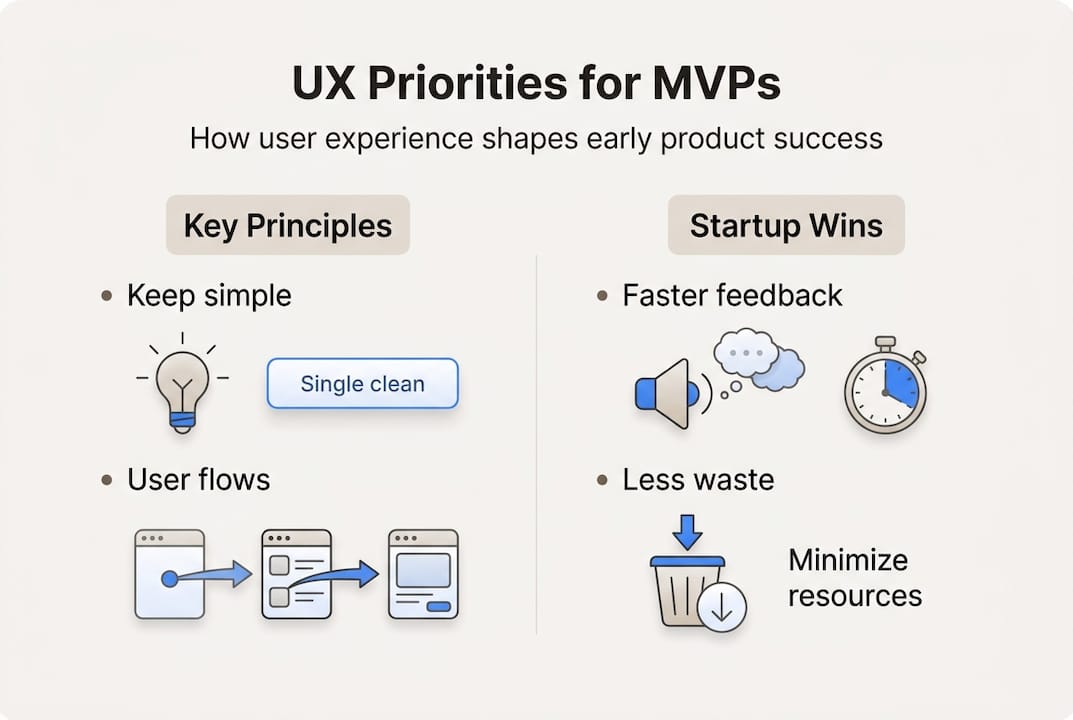
Pro Tip: Track activation rate and Day 7 retention instead of obsessing over how things look. Behavioral metrics reveal whether your UX supports the core value proposition. Visual polish can wait until you’ve validated that people actually want what you’re building.
The cost of ignoring UX compounds fast. Poor usability creates false negatives during testing. Users might love your concept but abandon it because the interface confuses them. You interpret that as product-market fit failure when it’s actually a design execution problem. Fixing that misread after you’ve pivoted wastes months and capital.
Key UX methodologies for MVPs: Lean UX and iterative testing
Lean UX prioritizes learning over deliverables. Instead of creating comprehensive design systems upfront, you build the minimum interface needed to test your riskiest assumption. That approach aligns perfectly with MVP development because both focus on validated learning, not feature completeness.
Key methodologies include Lean UX, user research, wireframing, prototyping, hypothesis-driven design, and testing with small user groups. Each technique serves a specific purpose in de-risking your product decisions before you write production code.
Here’s how to apply these methods as a non-technical founder:
- Define your core hypothesis and identify the user flow that tests it most directly
- Conduct lightweight user research through 5 to 7 interviews to understand pain points and current workarounds
- Create simple wireframes that map the essential steps users take to complete your core task
- Build a clickable prototype using tools like Figma or even paper sketches to simulate the experience
- Run usability tests with 5 users, observing where they get confused or stuck
- Iterate based on patterns you observe, focusing on removing friction from critical paths
- Measure behavioral metrics like activation rate and task completion time to validate improvements
User research doesn’t require a PhD in psychology. You need to understand what job users are hiring your product to do and what obstacles currently prevent them from doing it well. Those insights shape which features make it into your MVP and which get cut ruthlessly.
Wireframes and prototypes let you test flows before committing engineering resources. A clickable prototype costs a few hours of design time. Building the wrong feature in production costs weeks and thousands of dollars. That math makes prototyping the highest ROI activity in early product development.
Testing with 5 to 7 users reveals most critical usability issues. You don’t need statistical significance at this stage. You need to identify patterns where people consistently misunderstand your interface or can’t figure out the next step. Those insights guide your MVP validation checklist by showing what’s actually confusing versus what you assumed would be.
Hypothesis-driven design keeps you focused. Every UX decision should connect back to testing a specific assumption about user behavior. If you can’t articulate which hypothesis a design element serves, cut it. That discipline prevents scope creep and keeps your MVP lean enough to ship quickly.
Iteration happens in tight loops. Test, learn, adjust, test again. Each cycle takes days, not months. You’re optimizing for speed of learning, not perfection of execution. The goal is gathering enough signal to decide whether to persevere, pivot, or kill the idea before burning through your runway.
Balancing usability and speed: avoiding overbuilding in MVP UX
The biggest UX mistake founders make is over-investing in polish that delays launch without improving learning. You don’t need custom illustrations, smooth animations, or comprehensive error states in your MVP. You need core flows that work well enough to test your hypothesis accurately.
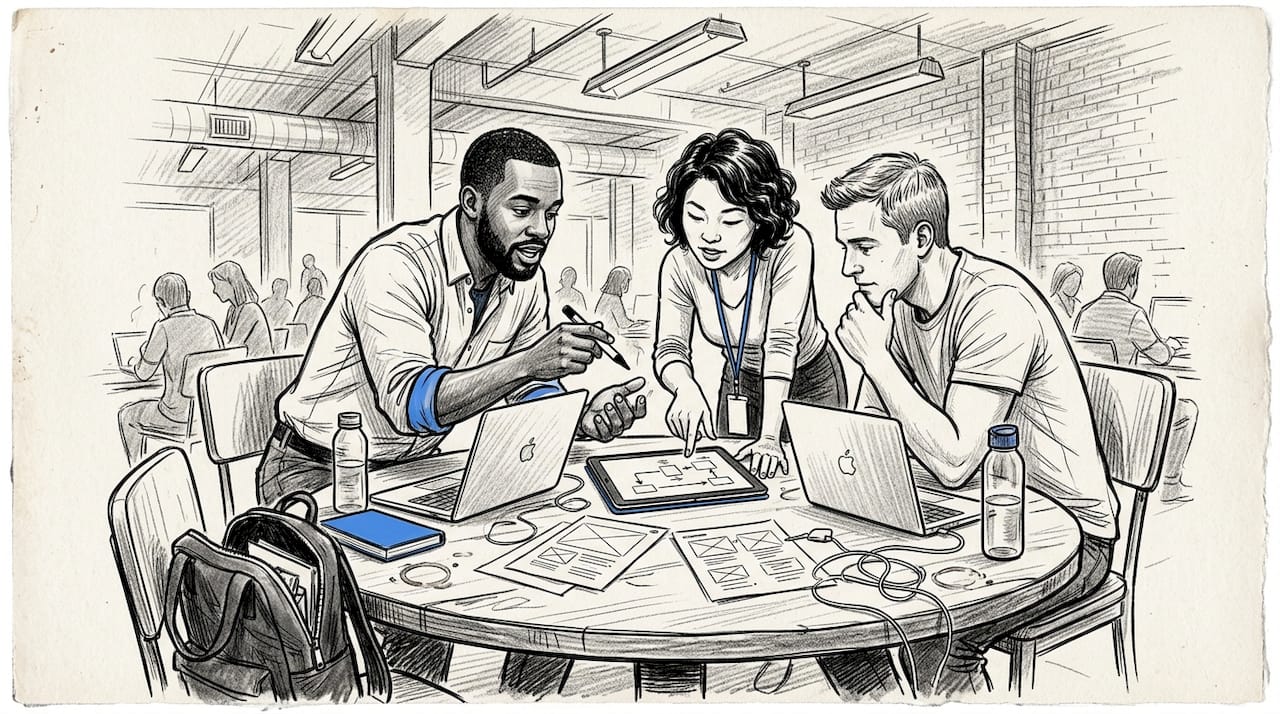
Balancing usability with speed means knowing where good enough actually is good enough. A signup form with basic validation beats a beautiful signup experience that takes three extra weeks to build. Ship the functional version, measure conversion, then decide if improving it moves the needle.
Here’s how different UX investment levels affect your MVP timeline:
| Investment Level | Speed Impact | Validation Risk | Best For |
|---|---|---|---|
| Minimal (core flows only) | Ships in 4-6 weeks | Low if flows work | Testing single hypothesis quickly |
| Moderate (core + mobile basics) | Ships in 8-10 weeks | Very low | Products requiring mobile access |
| High (polished UI + edge cases) | Ships in 12+ weeks | High (over-building) | Post-validation scaling, not MVPs |
Focus your early design effort on essential user flows and mobile responsiveness. If your target users access products primarily on phones, your MVP must work on mobile. That’s non-negotiable. But custom mobile animations? Those can wait until you’ve validated that people want the product at all.
Accessibility basics matter even in MVPs. Proper heading hierarchy, keyboard navigation, and sufficient color contrast cost almost nothing to implement correctly from the start. Retrofitting accessibility later costs significantly more and excludes users who could provide valuable feedback during validation.
Pro Tip: Design your MVP UX for learning, not retention. You’re trying to test whether your core value proposition resonates, not optimize conversion funnels. Build flows that let users experience the value quickly, then measure whether they come back. If they don’t return, polish won’t fix a broken value proposition.
The risk of over-building shows up in delayed launches and false confidence. Every extra week spent perfecting your interface is a week you’re not learning from real users. Worse, you might convince yourself the product is great because it looks professional, ignoring that it solves a problem nobody actually has.
Finding balance means shipping when core flows work and your riskiest assumption is testable. If users can sign up, complete your main task, and you can measure whether they found value, you’re ready to launch your SaaS MVP fast. Everything else is optimization you do after validating the fundamentals.
Practical UX steps for non-technical founders to improve MVP success
Non-technical founders often assume UX requires design skills they don’t have. That’s backwards. UX requires understanding user needs and removing obstacles, skills you already use when talking to customers. The tactics just formalize what good founders do instinctively.
No-code tools and concierge MVPs let you test UX hypotheses without writing code. A concierge MVP delivers your service manually while you learn which parts users value most. That hands-on approach reveals UX requirements no amount of upfront planning could predict.
Ruthless scoping on a single hypothesis prevents feature bloat. Pick the one assumption that, if wrong, kills your business. Build only the UX needed to test that assumption. Everything else is distraction that slows you down and clouds your learning.
Here’s your practical UX implementation checklist:
- Conduct 5 to 7 user interviews to identify the core job users need done
- Map the simplest possible flow that delivers your core value proposition
- Create wireframes or sketches showing each step in that flow
- Build a clickable prototype to simulate the experience
- Run usability tests with 5 users, watching where they struggle
- Iterate based on observed patterns, not individual opinions
- Implement the refined flow using no-code tools or with developer help
- Measure activation and retention to validate UX supports your hypothesis
Testing with 5 users gives you actionable feedback without statistical overhead. You’re looking for patterns where multiple people get confused in the same place. Those patterns indicate real UX problems worth fixing before launch.
Here’s how common UX validation methods compare for MVP testing:
| Method | Time Required | Users Needed | Validation Strength | Cost |
|---|---|---|---|---|
| User interviews | 3-5 hours | 5-7 | High for problem validation | Low |
| Usability testing | 2-4 hours | 5 | High for flow validation | Low |
| Prototype testing | 4-6 hours | 5-7 | Medium (simulated experience) | Low |
| Concierge MVP | 20-40 hours | 10-20 | Very high (real usage) | Medium |
| Fake door test | 1-2 hours | 50-100 | Medium (intent only) | Very low |
This approach helps you build products users actually want because you’re learning continuously. Each test cycle reveals assumptions you got wrong and validates decisions you got right. That feedback loop is how non-technical founders compete with well-funded teams who have full design departments.
The key is treating UX as a learning tool, not a creative exercise. You’re not trying to win design awards. You’re trying to remove friction from the path between user pain and your solution. Every UX decision should make that path shorter or clearer. If it doesn’t, cut it and ship faster.
You can validate most UX decisions with no-code MVP building before committing to custom development. That sequencing saves money and reduces risk because you’re only building what you’ve already validated users need and can use successfully. When you do validate your SaaS idea properly, the UX requirements become obvious rather than speculative.
Build your MVP with expert UX guidance
You’ve learned the frameworks, but implementing them while running a startup is a different challenge. Most founders underestimate how much UX debt slows down iteration cycles and clouds validation data. Getting it right from the start accelerates everything that comes after.
I’ve built MVPs for founders who tried the DIY route first, then brought me in to fix what broke. The pattern is always the same: they over-built features users didn’t need while under-investing in flows that mattered. We cut scope ruthlessly, fix the core UX, and ship in weeks instead of months. That’s what Fortune 500 discipline looks like at startup speed.
If you’re ready to build an MVP that tests your hypothesis accurately without wasting months on features that don’t move the needle, let’s talk. I work directly with founders, no project managers or account executives. You get the person writing the code making UX decisions based on what actually works, not what looks impressive in mockups. Check out my MVP development services or read the complete guide to building MVPs fast. When you’re done planning and ready to ship, my MVP validation checklist walks you through exactly what to measure.
Frequently asked questions
What is UX, and why is it important for an MVP?
UX stands for user experience and covers how people interact with your product to accomplish their goals. Good UX in MVPs ensures users can complete core tasks without confusion, which directly affects whether your validation data is trustworthy. If users abandon your MVP because navigation is broken, you haven’t tested your value proposition. You’ve tested whether people tolerate bad interfaces. Focusing on essential flows and basic usability speeds learning and reduces the risk of building something nobody wants. The goal is removing friction from the path between user pain and your solution, not creating beautiful interfaces that test poorly.
How can non-technical founders implement UX strategies effectively?
Use no-code platforms and concierge approaches to test ideas quickly without writing code. Focus on validating a single hypothesis rather than building comprehensive features. Conduct usability tests with 5 users to identify where people get stuck or confused. Iterate based on observed patterns, not individual preferences or your own assumptions. This approach lets you validate UX decisions before committing engineering resources, saving time and money while improving your odds of building something users actually want.
What are common pitfalls to avoid when designing MVP UX?
Avoid over-investing in visual polish that delays launch without improving validation quality. Many founders spend weeks perfecting interfaces when core flows still confuse users. Prioritize mobile responsiveness and accessibility basics from the start since retrofitting them later costs significantly more. Conduct usability testing early with minimal users to catch critical issues before they’re expensive to fix. The biggest mistake is treating UX as optional, then wondering why users abandon your product despite loving the concept. Balance usability with speed by shipping when core flows work, not when everything is perfect. That discipline helps you launch your SaaS MVP before competitors while still collecting meaningful behavioral data.
Recommended
- Build your MVP fast without coding: 2026 founder guide | HK
- MVP validation checklist for product-market fit in 2026 | HK
- Technical co-founder role drives 160% higher startup funding | HK
- Blog | SaaS Development Insights | HK
- How UX shapes successful web design in 2026
- What Is User Experience Design? Key Insights Explained - Titan Blue Australia