

Most SaaS startups fail. Not because the founders lacked hustle, but because 90% of startups fail and nearly half of those crash due to a single, avoidable mistake: building something nobody wants. If you’re a non-technical founder staring at a product idea and wondering how to turn it into a real, revenue-generating SaaS without hiring a dev team or learning to code, this guide is for you. We’ll walk through validation, tool selection, building, and launching, step by step, using modern no-code and AI tools that have fundamentally changed what one person can ship alone.
Table of Contents
- Understanding the core challenge: Why non-technical founders struggle
- Essential prep: Validate your SaaS idea and choose a high-ROI niche
- Building without code: Tools and frameworks for rapid MVP development
- Launching and growing: Steps to ship and scale your SaaS as a solo founder
- What most guides miss: The solo founder advantage
- Accelerate your SaaS journey with expert guidance
- Frequently asked questions
Key Takeaways
| Point | Details |
|---|---|
| Validate first | Testing market need is the single best way to avoid wasted effort and failure before you build. |
| Use no-code tools | No-code platforms and AI boosters enable rapid MVP development and higher revenue per founder. |
| Target boring niches | Non-trendy markets often yield more growth and fewer competitors for solo SaaS founders. |
| Grow organically | Content and partner strategies outpace paid ads in cost-effective scaling and acquisition. |
Understanding the core challenge: Why non-technical founders struggle
The biggest lie in startup culture is that you need a technical co-founder to build software. You don’t. But that myth keeps a lot of smart people stuck, waiting for permission that never comes.
The real problem isn’t code. It’s clarity. Most founders skip the hard thinking, jump straight to building, and discover too late that 42% of startups fail because there was never a real market need. That’s not a technical failure. That’s a research failure.
Here are the most common traps non-technical founders fall into:
- Chasing trends instead of solving real pain. Trendy markets attract competition fast. Boring, specific problems with a captive audience are where the money actually lives.
- Assuming they need to learn to code. Modern AI-first stacks have made this assumption outdated. Tools exist today that handle 80% of what used to require a developer.
- Skipping validation entirely. Founders often treat their idea as proven before a single customer has paid or even complained.
- Overbuilding the first version. The instinct to add features before launch is a budget and time killer.
“The best founders I’ve worked with didn’t have the most complex product. They had the clearest understanding of who they were building for.”
The good news: none of these are technical problems. They’re strategic ones. And strategy is something any founder can develop. Start with validating SaaS ideas before you write a single line of code or pay a single developer invoice. That one habit separates the founders who ship from the ones who spin.
Essential prep: Validate your SaaS idea and choose a high-ROI niche
Validation isn’t a formality. It’s the most important work you’ll do before building anything. And it doesn’t require a big budget or months of research.
Since 42% of startups fail from building something nobody needs, your job before writing a single line of code is to prove demand exists. Here’s a fast, low-cost process:
- Identify a specific pain point. Not a broad category. A specific, recurring frustration a defined group of people has right now.
- Talk to 10 potential users. Not surveys. Real conversations. Ask about their current workflow, what they pay for, and what they wish existed.
- Check if people are already paying for something similar. Existing competition is a green flag, not a red one. It confirms demand.
- Run a pre-sale or waitlist. If people won’t give you their email or $50 before you build, they won’t give you $99/month after.
- Set a validation threshold. Decide in advance what “enough” looks like. Ten paying pre-orders. Fifty signups. Make it concrete.
For niche selection, boring beats brilliant every time. Payroll software for dog groomers. Scheduling tools for mobile mechanics. These aren’t glamorous. They’re profitable because the competition is low and the buyer is motivated.
| Niche type | Competition level | Buyer urgency | Revenue potential |
|---|---|---|---|
| Trendy/consumer app | Very high | Low | Unpredictable |
| Broad B2B category | High | Medium | Moderate |
| Specific vertical B2B | Low | High | Strong |
| Underserved micro-niche | Very low | Very high | Outsized |
Pro Tip: Before building anything, run a 2-week sprint using fast validation best practices. Conduct five customer interviews, set up a landing page, and measure real interest. The data you collect will shape every product decision that follows. Also review market validation methods to pick the approach that fits your timeline and budget.
Building without code: Tools and frameworks for rapid MVP development
With your niche validated, let’s talk about building. The landscape for non-technical founders has shifted dramatically. No-code reduces development time by 80% and delivers 300% ROI in the first year for early-stage products. That’s not a marketing claim. That’s a measurable outcome from real deployments.

Here’s a comparison of popular platforms for SaaS MVP builds:
| Platform | Best for | Complexity | Cost to start |
|---|---|---|---|
| Bubble | Full web apps with logic | Medium | Free tier available |
| Webflow | Marketing sites + CMS | Low | Free tier available |
| Glide | Mobile apps from spreadsheets | Very low | Free tier available |
| Softr | Client portals, directories | Low | Free tier available |
| Framer | Landing pages | Very low | Free tier available |
The real power comes when you layer AI tools on top. Founders using AI-augmented approaches hit a median $240k ARR compared to $48k for non-AI solo founders. That’s a 5x difference in outcome from tool selection alone.
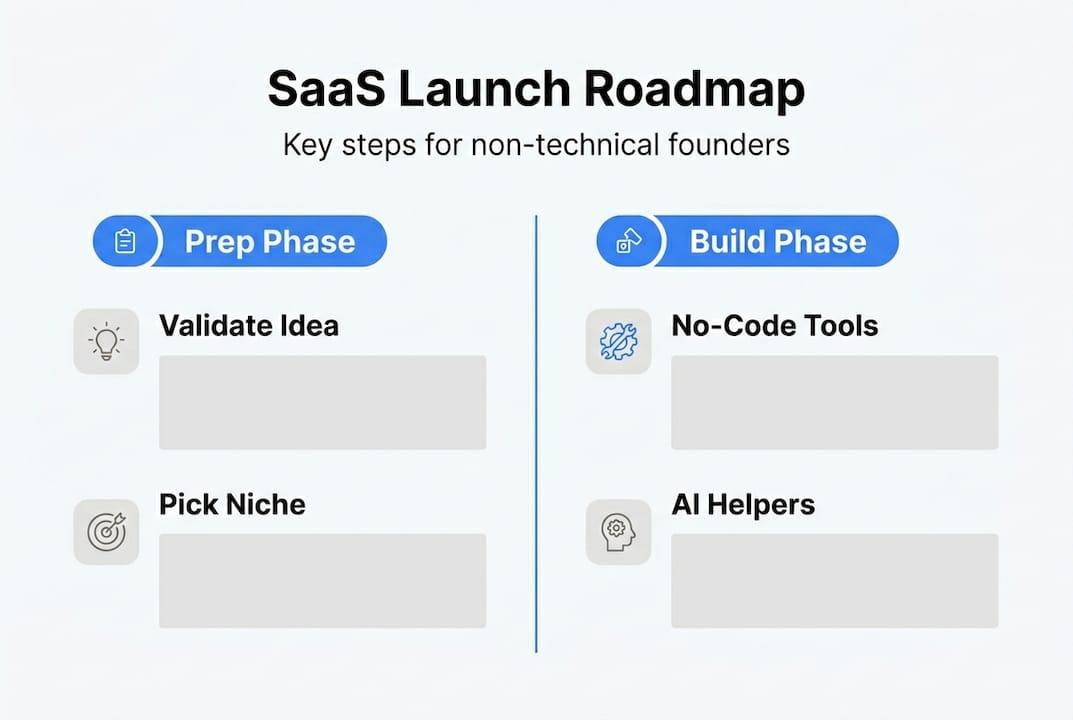
The AI-first SaaS roadmap approach works because it forces you to think in systems, not features. You define the core user flow, automate the repetitive logic, and ship something real in weeks instead of months.
Key principles for building your MVP without code:
- One core feature only. The feature that solves the validated pain. Nothing else.
- Use existing infrastructure. Stripe for payments, Auth0 for authentication, Airtable for data. Don’t reinvent anything.
- Automate with Zapier or Make. Connect your tools without custom code.
- Design for the job, not the portfolio. Functional beats beautiful at this stage.
Pro Tip: Read the MVP building no-code guide before choosing your stack. Platform lock-in is real. Pick tools that let you export data and migrate later. Also check the SaaS tech checklist to make sure you’re not missing critical infrastructure before you launch MVP fast.
Launching and growing: Steps to ship and scale your SaaS as a solo founder
Building is only half the battle. Launching is where most founders stall. Here’s a repeatable process that works.
Step-by-step launch checklist:
- Soft launch to your waitlist first. These are your warmest leads. Onboard them manually if needed.
- Set up basic analytics. You need to know where users drop off before you can fix it.
- Write a clear onboarding flow. The first five minutes a user spends in your product determines whether they stay.
- Post in relevant communities. Reddit, Slack groups, LinkedIn niches. Not spam. Genuine participation.
- Ask for feedback, not praise. You want to know what’s broken, not what’s nice.
- Iterate in two-week cycles. Fix the biggest friction point, then ship again.
Organic growth via content and partners consistently outperforms paid ads for early-stage SaaS. Ads scale what’s already working. They don’t create traction from scratch.
Paid ads are a trap at this stage. You don’t yet know your conversion rate, your churn rate, or your customer acquisition cost. Spending money on ads before you know those numbers is burning cash to learn lessons you could get for free.
What actually works for early growth:
- Content marketing. Write about the exact problem your product solves. Rank for searches your buyers are already making.
- Partnership outreach. Find adjacent tools or communities that serve your audience and propose genuine value exchanges.
- Referral loops. Build a simple referral incentive into your product from day one.
- Direct outreach. Email potential users personally. Ten thoughtful emails beat a thousand cold blasts.
Review the full launching SaaS app guide for a detailed checklist. And don’t underestimate UX in MVP. Retention is a UX problem as much as a product problem.
What most guides miss: The solo founder advantage
Here’s the take you won’t find in most startup playbooks: being a solo, non-technical founder in 2026 is actually an advantage, not a liability.
Large teams move slowly. They debate, align, and document. You decide and ship. When you combine that speed with AI and no-code tools, you get a leverage ratio that no agency or dev team can match on a per-dollar basis. Solo AI-augmented founders hit a median $240k ARR compared to $48k for those without AI tools. That gap will keep widening.
The founders who win in boring niches aren’t the ones with the best code. They’re the ones who understand the customer’s frustration better than anyone else and build the simplest possible fix for it. That insight doesn’t require a computer science degree. It requires curiosity and discipline.
Most guides push you toward complex tech stacks because complexity feels like progress. It isn’t. Use the SaaS founder tech checklist to stay lean and focused. The founder who ships a working product in six weeks with no-code tools beats the one who’s still planning their architecture in month four.
Your edge is speed, proximity to the customer, and zero bureaucracy. Use it.
Accelerate your SaaS journey with expert guidance
If you’ve worked through this guide and you’re ready to move from concept to launched product, but you want to make sure the technical foundation is solid, that’s exactly where working with a senior engineer who’s also a SaaS founder makes a real difference.
At hanadkubat.com, I work directly with non-technical founders to build production-ready MVPs in 4 to 12 weeks. No agency overhead, no project manager in the middle, no equity required. You get Fortune 500 engineering discipline applied at founder speed. If you’re serious about shipping your first SaaS product and want a technical partner who’s already been through the process, let’s talk.
Frequently asked questions
Can I launch a SaaS product without any coding skills?
Yes. Modern platforms like Bubble, Glide, and Softr let you build full SaaS products without writing code, and no-code reduces dev time by 80% compared to traditional development.
What are the risks of skipping market validation?
Skipping validation is the single biggest risk you can take. 42% of startups fail specifically because they built something the market didn’t need, and no amount of marketing fixes a product without demand.
How can solo founders compete with larger teams?
Speed and proximity to the customer are your advantages. Solo AI-augmented founders hit a median $240k ARR versus $48k for non-AI founders, proving that the right tools close the gap fast.
What should I focus on if I have limited resources?
Focus on validation first, then one core feature, then organic growth. Organic content and partner strategies consistently outperform paid ads for early-stage products where budgets are tight and conversion data is thin.