

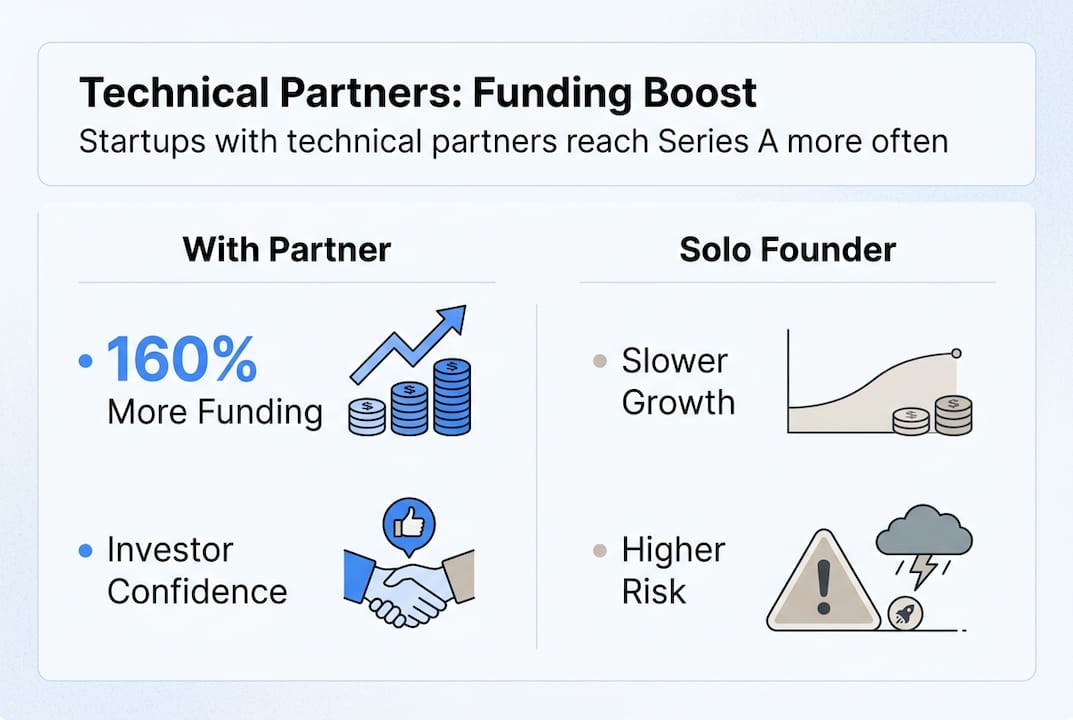
Most non-technical founders believe they can launch a startup with just a great idea, some no-code tools, and determination. Yet startups with technical cofounders are 160% more likely to reach Series A funding. This gap reveals a hard truth: technical expertise isn’t optional for scalable growth. Whether you choose a cofounder, fractional partner, or agency, the right technical leadership determines whether your MVP becomes a fundable business or stalls in development hell. This guide breaks down why technical partners matter, what risks you face going solo, and how to choose the model that fits your startup’s stage and goals.
Table of Contents
- Key takeaways
- Why technical partners matter for non-technical founders
- Risks of going solo or relying solely on no-code and AI
- Navigating technical partner options: cofounders, fractional partners, and agencies
- How technical partners accelerate MVP development and ensure scalability
- Partner with a seasoned expert to build your MVP
- FAQ
Key Takeaways
| Point | Details |
|---|---|
| Technical leadership matters | Having a technical lead reduces costly mistakes and guides scalable architecture from day one. |
| Faster milestones with cofounders | Cofounders with technical expertise reach milestones and funding faster, boosting investor credibility. |
| No code and AI risks | No code and AI MVPs can introduce security gaps and vendor lock in, complicating scaling. |
| Hybrid approach benefits | A hybrid model blends control, expertise, and cost efficiency by mixing in house leadership with external specialists. |
Why technical partners matter for non-technical founders
Technical partners do more than write code. They make strategic decisions about your technology stack, plan for scalability from day one, and provide the credibility investors demand. When you lack technical leadership, every decision becomes a gamble. Should you build on AWS or Google Cloud? Is PostgreSQL or MongoDB right for your data model? Without expertise, you either guess or pay consultants to guess for you.
The numbers tell the story. Startups with technical cofounders are 160% more likely to reach Series A funding. Teams with technical leadership reach $10K MRR 9% faster than those without. Investors notice this pattern. They know that technical debt compounds, that poor architecture kills products during scaling, and that non-technical founders often underestimate development complexity by 3-5x.
Technical cofounders provide credibility to investors, reduce development costs through smart technology choices, and handle scaling challenges that would otherwise require expensive rewrites. They prevent the common trap of building features customers don’t want because they can rapidly prototype, test, and iterate based on real user feedback.
Here’s what technical partners deliver:
- Cost reduction through efficient technology choices and avoiding vendor lock-in
- Technical credibility that opens doors with investors and enterprise customers
- Faster milestone achievement via direct communication and rapid iteration
- Scalability planning that prevents expensive rewrites when you hit growth
- Security focus that protects user data and prevents compliance nightmares
“Teams with technical leadership reach product-market fit faster because they eliminate the ‘translation tax’ between business vision and technical execution. Every conversation about features becomes a direct discussion about trade-offs, not a game of telephone through project managers.”
The technical co-founder role drives startup funding because it signals to investors that you can execute without burning cash on agencies or hiring junior developers who need supervision. Technical partners turn your vision into architecture, your features into code, and your MVP into a fundable business.
Risks of going solo or relying solely on no-code and AI
Solo non-technical founders can succeed, but the path is slower and harder. You’ll spend months learning enough to make basic decisions, hire contractors who may or may not deliver quality work, and face technical debt that compounds with every shortcut. The data shows non-technical solo founders succeed but typically take longer to reach milestones and struggle more with scaling challenges.

No-code and AI tools promise speed, but they come with hidden costs. AI-generated MVPs often contain security vulnerabilities because the AI doesn’t understand your specific threat model. No-code platforms lock you into their ecosystem, making it expensive or impossible to migrate when you outgrow their limitations. One founder reported their AI-built MVP was hacked within weeks of launch because the generated code had basic authentication flaws.
Here are the key risks of going solo with no-code or AI:
- Limited technical expertise means you can’t evaluate contractor quality or spot red flags in architecture decisions.
- Hidden costs emerge when you need custom features that no-code platforms don’t support, forcing expensive workarounds.
- Security vulnerabilities pile up because AI-generated code often lacks proper input validation, authentication, or data encryption.
- Slower iteration cycles happen when you depend on contractors or agencies with their own schedules and priorities.
- Technical debt compounds when quick fixes create maintenance nightmares that eventually require complete rewrites.
No-code/AI risks include technical debt and unscalable solutions that work for 100 users but collapse at 1,000. The platforms optimize for ease of use, not performance or scalability. When growth hits, you face a painful choice: rebuild from scratch or accept slow performance that drives users away.
Pro Tip: Validate your concept with no-code before committing to custom development. Use tools like Bubble or Webflow to test your core value proposition with real users. Once you’ve proven demand, bring in technical expertise to build a scalable foundation. This approach lets you build MVP fast without coding while avoiding long-term technical debt. Consider fractional technical partners who provide senior expertise without equity dilution, giving you the best of both worlds.
The MVP validation checklist shows that successful founders validate demand before building, then invest in proper technical execution once they’ve proven the concept. This two-stage approach minimizes risk while maximizing learning speed.
Navigating technical partner options: cofounders, fractional partners, and agencies
You have three main paths to technical expertise: equity-based cofounders, fractional technical partners, or development agencies. Each model fits different startup stages, risk tolerances, and founder preferences. Understanding the trade-offs helps you choose strategically instead of defaulting to conventional wisdom.
| Model | Equity impact | Control | Cost | Conflict risk |
|---|---|---|---|---|
| Technical cofounder | High (20-40% equity) | Shared | Sweat equity | High (65% failure rate) |
| Fractional partner | Low/None | Founder retains | €5K-15K/month | Low |
| Agency | None | Founder retains | €50K-200K+ | Medium |
The cofounder model offers deep alignment when it works. You share vision, risk, and rewards equally. But 65% of startups fail due to cofounder conflict, mostly over equity splits, role definitions, and vision disagreements. The honeymoon phase ends when tough decisions arise: Should we pivot? Who gets final say on product direction? What happens if one cofounder wants out?
Fractional partners and agencies preserve control and equity. You pay for expertise without dilution, maintain decision-making authority, and can change providers if the relationship doesn’t work. The downside is cash cost, but many founders prefer paying €10K-15K monthly over giving up 30% equity that could be worth millions.
Consider these factors when choosing:
- Vision alignment: Do you need someone who shares your long-term mission, or just technical execution?
- Financial constraints: Can you afford cash payments, or do you need to conserve runway by offering equity?
- Speed requirements: Agencies and fractional partners often start faster than recruiting a cofounder.
- Long-term scalability: Will this model support your needs through Series A and beyond?
Pro Tip: If you choose a cofounder, use vesting schedules and milestone-based equity grants to align incentives. A four-year vest with a one-year cliff protects both parties. If the relationship fails early, neither side loses much. If it succeeds, both earn their equity through sustained contribution. This structure reduces the 65% conflict rate by making equity contingent on performance.
The technical co-founder contrasting views debate shows experienced founders on both sides. Pro-cofounder arguments emphasize building defensible moats and deep product innovation. Anti-cofounder voices highlight conflict risks and the value of preserving equity for future fundraising. Your choice depends on whether you prioritize alignment or control.
Once you’ve validated demand and need to launch SaaS MVP fast, the right technical model accelerates execution. Understanding key features every SaaS needs helps you evaluate whether a potential partner has relevant experience in your domain.
How technical partners accelerate MVP development and ensure scalability
Technical partners transform your vision into working software faster than any other approach. They eliminate the translation layer between business requirements and code, make real-time trade-off decisions, and build foundations that scale without rewrites. This speed advantage compounds: every week saved in development is a week gained in market learning.
Here’s how technical partners accelerate MVP development:
- Quick iteration: Direct feedback loops mean you test ideas in days, not months, adjusting based on real user behavior.
- Direct communication: No project managers translating requirements, no game of telephone distorting your vision.
- Quality assurance: Senior technical partners catch bugs and edge cases before users do, protecting your reputation.
- Scalability planning: They design architecture that handles 10x growth without performance degradation or expensive rewrites.
- Security focus: They implement authentication, encryption, and data protection from day one, not as afterthoughts.
Working effectively with technical partners requires clear processes:
- Define roles explicitly: Who owns product decisions? Who makes technical architecture choices? Document this upfront to avoid conflicts.
- Set milestone-based deliverables: Break the MVP into 2-week sprints with specific, testable outcomes for each cycle.
- Establish feedback loops: Schedule daily standups or async updates so both sides stay aligned on progress and blockers.
- Prioritize ruthlessly: Technical partners help you cut scope intelligently, focusing on features that validate your core hypothesis.
- Plan for scale: Discuss architecture decisions that affect future growth, like database choices, API design, and infrastructure.
“Technical partners eliminate the ‘translation tax’ that agencies and contractors impose. When you work directly with the person writing the code, every conversation about features becomes a discussion about trade-offs, feasibility, and impact. This direct communication accelerates decision-making and reduces misunderstandings that lead to expensive rework.”
Technical partners enable fast iteration via direct feedback loops and avoid the translation tax that slows agency relationships. They transform your ideas into scalable products by making hundreds of micro-decisions daily, each informed by technical expertise and business context.
Selecting the right tech stack, ensuring security, and planning for scalability reduces costly mistakes that would otherwise require expensive fixes or complete rebuilds. Technical partners have seen these patterns before. They know which shortcuts create technical debt and which optimizations are premature.
Explore SaaS development insights to understand how experienced technical partners approach common challenges. Learn how to validate SaaS idea before investing development resources, ensuring you build something users actually want.
Partner with a seasoned expert to build your MVP
You need senior technical expertise without giving up equity or dealing with agency overhead. That’s the gap most non-technical founders face: cofounders want 30-40% equity, agencies charge €100K+ and add project management layers, and junior developers need supervision you can’t provide.
I build production-ready MVPs in 4-12 weeks using React, Next.js, Node.js, and React Native. No team, no project managers, no game of telephone. You work directly with the person writing your code. Fortune 500 engineering discipline meets founder speed.
This approach delivers what you actually need: a working product that validates your idea, scales when users arrive, and doesn’t require a rewrite in six months. Every recommendation comes from building my own SaaS products first. I’ve made the expensive mistakes so you don’t have to.
Check out Fortune 500 engineer MVP development to see how this works in practice. Review technical resources and full documentation to understand the approach and technology choices that power scalable MVPs.
FAQ
Why do non-technical founders need technical partners?
Technical partners provide the expertise to make smart technology decisions, avoid costly mistakes, and build products that scale. Startups with technical cofounders are 160% more likely to reach Series A because investors trust teams that can execute without burning cash on agencies or making architectural mistakes that require expensive rewrites.
What are the alternatives to giving up equity for a technical cofounder?
Fractional technical partners and specialized agencies offer senior expertise without equity dilution. You pay monthly fees instead of giving up ownership, maintain full control over product decisions, and can change providers if the relationship doesn’t work. This model works well for founders who’ve validated demand and need execution speed without cofounder conflict risk.
How do I avoid cofounder conflicts over equity and vision?
Use four-year vesting schedules with one-year cliffs to align incentives and protect both parties. Document role definitions, decision-making authority, and exit terms before you start working together. Consider milestone-based equity grants that reward sustained contribution rather than upfront splits. These structures reduce the 65% conflict rate by making expectations explicit from day one.
Can I build a successful MVP using only no-code tools?
No-code tools work great for validating concepts with early users, but they create technical debt and scalability limits. Use them to test your core value proposition, then invest in proper technical execution once you’ve proven demand. This two-stage approach minimizes risk while avoiding the long-term costs of vendor lock-in and performance issues that emerge at scale.
How do technical partners accelerate time to market?
Technical partners eliminate the translation layer between your vision and working code, make real-time trade-off decisions, and build scalable foundations from day one. Direct communication means you iterate in days instead of weeks, catch issues before they become expensive problems, and ship features that actually solve user needs. Review the technical co-founder role drives startup funding to understand how this speed advantage compounds into funding success.