

Most non-technical founders assume they need a co-founder with a computer science degree before they can build anything real. That assumption kills more startups than bad ideas do. The truth is that lean MVP validation through mobile app development has become the fastest way to test whether your SaaS idea has legs, and you do not need to write a single line of code to get started. This guide walks you through the frameworks, tools, benchmarks, and pitfalls that matter most when you are trying to go from idea to paying users as quickly as possible.
Table of Contents
- Why mobile app development matters for SaaS founders
- Choosing the right tools: Cross-platform vs native development
- Validating your SaaS idea: Subscription benchmarks and best practices
- Pitfalls: Edge cases, prototype traps, and scaling headaches
- Get expert mobile app development support for your SaaS MVP
- Frequently asked questions
Key Takeaways
| Point | Details |
|---|---|
| Rapid MVP validation | Mobile app development empowers founders to quickly test and refine SaaS ideas before investing heavily. |
| Cross-platform efficiencies | Founders can save time and money using cross-platform tools for MVPs, switching to native only when needed. |
| Data-driven growth | Understanding benchmarks for conversion and retention is crucial for validating and scaling your SaaS app. |
| Avoid costly pitfalls | Planning for edge cases and migrating away from prototypes early prevents expensive post-launch fixes. |
Why mobile app development matters for SaaS founders
The build-measure-learn loop is not just a buzzword. It is the actual mechanism that separates founders who ship from founders who plan forever. When you put a working app in front of real users, you get feedback that no amount of market research can replicate. You learn what people actually do, not what they say they will do.
Rapid MVP validation through lean build-measure-learn loops is what gives early-stage startups their biggest competitive edge. A mobile app MVP lets you test your core value proposition in weeks, not months. That speed is the whole game at the pre-revenue stage.
Here is what mobile app development gives you that a landing page or a spreadsheet cannot:
- Real usage data: You see where users drop off, what they tap, and what they ignore.
- Subscription signal: You find out fast whether people will pay, not just sign up.
- Iteration speed: Sprint-based rapid MVP deployment lets you push updates in days, not quarters.
- Investor credibility: A working app beats a pitch deck every single time.
“Most successful founders rely on app prototypes, not full products, to test ideas. The goal is to learn, not to launch perfectly.” This mindset shift is what separates founders who validate fast from those who over-build and run out of runway.
Pro Tip: Structure your first build as a two-week sprint with one core user flow. Resist the urge to add features. One flow, real users, real data. That is your only goal in week one.
When you are launching a SaaS MVP, the app itself is your research instrument. Treat it that way.
Choosing the right tools: Cross-platform vs native development
To put rapid development into practice, you need to pick the right technical approach. This decision affects your budget, your timeline, and how much technical debt you carry into your first growth phase.

Cross-platform tools like React Native and Flutter let you build one codebase that runs on both iOS and Android. Cross-platform tools are recommended for startups because of budget efficiency and faster MVP delivery. Native development, where you build separately for iOS and Android, is reserved for apps that need maximum performance or deep hardware integration.
| Factor | Cross-platform | Native |
|---|---|---|
| Cost | Lower (one codebase) | Higher (two codebases) |
| Speed to market | Faster (weeks) | Slower (months) |
| Performance | Good for most SaaS apps | Best for complex, hardware-heavy apps |
| Scalability | Solid up to mid-scale | Best for high-scale products |
| Best for | MVPs, early validation | Post-PMF, performance-critical apps |
Choose cross-platform when:
- You are validating an idea and need to move fast.
- Your budget is under $50,000 for the first build.
- Your app does not rely on complex device hardware like AR or real-time video processing.
- You want to reach both iOS and Android users from day one.
Choose native when:
- You have validated product-market fit and need to optimize performance.
- Your app requires deep OS-level integrations.
- You are scaling past 50,000 active users and performance is becoming a bottleneck.
One trap to avoid: the prototype trap. Many founders build a no-code prototype, get early traction, and then stay on that platform too long. No-code tools are great for testing, but they will limit you when you need custom logic, complex integrations, or real scalability. Read the custom app development guide to understand when and how to make that migration cleanly.
Validating your SaaS idea: Subscription benchmarks and best practices
Once the MVP is launched, what does successful validation actually look like in 2026? You need numbers to compare against, not just gut feelings.
Here are the benchmarks that matter most for subscription-based mobile SaaS apps:
| Metric | Median benchmark | Top 25% |
|---|---|---|
| Day 35 download-to-paid conversion | 2 to 4% | 6%+ |
| Day 30 retention rate | 20 to 30% | 40%+ |
| Annual subscriber LTV | $80 to $150 | $300+ |
| MRR growth (YoY) | Flat to 20% | 80%+ |
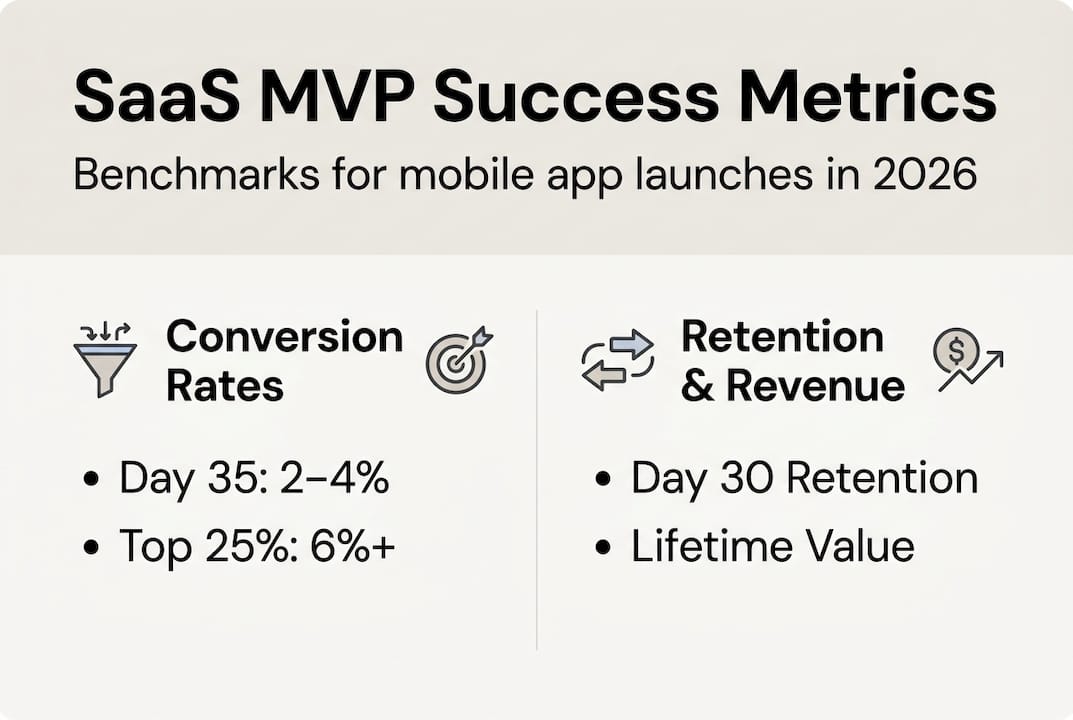
Median Day 35 conversion rates sit between 2 and 4%, which means if you are converting 5% of downloads to paid subscribers within five weeks, you are already outperforming most apps in the market. That is a strong signal to keep building.
Top 25% of subscription apps grow MRR by 80% or more year over year, while the bottom quartile actually shrinks by 33%. The gap between winners and losers comes down almost entirely to retention and churn management from day one.
Practical steps for your first 30 days post-launch:
- Day 1 to 7: Track activation rate. Are users completing your core flow after downloading?
- Day 7 to 14: Measure engagement depth. Are they returning? How many sessions per week?
- Day 14 to 21: Test your paywall. Hard paywalls convert faster but see higher early churn. Freemium paywalls build habit first.
- Day 21 to 30: Calculate early LTV signals. If your Day 30 retention is under 15%, fix the product before scaling ads.
One data point worth noting: AI-powered apps currently outperform traditional SaaS apps in early revenue but show faster churn after the novelty wears off. If you are building an AI feature into your SaaS, plan your retention hooks early. Use MVP best practices and SaaS idea validation frameworks to structure your measurement from the start.
Pitfalls: Edge cases, prototype traps, and scaling headaches
Even with the right frameworks and benchmarks, founders must know what can stall success and how to prevent it before it costs real money.
The most underestimated cost in mobile app development is edge cases. These are the scenarios your app was not designed to handle gracefully. Here are the ten most common ones that get missed:
- Empty state: What does the app show when there is no data yet?
- Loading state: What happens while data is fetching?
- Error state: What shows when an API call fails?
- Offline mode: Does the app crash or handle no connectivity?
- Slow network: Does the UI freeze on a 3G connection?
- Permission denied: What if the user blocks camera or location access?
- Session timeout: What happens when the auth token expires mid-session?
- Large data sets: Does the app slow down with 10,000 records vs 10?
- Interrupted flows: What if a user closes the app mid-checkout?
- Device size extremes: Does the layout break on very small or very large screens?
Edge cases cost 50 to 100 times more to fix after launch than before. That is not a small multiplier. Catching one edge case in a prototype review saves you weeks of post-launch firefighting.
The prototype trap is the second major pitfall. No-code and low-code tools are ideal for prototyping and early validation, but founders who stay on them too long end up rebuilding everything from scratch at the worst possible time, usually right when they are trying to close their first funding round or onboard a major customer.
Pro Tip: Before launch, test your app on at least three different device sizes, two operating system versions, and both strong WiFi and a throttled 3G connection. This one hour of testing will surface 80% of the issues your users would have found for you.
For scaling architecture, the decisions you make at the MVP stage follow you. Use SaaS development insights and agile frameworks for MVP to build with future scale in mind, even when you are still small.
Get expert mobile app development support for your SaaS MVP
Ready to turn these insights into real app progress? If you are a non-technical founder who wants to ship fast without hiring an agency or giving up equity, this is where practical support meets your mobile app development needs.
Hanad Kubat builds production-ready MVPs and SaaS products in 4 to 12 weeks using React Native, Next.js, and Node.js. You work directly with the engineer writing your code, no project managers, no handoffs, no guesswork. Every recommendation comes from someone who has built and validated his own SaaS products using the same frameworks covered in this article. Whether you need expert MVP development from scratch or a migration from your current prototype to a scalable custom build, the custom development guide for founders is a good place to start understanding what that process looks like in practice.
Frequently asked questions
How much does it cost to build a SaaS MVP mobile app in 2026?
MVP builds using lean tools and sprint-based cycles typically range from $3,000 to $8,000 for a focused, single-flow product. Scope and complexity push that number up fast, so cutting features early is the best cost control you have.
Should non-technical founders use no-code or low-code platforms for their MVP?
No-code and low-code builders are excellent for fast prototyping and early validation, but plan your migration to custom code before you hit scale. Staying on no-code too long is the prototype trap, and it is expensive to escape late.
What are the top metrics to track when validating a SaaS mobile app?
Focus on Day 35 download-to-paid conversion, Day 30 retention, churn rate, and subscriber lifetime value. These four numbers tell you whether your product has a real business inside it or just early curiosity.
How can founders avoid expensive mistakes when launching their MVP?
Edge cases cost 50 to 100 times more to fix after launch, so test interrupted flows, offline states, and error handling before you ship. Plan your migration from prototype to custom code early, not after your first scaling crisis.