

Most successful SaaS companies you admire today launched with something embarrassingly basic. Slack started as a gaming tool. Airbnb was a simple website with photos taken on a cheap camera. The founders didn’t wait for perfection. They shipped, learned, and iterated fast. Validated learning through the Build-Measure-Learn loop is the engine behind this approach, testing real business hypotheses with minimal effort instead of perfecting products upfront. If you’re a non-technical founder trying to figure out when to launch and what to build, this guide cuts through the noise and gives you a clear path forward.
Table of Contents
- What is rapid MVP deployment and why does it matter?
- The Build-Measure-Learn loop: From idea to feedback fast
- Common pitfalls: Rushing too much or over-engineering?
- MVP as an experiment: Validating your market faster
- From learning to scaling: Applying your feedback
- Accelerate your MVP journey with expert support
- Frequently asked questions
Key Takeaways
| Point | Details |
|---|---|
| Speed brings insight | Launching your MVP rapidly delivers real user feedback much faster than perfecting a full product upfront. |
| Balance shortcuts wisely | Skip non-essentials but never cut corners on security or core functionality in early MVPs. |
| Learning beats guessing | Testing real-world assumptions leads to smarter pivots and stronger startup growth. |
| Iterate post-launch | The most actionable feedback comes in the first two weeks after MVP launch—use it to refine and improve. |
What is rapid MVP deployment and why does it matter?
An MVP, or Minimum Viable Product, is the smallest version of your product that delivers real value to real users. Not a prototype. Not a mockup. A working product with just enough features to test your core assumptions. The goal is never to build everything. The goal is to learn what customers actually need before you spend months building what they don’t.
Traditional product planning often looks like this: spend six months designing, three months building, then launch and hope. Rapid MVP deployment flips that. You launch your SaaS MVP quickly, get it in front of users within weeks, and let real feedback drive every decision after that. This approach is not about being sloppy. It’s about being strategic.
Here’s what rapid MVP deployment actually gives you:
- Speed to market: You stop guessing and start learning from real users.
- Lower burn rate: You spend less money before you know what works.
- Investor credibility: Traction beats pitch decks every time.
- Focused roadmap: User feedback tells you what to build next.
- Reduced risk: You validate startup ideas before committing full resources.
“The goal of an MVP is not to build a mini version of your final product. It’s to test a business hypothesis with the least amount of effort possible.”
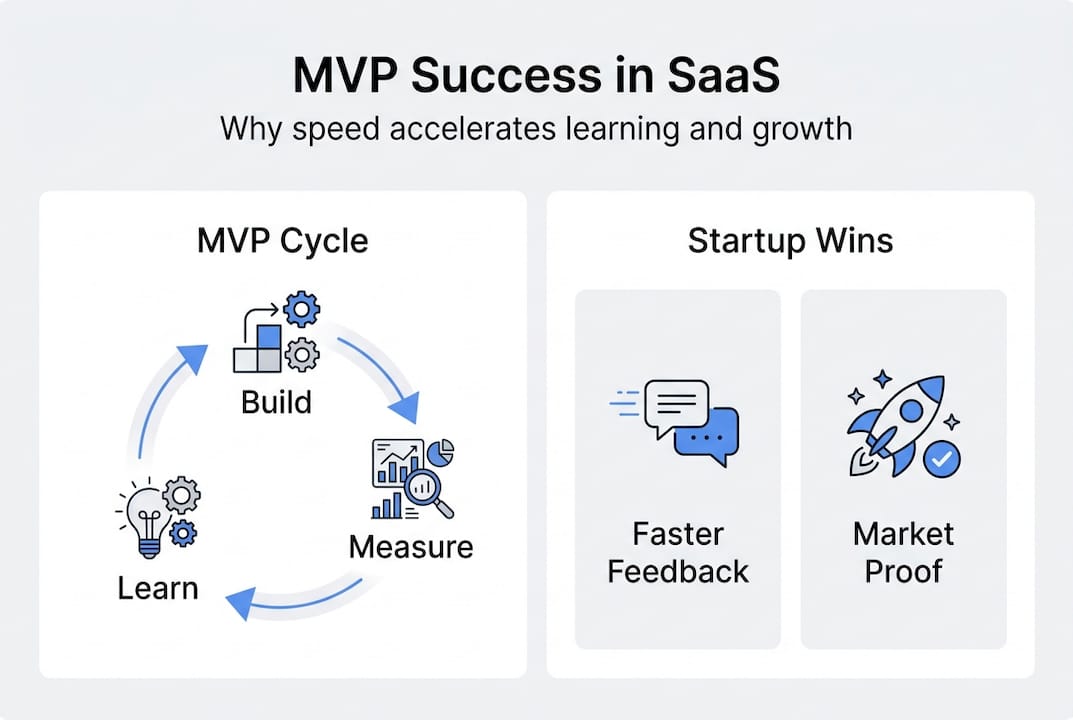
The Build-Measure-Learn feedback loop is the backbone of this entire philosophy. Build the smallest thing that tests your assumption. Measure what users do. Learn from that data. Repeat. It sounds simple, but most founders skip the “measure” and “learn” parts entirely.
The Build-Measure-Learn loop: From idea to feedback fast
Eric Ries introduced the Build-Measure-Learn cycle in The Lean Startup, and it remains one of the most practical frameworks for early-stage SaaS founders. The idea is straightforward: stop theorizing and start testing. Every week you spend planning without shipping is a week of learning you’re throwing away.
Here’s how the cycle works in practice:
- Build the smallest feature set that tests one specific assumption about your users.
- Measure how users interact with it. Are they clicking? Signing up? Dropping off?
- Learn from the data. Was your assumption right? What surprised you?
- Repeat the cycle with your updated understanding.
The Build-Measure-Learn loop is not about rushing. It’s about removing the guesswork from product decisions. Founders who skip this cycle tend to build features nobody asked for, then wonder why their product isn’t growing.
As Eric Ries puts it, traditional product development involves a long, silent period of building before any customer feedback is gathered. The Lean Startup method inverts this entirely.
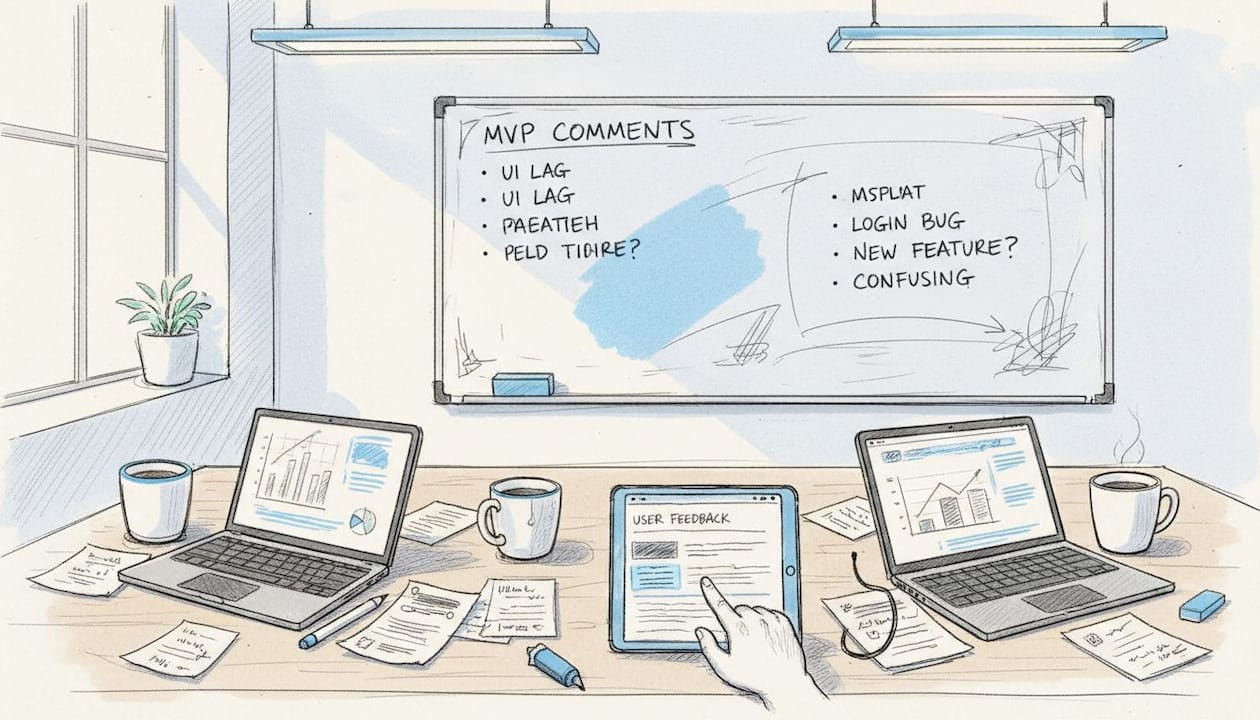
The first two weeks after launch are often the most information-dense period in your entire product journey. Users will tell you things through their behavior that no amount of market research could predict. Use your MVP validation checklist to make sure you’re capturing the right signals from day one.
Common pitfalls: Rushing too much or over-engineering?
Speed is a weapon. But like any weapon, it can hurt you if you use it wrong. There are two failure modes founders fall into, and both will kill your momentum.
Failure mode 1: Ship everything, worry later. Some founders treat “move fast” as a license to skip authentication, ignore data security, and write code that will need to be completely rewritten in six months. Technical debt from rushed MVPs, like poor database design, missing security layers, and monolithic code structures, makes scaling a nightmare. You’ll spend more time fixing old problems than building new features.
Failure mode 2: Over-engineer before launch. The opposite trap is spending months building a “scalable architecture” for a product that has zero users. Over-engineering delays validation and burns your runway before you’ve learned anything useful.
Here’s a simple comparison to help you decide what to skip and what to keep:
| Feature | Safe to skip at MVP stage | Must include at MVP stage |
|---|---|---|
| Advanced analytics dashboard | Yes | No |
| User authentication | No | Yes |
| Payment processing (if monetizing) | No | Yes |
| Admin panel | Yes | No |
| Data encryption and security | No | Yes |
| Multi-language support | Yes | No |
| Core user workflow | No | Yes |
Pro Tip: Think of your MVP like a food truck, not a restaurant. You don’t need a full kitchen, a dining room, and a sommelier. You need one great dish, served fast, to people who are hungry right now. Nail that, then expand.
The UX in your MVP matters more than most founders think. A confusing interface will make users quit before they even experience your core value. And if you’re wondering whether you can build your MVP without coding, there are real options worth exploring depending on your product type.
The key is balance. Cut scope aggressively, but protect the features that make your product trustworthy and usable.
MVP as an experiment: Validating your market faster
Here’s a mindset shift that changes everything: your MVP is not a product. It’s a hypothesis. You’re not launching a company. You’re running an experiment to find out if a company is worth building.
This reframe matters because it removes the pressure of perfection. An MVP is a hypothesis test, not a mini-product. You’re asking: “Do real users have this problem? Will they pay to solve it? Does our solution actually work for them?”
Here’s how to structure your MVP as a series of experiments:
- Define your core assumption. What must be true for your business to work?
- Build the minimum feature that tests that assumption. Nothing more.
- Set a measurable success metric. Signups, conversions, session length.
- Launch to a small, targeted group. Not the whole world. A focused segment.
- Analyze results honestly. Did users behave the way you expected?
One thing that surprises most founders: fake or manual features are completely normal at this stage. Zapier’s founders manually connected apps before building any automation. Airbnb’s founders personally photographed listings. The Lean Startup calls these “concierge MVPs,” where you deliver the service manually to learn what the automated version should actually do.
Here’s a quick reference for common MVP experiment types:
| Experiment type | Best for | Example |
|---|---|---|
| Landing page test | Validating demand | Collect emails before building |
| Concierge MVP | Understanding workflow | Do the service manually first |
| Wizard of Oz MVP | Testing automation ideas | Fake the tech, do it by hand |
| Prototype test | UX and flow validation | Clickable mockup with real users |
| Single-feature MVP | Core value validation | One workflow, nothing else |
Pro Tip: Don’t launch to everyone. Pick 10 to 20 users who match your ideal customer profile exactly. Their feedback will be ten times more useful than 1,000 random signups who don’t fit your target.
Using agile MVP frameworks helps you stay organized through these rapid cycles. And before you go live, run through a technical checklist for your MVP to make sure you’re not missing anything critical.
From learning to scaling: Applying your feedback
You’ve launched. Users are in the product. Now what? This is where most founders either accelerate or stall. The difference is almost always how fast they act on what they learn.
The first two weeks post-launch are your most valuable learning window. Users are fresh. Their reactions are unfiltered. Their drop-off points are telling you exactly where your product breaks down. Don’t waste this window by waiting for a “big enough” data set.
Here’s how to turn early feedback into real momentum:
- Talk to users directly. Not surveys. Actual conversations. Ask why they did or didn’t do something.
- Track behavior, not just opinions. What users say and what they do are often very different.
- Prioritize ruthlessly. Fix the one thing that’s blocking the most users first.
- Kill features that don’t serve the business. If nobody uses it, remove it.
- Document every insight. Your future self and your investors will thank you.
Pro Tip: Build a simple feedback log. After every user conversation, write down the exact words they used to describe their problem. Those words become your marketing copy, your feature names, and your pitch deck language.
Early feedback also gives you something powerful with investors: evidence. A product with 50 engaged users and clear retention data is worth more in a pitch meeting than a polished deck with no traction. Working with technical partners who understand scaling means you can move from feedback to implementation without losing weeks to miscommunication or handoffs.
The founders who win are the ones who treat every piece of feedback as a gift, act on it fast, and keep the cycle moving.
Accelerate your MVP journey with expert support
If you’ve read this far, you already know that speed and learning are the two things that matter most in early-stage SaaS. The problem most non-technical founders face isn’t motivation. It’s execution. Building a production-ready MVP in 4 to 12 weeks requires someone who knows exactly what to cut, what to keep, and how to ship without creating a mess you’ll spend years cleaning up.
That’s exactly what Hanad Kubat delivers. With Fortune 500 engineering experience at BMW, Deutsche Bahn, and IBM, combined with the speed of a founder who has built and shipped his own SaaS products, you get senior technical execution without agency overhead or equity dilution. No project managers. No game of telephone. You work directly with the person writing the code. If you want to go deeper on strategy, tactics, and real-world MVP lessons, the SaaS development blog is the place to start.
Frequently asked questions
What is the main benefit of rapid MVP deployment?
Rapid MVP deployment lets you test business ideas quickly and learn what works before investing heavily in features that may not matter.
Is it okay to skip core features during MVP development?
You can skip non-essential extras like admin panels and analytics dashboards, but baseline security and authentication must be included from day one.
How do I know if my MVP is successful?
If real users engage, give actionable feedback, or convert to early paying customers, your MVP is working. The Build-Measure-Learn loop gives you the framework to measure this clearly.
How fast should I iterate after my MVP launch?
Move fast. The first two weeks post-launch are when you collect the most useful feedback, so prioritize fixes and improvements immediately after going live.