

TL;DR:
- An MVP is a functional product used to validate demand and learn from real users.
- Non-technical founders can build MVPs using no-code, low-code, or agency services without giving up equity.
- Shipping quickly and learning iteratively is more valuable than perfecting technical details before market testing.
You don’t need a technical co-founder to launch a SaaS product. That belief has killed more startups than bad code ever did. The real shortcut is an MVP, a Minimum Viable Product, and it’s the fastest way to test whether your idea has legs before you burn your savings or hand over equity. 42% of startups fail because they build something nobody wants. An MVP flips that equation. This article breaks down exactly what an MVP is, how to build one fast, which path suits non-technical founders, and which mistakes will stall you before you ever see your first paying customer.
Table of Contents
- What is an MVP and why does it matter in SaaS?
- The step-by-step process to build a SaaS MVP fast
- No-code, low-code, or agency: Choosing your MVP implementation path
- Common MVP mistakes SaaS founders make (and how to avoid them)
- Why validation speed matters more than technical polish
- How to get expert help building your SaaS MVP
- Frequently asked questions
Key Takeaways
| Point | Details |
|---|---|
| MVP accelerates validation | Launching a minimum viable product gets you real customer feedback and market proof fast. |
| You don’t need a technical co-founder | Non-technical founders can ship production-ready SaaS MVPs using no-code tools or agencies—keeping full ownership. |
| Focus on essentials | Limit MVP features to authentication, core workflow, and billing for rapid, affordable iteration. |
| Avoid classic founder mistakes | Scope creep, overbuilding, and skipping market validation cause most failures—prioritize speed and learning. |
| Consider expert help | MVP specialists offer founder-friendly ways to launch without equity dilution or tech debt. |
What is an MVP and why does it matter in SaaS?
A lot of founders confuse an MVP with a rough draft or a demo. It’s neither. An MVP is a functional product that real users can interact with. It’s built to learn, not to impress. The goal is to answer one question as fast as possible: will people pay for this?
MVP is functional and focused on learning, while a prototype is visual only. A prototype is a mockup. An MVP has working code, real data, and actual user flows. A full product, on the other hand, has everything including polish, edge cases, and features for every user segment. You don’t need that yet. You need to know if your core value proposition works.

Here’s how the three compare:
| Type | Functional? | Users interact? | Goal |
|---|---|---|---|
| Prototype | No | No | Visualize the idea |
| MVP | Yes | Yes | Validate and learn |
| Full product | Yes | Yes | Scale and retain |
For SaaS specifically, MVPs are powerful for several reasons:
- Validation before investment: You find out if there’s real demand before spending six figures.
- Reduced risk: You’re not betting everything on assumptions.
- Faster feedback loops: Real users tell you what to fix, not your gut.
- Focus by design: You’re forced to cut everything that isn’t essential.
- Affordable iteration: Smaller codebase means cheaper changes.
“42% of SaaS startups fail because they build products nobody wants. An MVP is the most direct way to avoid becoming that statistic.”
Understanding why startups need MVP is one thing. Knowing how to structure it technically is another. Getting your MVP architecture right from the start saves you painful rewrites later.
The step-by-step process to build a SaaS MVP fast
Knowing the value of an MVP is not enough. You need a repeatable process that keeps you moving without spinning your wheels. The Lean Startup’s Build-Measure-Learn loop with 2 to 6 week sprints is the industry benchmark for a reason. It forces you to ship, observe, and adjust instead of planning forever.
Here’s the process broken down:
- Validate the problem — Talk to 10 to 20 potential users before writing a single line of code.
- Run user interviews — Ask about current behavior, pain points, and what they’re already paying for.
- Prioritize features — Use the MoSCoW method (Must-have, Should-have, Could-have, Won’t-have) or RICE scoring to cut ruthlessly.
- Choose your tech stack — React, Next.js, and Supabase are solid choices for SaaS MVPs in 2026.
- Build the core workflow — Only the features in the Must-have column. Nothing else.
- Set up basic billing — Stripe integration from day one. Charge early.
- Launch to a small group — 10 to 50 beta users, not the whole market.
- Measure what matters — Activation rate, retention, and revenue. Ignore vanity metrics.
- Iterate based on data — Fix what’s broken, kill what’s ignored, double down on what sticks.
Here’s a rough timeline:
| Phase | Activities | Duration |
|---|---|---|
| Discovery | Problem validation, user interviews | Week 1 |
| Planning | Feature prioritization, tech selection | Week 2 |
| Build | Core MVP development | Weeks 3 to 5 |
| Launch | Beta release, feedback collection | Week 6 |
Pro Tip: Don’t skip user interviews. Most SaaS founders accidentally solve their own problem, not the market’s. If you talk to real users first, you’ll build the right thing the first time and launch a SaaS MVP fast without wasting weeks on features nobody asked for.
Following MVP best practices keeps your scope tight and your timeline honest.
No-code, low-code, or agency: Choosing your MVP implementation path
Once you have a plan, you need to pick how you’ll actually build the thing. Non-technical founders have more options than ever in 2026, and fixed-price agency sprints starting at $4,000 to $15,000 with zero equity required are now a real alternative to hiring a technical co-founder.

Here’s a side-by-side comparison:
| Path | Cost | Timeline | Scalability | Equity risk |
|---|---|---|---|---|
| No-code (Bubble, Webflow) | $0 to $500/mo | 1 to 4 weeks | Limited | None |
| Low-code (Supabase, Retool) | $50 to $300/mo | 2 to 6 weeks | Moderate | None |
| Freelancer | $2,000 to $10,000 | 4 to 12 weeks | Variable | Low |
| Agency | $4,000 to $15,000 | 4 to 8 weeks | High | None |
Key platforms worth knowing:
- Bubble — Visual app builder, good for internal tools and simple SaaS flows.
- Webflow — Best for marketing sites and landing pages, not complex app logic.
- Supabase — Open-source backend with auth, database, and storage built in.
- Retool — Ideal for internal dashboards and admin panels.
Pro Tip: Always negotiate for full code and IP ownership before signing any contract. A good agency or developer will never ask for equity to build your MVP. If they do, walk away. You can build MVP without coding and still own 100% of what you ship.
For founders in Europe, fixed-price MVP studios offer fast delivery with clear contracts and no surprise invoices. That’s the model that protects your runway and your cap table at the same time.
Common MVP mistakes SaaS founders make (and how to avoid them)
Even with the right plan and the right partner, founders consistently make the same errors. Knowing them in advance is your best defense.
The most costly mistakes include scope creep, overbuilding, ignoring GDPR, skipping validation, and delaying launch. Here’s the full list:
- Scope creep — Adding features mid-build because they “seem important.” Stick to your Must-have list.
- Building before validating — Writing code before talking to users. Always validate first.
- Targeting too broadly — Trying to serve everyone means serving no one. Pick a niche.
- Ignoring metrics — Launching without tracking activation, churn, or revenue is flying blind.
- Missing GDPR compliance — In Europe, this is not optional. You need a privacy policy, cookie consent, and data processing agreements from day one.
- Delaying paid launch — Free users give feedback. Paying users give you signal. Charge early.
- Over-scaling too soon — Don’t invest in infrastructure for 100,000 users when you have 50.
Every production-ready SaaS MVP needs at minimum: authentication, a core user workflow, basic billing via Stripe, and GDPR compliance. Everything else is optional until users ask for it.
Pro Tip: Prioritize learning over perfection. A paying customer on an imperfect product beats a polished product with zero revenue every time. Learn how to avoid MVP pitfalls and follow a practical SaaS launch guide to keep your launch on track.
Why validation speed matters more than technical polish
Here’s the uncomfortable truth most developers won’t tell you: the quality of your code at launch is almost irrelevant. What matters is how fast you learn whether you’re solving a real problem.
The startup graveyard is packed with beautifully engineered products that nobody wanted. Founders spent months perfecting their architecture, their UI animations, and their onboarding flow, only to discover there was no market. Speed of validation is your actual competitive advantage. Startups using MVPs enter the market 2.3x faster than those who don’t, and that gap compounds over time.
I’ve seen this pattern repeatedly. Founders who ship fast, collect feedback, and iterate ruthlessly outperform founders who wait for perfection. Every week you spend polishing features that haven’t been validated is a week your competitor is learning from real users. Rapid MVP deployment isn’t a shortcut. It’s the actual strategy.
An MVP is not an excuse for sloppy work. It’s a discipline. You build the minimum that teaches you the maximum. That’s a skill, and it’s harder than building everything.
How to get expert help building your SaaS MVP
If you’re ready to stop planning and start shipping, working with someone who has built production-ready SaaS products before is the fastest way to get there without giving up equity or getting burned by a generic agency.
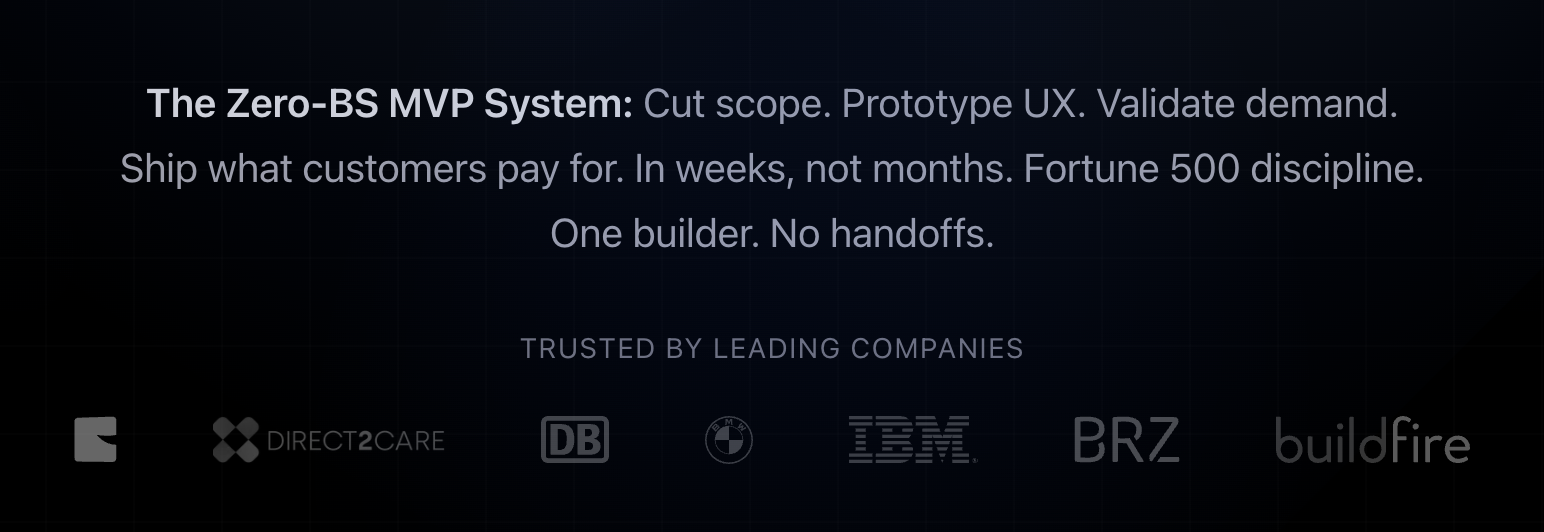
Hanad Kubat builds production-ready MVPs for non-technical SaaS founders in 4 to 12 weeks using React, Next.js, Node.js, and React Native. You work directly with the engineer writing your code, no project managers, no hand-offs, no fluff. The process is transparent, the pricing is fixed, and you own everything from day one. If you want your MVP built right the first time, this is where to start.
Frequently asked questions
Can I launch a SaaS MVP without a technical co-founder?
Yes. Non-technical founders can use no/low-code tools or fixed-price agencies to launch an MVP fast without giving up equity. You don’t need a co-founder to ship.
What features are essential in a SaaS MVP?
Focus on authentication, your core user workflow, and basic billing. In Europe, GDPR compliance is also non-negotiable from launch day.
How much does it cost to build a SaaS MVP?
Typical production-ready MVPs cost $4,000 to $15,000 via trusted agency MVP sprints, often delivered in 2 to 4 weeks with full code ownership included.
What’s the difference between an MVP and a prototype?
An MVP is functional and built for real users to interact with and validate, while a prototype is a visual mockup used only to explore design or concept ideas.