

Most non-technical founders assume their MVP failed because of the wrong features, bad timing, or a crowded market. Rarely do they point to architecture. But 68% of MVPs fail after launch due to fragile architecture, poor scalability signals, and lack of observability. These are invisible problems until they explode. This guide breaks down what architecture actually means for your SaaS MVP, why it matters more than most founders realize, and what you can do about it before you write a single line of code or hire your first developer.
Table of Contents
- What is MVP architecture and why does it matter?
- The cost of ignoring architecture: Technical debt and delayed growth
- How much is enough? The art of Minimum Viable Architecture (MVA)
- Architect for growth: Observability, scalability, and adaptability in MVPs
- Practical steps for non-technical founders: Collaborating on MVP architecture
- Get expert help for your MVP architecture
- Frequently asked questions
Key Takeaways
| Point | Details |
|---|---|
| MVP failure risk | Most MVPs fail post-launch due to overlooked architectural issues, not just missing features. |
| Avoid technical debt | Attending to MVP architecture early prevents wasted budget and stressful delays later. |
| Just enough architecture | Aim for ‘minimum viable architecture’ that supports learning and growth, but nothing extra. |
| Plan for scaling | Set up basic observability and adaptability early to ensure your MVP can evolve with users. |
| Collaboration is key | Non-technical founders should engage tech partners early to align architecture and business goals. |
What is MVP architecture and why does it matter?
Architecture is not a fancy word for code. Think of it as the blueprint of your product. It defines how the different pieces of your software connect, communicate, and hold up under pressure. For an MVP, that means deciding how your database talks to your backend, how your backend serves your frontend, and how the whole system behaves when ten users become ten thousand.
The most common mistake founders make is treating MVP as a synonym for “throw it together fast.” That mindset is expensive. Architecture ensures technical viability alongside product-market validation, and skipping it creates technical debt that compounds fast. Technical debt is the hidden cost you pay later for shortcuts taken now.
Here is why architecture matters from day one:
- It determines whether your product can handle real user load
- It controls how fast your team can add or change features
- It shapes whether investors see a scalable business or a fragile prototype
- It directly affects how well you can validate startup ideas with real data
“The structure of your MVP is not a technical detail. It is a business decision that will either accelerate or kill your growth.”
The reasons MVPs fail are rarely about missing features. They are almost always about structural weaknesses that were baked in from the start.
The cost of ignoring architecture: Technical debt and delayed growth
Technical debt is like a credit card for your codebase. You borrow speed now by cutting corners, and you pay it back later with interest. The longer you wait, the more it costs. For SaaS startups, this is not a theoretical risk. It is a budget killer.
Poor MVP architecture wastes 20 to 40 percent of your development budget on rework, patches, and workarounds. That is money that should be going toward new features, marketing, or hiring.
Here is what technical debt looks like in practice:
- Your developer says “we need to refactor before we can add that feature”
- A simple bug fix takes three weeks because the code is tangled
- Onboarding a new developer takes months instead of days
- You hit a scaling wall right when growth starts picking up
- You end up doing a full rewrite, which can delay your roadmap by 9 to 18 months
| Impact area | Short-term cost | Long-term cost |
|---|---|---|
| Development speed | Slower feature delivery | Full rewrites required |
| Budget | 20-40% wasted on rework | Entire rebuild investment |
| Team morale | Frustration and burnout | High developer turnover |
| Investor confidence | Missed milestones | Loss of funding opportunities |
| User experience | Bugs and downtime | Churn and reputation damage |
“Architecture decisions are business choices. Poor ones lead to rewrites that cost founders 9 to 18 months of delay.”
The MVP launch benefits you are chasing, speed, learning, and traction, disappear fast when your foundation is cracked.

Pro Tip: You do not need a perfect architecture on day one. You need one that is honest about its limits and designed to evolve. Spending an extra week on structural decisions upfront can save you six months of pain later.
How much is enough? The art of Minimum Viable Architecture (MVA)
Minimum Viable Architecture, or MVA, is the sweet spot between overbuilding and underbuilding. It means designing just enough structure to support your first real users, absorb feedback, and allow for pivots without a full teardown. MVA validates tech feasibility without the overhead of enterprise-grade engineering.
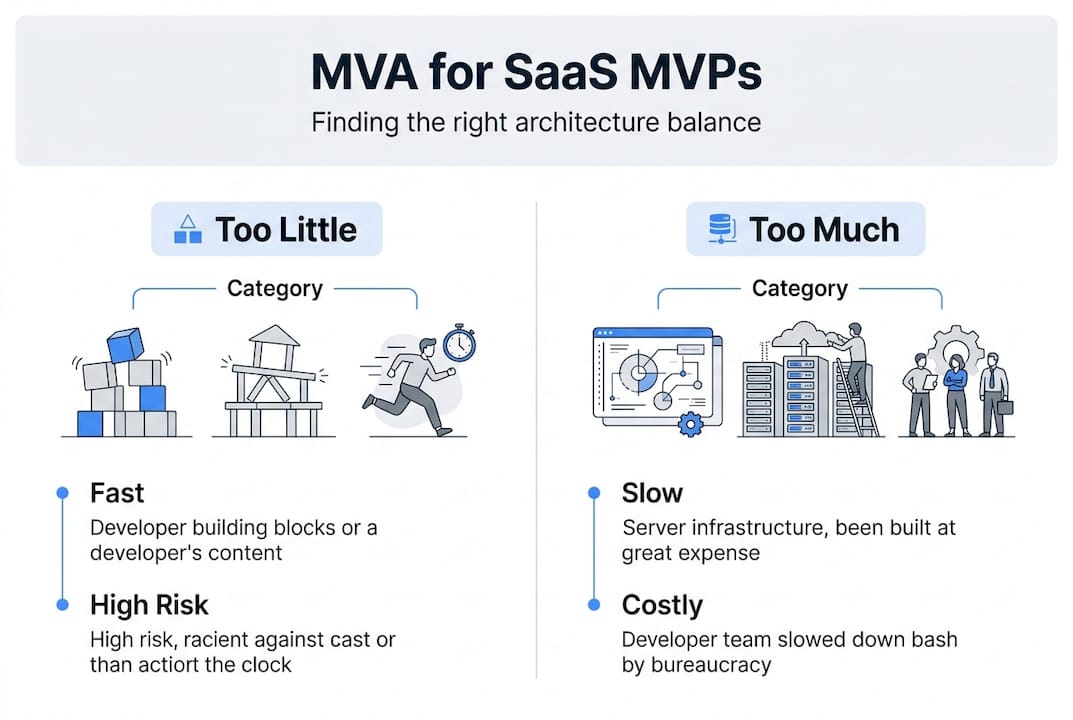
Here is how the three approaches compare:
| Approach | Build time | Scalability | Pivot flexibility | Risk |
|---|---|---|---|---|
| Underbuilt | Very fast | Very low | Very low | High rework |
| MVA | Fast | Moderate | High | Balanced |
| Overengineered | Very slow | Very high | Low | Wasted budget |
Most founders think they are building an MVA but are actually overengineering. They add features “just in case” or build for a scale they will not hit for two years. That is a trap. The goal is to ship, learn, and adjust, not to build the final product on the first try.
Ask yourself these questions to check if you have hit MVA:
- Can your system handle your first 500 users without breaking?
- Can your developer add a new feature without touching five other systems?
- Do you have basic logging so you know when something goes wrong?
- Is your data model flexible enough to change if your core assumption is wrong?
- Are you building for the users you have, not the users you hope to have in three years?
Getting UX and MVP balance right is part of this same discipline. Every layer of your product, from interface to infrastructure, should serve your current validation goals, nothing more.
Pro Tip: If your developer cannot explain why a specific architectural choice is needed for your current stage, push back. Complexity should always be justified by a real, present business need.
Using agile MVP practices alongside MVA thinking helps you stay lean and responsive. And if you want to move fast without cutting dangerous corners, the principles behind a fast MVP launch are built on exactly this kind of disciplined simplicity.
Architect for growth: Observability, scalability, and adaptability in MVPs
Three words come up constantly in architecture conversations: observability, scalability, and adaptability. Here is what they actually mean for your business.
Observability means you can see what is happening inside your product. When something breaks, you know where and why. Without it, you are flying blind. You find out about problems from angry users, not from your own monitoring.
Scalability means your system can handle more users without falling over. It does not mean you need to handle a million users on day one. It means the path to growth is not blocked by your own infrastructure.
Adaptability means you can change direction without starting over. Your early assumptions will be wrong. The architecture should make it cheap to be wrong.
Architecture that ensures technical viability from the start is what separates MVPs that attract follow-on investment from those that stall out after the first cohort of users.
Here are the signals that tell you your MVP has these traits:
- You get alerts before users report bugs
- Adding a new user type does not require rewriting your database
- Your developer can deploy a fix in hours, not days
- You can run experiments on specific features without breaking others
- Your system slows down gracefully under load instead of crashing
Use a founder tech checklist to make sure these signals are built into your product from the start. And when you are ready to test your assumptions with real users, an MVP validation checklist will help you measure what actually matters.
Practical steps for non-technical founders: Collaborating on MVP architecture
You do not need to understand every technical decision. But you do need to ask the right questions and make sure every architectural choice connects back to a business goal. Here is how to do that.
- Start with constraints, not features. Tell your technical partner what you need to learn from your MVP, not just what you want to build. Architecture should serve your validation goals.
- Ask for a plain-language explanation. If your developer cannot explain an architectural decision in two sentences without jargon, that is a red flag. Complexity should always be justified.
- Request a simple system diagram. You do not need to read code. A basic diagram showing how the pieces connect gives you enough context to ask smart questions.
- Tie every major decision to risk. Ask: “What happens if this breaks?” and “How hard is it to change this later?” These two questions surface the most important trade-offs.
- Set a review checkpoint. Before you build, agree on a moment to revisit architectural decisions once you have real user feedback. Architecture should evolve with your product.
Architecture decisions are business choices, and poor ones lead to rewrites that cost 9 to 18 months of delay. That is not a technical problem. That is a founder problem.
If you are working with an external team, the custom app development guide for startup founders walks through how to structure that relationship so you stay in control of the decisions that matter.
Pro Tip: Every time your developer proposes a new tool, framework, or system, ask one question: “Does this serve our users right now, or does it serve a future version of the product we have not built yet?” That single question kills a lot of unnecessary complexity.
Get expert help for your MVP architecture
Knowing what questions to ask is a huge step. But finding someone who will give you straight answers and build the right thing the first time is a different challenge entirely.
At hanadkubat.com, the entire model is built around this problem. No agency overhead, no project manager playing telephone, no junior developer learning on your budget. You work directly with a senior engineer who has shipped MVPs for real businesses and built his own SaaS products using the same stack he recommends to you. If you want to understand what it actually takes to build an MVP fast without creating a structural mess, that is exactly the kind of work that happens here. Architecture is not an afterthought. It is where the work starts.
Frequently asked questions
What happens if I skip thinking about architecture in my MVP?
Skipping architecture almost always leads to expensive rework or complete failure. 68% of MVPs fail after launch due to exactly these kinds of structural oversights.
How much should I invest in MVP architecture?
Focus on minimum viable architecture, enough to support early users and absorb feedback without overbuilding. MVA validates tech feasibility without the cost of enterprise-level engineering.
What technical terms should I understand as a non-technical founder?
The four terms that matter most are architecture, technical debt, scalability, and observability. Architecture ensures technical viability and your tech lead should be able to explain each one in plain language.
Can I fix architecture later if my MVP gets traction?
You can, but it is costly and disruptive. Poor architecture decisions lead to rewrites that delay your roadmap by 9 to 18 months, right when momentum matters most.