

TL;DR:
- Direct founder-developer communication accelerates MVP development by reducing misunderstandings and iteration time.
- Relying on agencies can cause delays, scope creep, and loss of product ownership during early testing.
- Structured regular dialogue and shared goals enhance product alignment, speed, and long-term cost savings.
Most non-technical founders assume hiring an agency is the fastest, safest route to launching an MVP. It feels logical: they have a team, processes, and experience. But that assumption is costing founders time, money, and product control at the exact moment those things matter most. The reality is that the communication layers inside agency workflows create invisible drag on your product, and by the time you notice the problem, you’ve already burned weeks and budget. This guide breaks down why direct founder communication is not just a nice-to-have, but the actual engine behind faster, sharper MVP launches.
Table of Contents
- Common misconceptions about building your MVP
- The real benefits of direct founder-to-developer communication
- Direct vs. agency: A clear comparison for MVP-stage startups
- How to structure direct communication for rapid MVP launches
- Why the conventional wisdom about speed is misleading for startups
- Take your MVP further with hands-on founder guidance
- Frequently asked questions
Key Takeaways
| Point | Details |
|---|---|
| Vision control | Direct founder communication helps you fully own and shape your MVP’s core vision. |
| Long-term efficiency | Initial agency speed often leads to costly rework, while direct engagement prevents misunderstanding. |
| Startup risk reduction | Founders avoid scams and costly misalignment by working directly with technical collaborators. |
| Actionable frameworks | Founders can use structured check-ins and clear documentation for rapid, low-friction launches. |
Common misconceptions about building your MVP
Now that we’ve set the stage, let’s break down the most common misconceptions founders encounter during MVP development.
The number one myth is that agencies are inherently faster. They have more people, so they must move faster, right? Not quite. What agencies have is more process. Project managers, account managers, handoff meetings, scope documentation, revision cycles. Each layer of that process is a potential delay. And when you’re pre-product-market fit (pre-PMF), every delay is a competitive risk.
Here’s what actually happens. You write a brief. The account manager interprets it. The project manager turns it into tickets. The developer reads those tickets. By the time someone writes the first line of code, your vision has passed through three filters. Each filter introduces distortion. The feature you imagined and the feature that gets built are rarely the same thing.
A commonly discussed pattern among YC founders, particularly in discussions about why technical founders matter, is that agencies may appear faster initially, but direct approaches ensure the founder actually owns the product vision. Indirect approaches also carry genuine scam risk, especially in offshore agency markets where pre-PMF founders are easy targets.
Let’s look at the other big misconceptions:
- “I need an agency because I’m not technical.” Being non-technical doesn’t mean you can’t lead product decisions. It means you need a technical partner who translates your business thinking into code, not one who hides behind jargon.
- “Agencies are accountable.” Agencies are accountable to contracts, not outcomes. Your success is not their success.
- “Outsourcing is cheaper.” The initial quote often is lower. But scope creep, revision rounds, and rework from miscommunication inflate costs fast.
- “An MVP doesn’t need that much vision.” This one is dangerous. A weak vision going into an MVP produces a product nobody wants. The MVP exists to test your thesis, and if that thesis is blurry, your test is worthless.
As one principle from the best practices for non-technical founders makes clear: the founder’s role is never just to write checks. It’s to stay in the driver’s seat on product decisions, especially before you know what the market actually wants.
“The biggest risk for pre-PMF founders isn’t building too slowly. It’s building the wrong thing confidently.”
Long-term costs of indirect development tend to rise because every misalignment compounds. A wrong assumption in week one becomes a wrongly built feature in week three and a required rebuild in week six. That’s the real math agencies don’t show you in their proposals.
The real benefits of direct founder-to-developer communication
Having explored the misconceptions, we can now look at what direct communication really delivers for founders.
Direct communication between a founder and a developer isn’t just about cutting out middlemen. It’s about creating a shared mental model of the product. When you’re talking to the person actually building your product, something different happens: feedback loops shrink, misunderstandings surface immediately, and your vision stays intact through iteration.
Here’s what that looks like in practice. You have an idea for how a user should onboard. Instead of writing a document that goes through three layers of interpretation, you describe it directly to your technical partner. They push back: “That’s going to take two weeks and complicate the data model. What if we do it this way instead?” You discuss it, decide in ten minutes, and move. That conversation would have taken a week through an agency workflow.

The core benefits stack up fast:
| Benefit | Direct communication | Agency workflow |
|---|---|---|
| Feedback loop speed | Hours | Days to weeks |
| Vision accuracy | High | Degraded per layer |
| Pivot flexibility | Immediate | Requires rescoping |
| Cost transparency | Clear | Often hidden |
| Accountability | Personal | Contractual |
| Scam/fraud risk | Very low | Higher, especially offshore |
As the YC founder community regularly notes, direct founder collaboration avoids scam risks and ensures the founder owns the product vision throughout the build. That ownership is not a soft benefit. It’s what makes your MVP testable and your learning real.
Founders who apply direct communication tips into their daily workflow report tighter iteration cycles and fewer moments of “that’s not what I meant.” The practical impact is faster shipping, and shipping faster is the only meaningful metric at the pre-PMF stage.
The founder-developer alignment guide framework reinforces this. When founders and developers share the same goals, speak openly about trade-offs, and trust each other enough to disagree, products get better. Not just faster. Better.
Pro Tip: Schedule a brief 15-minute “vision check” with your technical partner at the start of every sprint. Ask one question: “Does what we’re building this week serve the hypothesis we’re testing?” If the answer is unclear, stop and clarify before a single line of code gets written.
Iteration speed is everything at the MVP stage. But iteration only creates value if you’re iterating on the right thing. Direct communication is how you stay aligned on what the right thing actually is.
Direct vs. agency: A clear comparison for MVP-stage startups
To make the case fully clear, let’s look directly at how agency and direct founder communication models stack up in a side-by-side comparison.
This isn’t about whether agencies are bad. Some agencies do excellent work. The question is whether the agency model fits the pre-PMF startup context, where learning speed, product ownership, and budget discipline are non-negotiable.
| Factor | Direct founder communication | Agency model |
|---|---|---|
| Initial speed | Moderate | Fast (established processes) |
| Long-term cost | Lower (less rework) | Higher (scope creep, revisions) |
| Vision control | Strong | Diluted through handoffs |
| Flexibility | High | Low (change orders, rescoping) |
| Communication overhead | Minimal | Significant |
| Risk of misalignment | Low | High |
| Accountability | Direct, personal | Contractual |
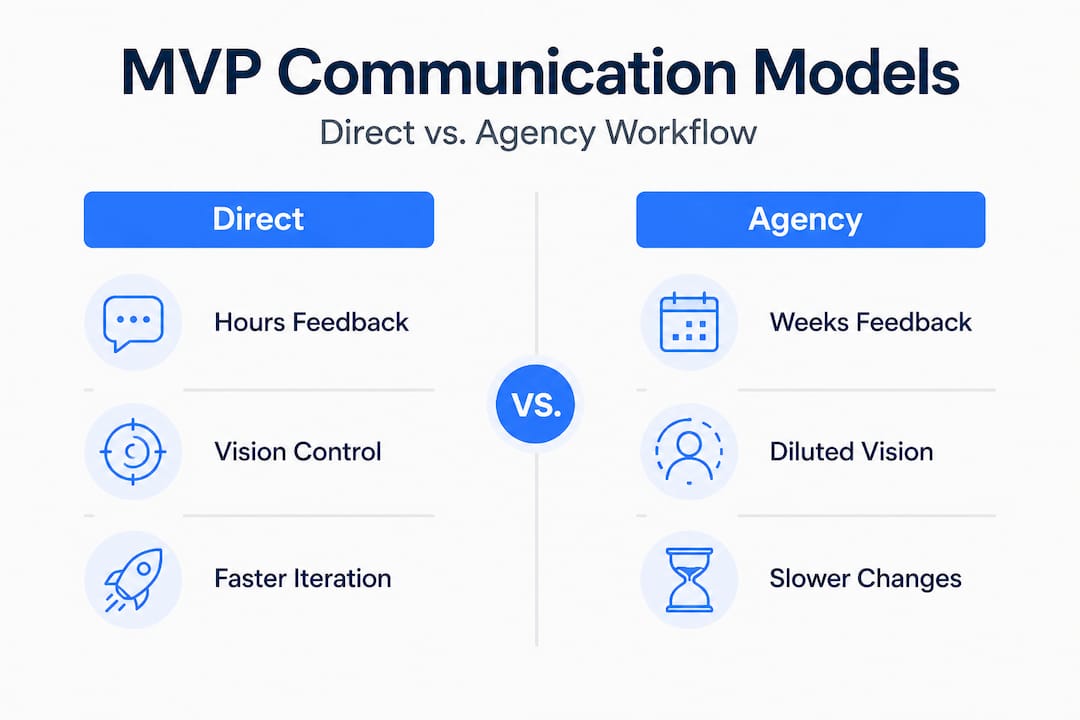
The data is clear: as noted in YC discussions, in-house or direct approaches may cost 2-3x more over the long run when compared to the sticker price of agencies, but they pay back in reduced rework, faster learning, and a product that actually reflects what the founder intended.
Now, agencies are faster initially because they have templates, existing codebases, and repeatable processes. But that speed is calibrated for building known things. MVPs aren’t known things. They’re experiments. And running an experiment through someone else’s rigid process is how you get an answer to a question you didn’t actually ask.
Here’s a step-by-step process for evaluating which path fits your stage:
- Define your decision criteria. What matters most right now: speed to first user, budget control, or vision fidelity? Rank them honestly.
- Map your communication needs. How quickly do you need to change direction? If your pivot cycles are short, direct communication is essential.
- Assess your technical literacy. You don’t need to know how to code. But can you articulate your product in functional terms? If yes, direct collaboration is accessible to you.
- Evaluate the vendor’s model. Does the agency give you direct access to the developer? Or do you go through an account manager? The answer tells you almost everything.
- Calculate real cost, not quote cost. Add up the price of scope change requests, revision rounds, and the cost of your time spent on briefings. That’s your real number.
- Check for product-market fit stage. Pre-PMF? Direct wins. Post-PMF with clear, documented specs? Agencies become more viable.
The principle from lean product development strategies applies here: minimize waste, test fast, and don’t add process where clarity would do the same job. Agencies add process. Direct communication adds clarity.
How to structure direct communication for rapid MVP launches
Once you recognize the value of direct communication, here’s how to structure it for best results.
Recognizing that direct communication is better is the easy part. Actually doing it well is where most founders stumble. Many non-technical founders are nervous about talking to developers. They’re afraid of sounding uninformed or wasting time with questions. That fear leads to under-communication, which ironically produces the same problems as having too many layers.
The fix is structure. Not bureaucratic structure, but a lightweight rhythm that creates momentum without overhead.
Here are the core elements of effective direct communication with your technical partner:
- Weekly video calls, not just Slack messages. Text strips out tone and context. A 30-minute video call at the start of each week aligns priorities, surfaces blockers, and builds the trust needed for honest technical dialogue.
- A shared product doc, not a deck. A living document that captures current goals, active assumptions, and what you’re testing this sprint. Both you and your developer update it. It becomes the single source of truth.
- Explicit decisions log. Every time you decide something together, write it down with a date. “We decided to remove social login because it’s not core to the first test.” This prevents revisiting settled questions and keeps momentum.
- A simple weekly demo. At the end of each sprint, the developer shows you what was built. Not a written report. A working demo. This forces shared understanding and catches drift early.
- Asynchronous updates for small things. Not everything needs a meeting. Routine updates, code deployment notes, and minor decisions can live in a project tool or shared doc. Save the real-time conversations for decisions that require judgment.
The risk of skipping this structure is exactly what direct founder-led projects aim to avoid: losing the product vision to ambiguity and assumption. Structure doesn’t slow down direct communication. It amplifies it.
For a practical framework that maps this across your full product lifecycle, the SaaS product strategy guide is worth working through. And for the execution mechanics week by week, the MVP launch steps lay out how to keep delivery on track without micromanaging your technical partner.
Pro Tip: Create a one-page “product north star” document before your first sprint. Write down: the one problem you’re solving, the one user you’re solving it for, and the one metric that will tell you if the MVP works. Share it with your developer. Revisit it before every major decision. Everything that doesn’t serve that document is scope creep.
Tech literacy matters here, but not in the way most founders think. You don’t need to understand React or database architecture. You do need to understand trade-offs. “If we build it this way, we can ship in two weeks but it’ll be harder to change later. If we do it this way, it takes three weeks but we can pivot faster.” That’s a business decision wrapped in technical language. Direct communication gives you access to those conversations before they become expensive mistakes.
Why the conventional wisdom about speed is misleading for startups
There’s a popular narrative in startup culture: the fastest team to ship wins. Get to market, get feedback, iterate. Speed above all else. And on the surface, that’s reasonable advice. Markets move. Momentum matters. Waiting for perfect is how you miss the window.
But here’s where the conventional wisdom breaks down. The advice to “go fast” is almost always interpreted as “skip the alignment.” Founders rush into builds without locking down their core hypothesis. Developers start writing code before the product question is fully clear. The MVP ships fast. And then nothing. The feedback is murky because the product was unfocused. The “speed” produced a fast answer to the wrong question.
I’ve seen this pattern play out repeatedly. A founder hires an agency, sets a six-week timeline, and the agency delivers on time. But what’s delivered doesn’t match the mental model the founder had. Revision rounds begin. Another four weeks. The “fast” build is now ten weeks in, over budget, and still not ready to test. The agency was never slow. The process was.
The military phrase “slow is smooth, smooth is fast” captures what actually works. When founders invest time in real alignment before and during the build, the build moves without friction. There’s no rework. No reinterpretation. No “that’s not what I meant.” As the broader YC founder conversation confirms, for pre-PMF founders, avoiding scam risk and owning the product vision are more valuable than early speed gains that come with misalignment risk.
The founders I’ve worked with who move fastest are not the ones who skip conversations. They’re the ones who have the right conversations early. They know exactly what they’re building and why. Their technical partner knows it too. That shared clarity is what removes friction from execution.
The takeaway isn’t to go slow. It’s to be deliberate early so you can move without hesitation later. That’s the real speed advantage of direct communication, and it’s why founders who work directly with technical partners for startups consistently outperform those who route through agency layers at the critical pre-PMF stage.
Take your MVP further with hands-on founder guidance
If you’re ready to move beyond theory and put direct communication principles into practice, here’s where to start.
Everything covered in this article points to one conclusion: the quality of your working relationship with your technical partner is a product decision. It determines how fast you learn, how accurately your MVP reflects your vision, and how quickly you can pivot when the market gives you feedback.
At hanadkubat.com, that principle is the entire model. There’s no agency layer, no project manager between you and the code, and no version of your vision that’s been filtered through three people’s interpretations. You work directly with a senior engineer who has shipped products at BMW, Deutsche Bahn, and IBM, and who has built his own SaaS products using the exact frameworks described here. MVPs ship in 4 to 12 weeks, starting at €15K, with zero equity required. If your MVP is stalled, misaligned, or just not moving fast enough, that’s exactly the kind of situation this work is built for.
Frequently asked questions
Are agencies ever better than direct founder communication for MVPs?
Agencies can be faster at the start, but direct founder communication typically leads to stronger vision alignment and lower risk for pre-product-market fit startups. As noted in YC discussions, agencies are faster initially but direct collaboration ensures founders own the product vision.
Does direct founder communication cost more?
Direct collaboration can appear more expensive upfront, but it significantly reduces rework, scope creep, and the cost of misalignment. Research from the YC founder community shows in-house and direct approaches may cost 2-3x more long-term than sticker agency prices, though the real-world cost picture often favors direct when rework is factored in.
What’s the main risk of not communicating directly with developers?
Indirect communication increases the likelihood of costly misunderstandings, misbuilt features, and loss of product vision control. The YC community consensus is clear: direct communication specifically avoids scam risks and ensures the founder retains ownership of what gets built.
How can a non-technical founder learn to communicate effectively with tech partners?
Start with structured weekly video calls, a shared living product document, and a simple weekly demo from your developer. You don’t need to learn to code. You need to learn how to articulate trade-offs, clarify your product hypothesis, and build enough trust with your technical partner to have honest disagreements before problems become expensive.
Recommended
- Founder communication tips to accelerate MVP success | HK
- Why startups need MVP to validate ideas and launch fast | HK
- Why rapid MVP deployment accelerates SaaS startup success | HK
- Startup MVP best practices: fast validation for non-tech founders | HK
- Remote Team Communication Tools: Driving Productivity - Projector Display