

TL;DR:
- Founder-developer misalignment is a leading cause of startup failure due to unresolved people issues.
- Building clear roles, shared vision, and testing partnership through short pilots prevents costly disagreements.
- Choosing the right technical engagement model depends on commitment level, risk, and long-term goals.
65% of high-potential startups fail because of people problems, not product problems. That number should stop every non-technical founder cold. You can have a brilliant idea, a growing waitlist, and early traction, yet still watch your MVP stall because you and your technical partner are pulling in different directions. Most founders obsess over features, funding, and market fit while quietly ignoring the one variable that determines whether any of that matters: alignment with the person building the product. This guide breaks down what alignment actually looks like, how to spot when it’s falling apart, and the practical frameworks you can use to build a partnership that ships fast and survives pressure.
Table of Contents
- Why founder-developer alignment determines startup survival
- Warning signs and root causes of early misalignment
- Comparison: Co-founder, contractor, or fractional CTO?
- Frameworks for healthy alignment: Equity, roles, and PMF clarity
- The uncomfortable truth about founder-developer alignment
- Build your MVP faster with expert technical alignment
- Frequently asked questions
Key Takeaways
| Point | Details |
|---|---|
| Misalignment kills startups | Most early-stage failures trace back to team issues, not just product or market mistakes. |
| Alignment means shared vision | Clarity in roles, values, and outcomes is essential between founders and technical partners. |
| Test before committing equity | Work together on a short-term MVP project to ensure you can collaborate successfully. |
| Choose the right partner model | Consider fractional CTOs or contractors as lower-risk options for first MVPs. |
Why founder-developer alignment determines startup survival
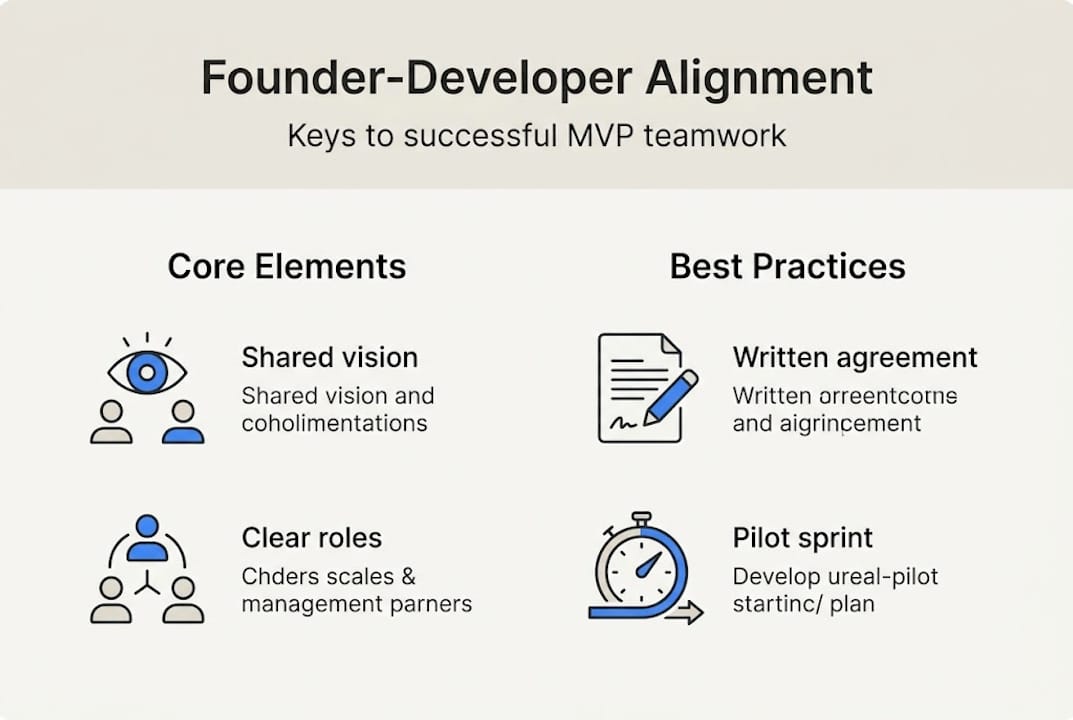
Alignment is not a buzzword. It means three specific things: a shared vision for what the product is supposed to accomplish, clearly defined roles so nobody is guessing who owns what, and mutual commitment to the same timeline and priorities. When all three exist, teams move fast. When even one breaks down, everything else slows to a crawl.
The consequences of misalignment are not subtle. Your MVP stalls while both sides argue about scope. Capital burns while the team debates architecture choices that should have been settled in week one. Founders burn out trying to manage a developer who has a completely different definition of “done.” In the worst cases, the whole company folds before a single user ever sees the product.
Here is what the data actually says:
- Co-founder breakups are among the leading causes of early startup death
- Wrong team was cited in 23% of startup failures, outranking reasons like running out of cash or losing to competitors
- More startups die from people problems than from bad timing or weak products
Think about what that means. You are more likely to fail because of who you build with than because of what you build.
“The best idea with the wrong team is a liability. The right team with an average idea is a startup that learns and pivots.”
The most overlooked shift you can make is treating your technical co-founder role as a business partnership, not a staffing decision. The best technical partners are not order-takers. They push back on bad scope, flag business risks in the architecture, and care about whether the product actually solves the problem. If your developer is only thinking about code, you are missing half the value they could bring. Understanding why founders need technical partners in this broader sense is the first mindset shift that separates founders who ship from founders who stall.
Alignment gives you speed. Misalignment costs you everything.
Warning signs and root causes of early misalignment
Most teams do not fall apart in one dramatic fight. They erode slowly. By the time it is obvious something is broken, months of runway are already gone. Catching the early signals is what separates founders who course-correct from founders who lose their co-founder at the worst possible moment.
Here are the most common warning signs, in order of how early they tend to appear:
- Uneven work distribution: One person is always the one pushing for progress. The other is always explaining why something is taking longer than expected.
- Unclear ownership: Decisions keep getting revisited because nobody agreed on who has final say over product, scope, or technical approach.
- Different definitions of success: You want to launch in six weeks. Your developer wants it to be “right.” Neither of you has defined what right means.
- Conflict avoidance: Problems get mentioned once, never resolved, and quietly turned into resentment.
- Diverging personal goals: One partner wants to build a scalable business. The other wants to stay small, stay technical, or exit quickly.
The root cause behind most of these is speed. Founders rush to lock in a developer because they are afraid of losing momentum. They skip the slow, uncomfortable conversations about values, goals, and working styles because those conversations feel like a delay. They are not. They are the investment that prevents a much larger delay later.
Unequal commitment and role ambiguity consistently produce resentment, and in many cases, a solo founder outperforms a misaligned pair because at least one person is making clear decisions.
If you want to avoid these traps, your SaaS launch guide for founders needs to include a real conversation about roles before a single line of code is written. And product development best practices for non-technical founders almost always start with that same step.
Pro Tip: Before you even discuss equity, run a short two to four week paid sprint together on a small piece of the product. Watch how your partner communicates under pressure, handles scope changes, and responds when you push back. That data is worth more than any interview or reference call. The founder matching insights from studying hundreds of partnerships confirm that working history is the most reliable predictor of long-term fit.
Comparison: Co-founder, contractor, or fractional CTO?
Once you know what you are looking for, you need to choose the right model for engaging a technical partner. These three options have very different risk profiles for alignment.
| Model | Alignment risk | Commitment level | Equity exposure | Best for |
|---|---|---|---|---|
| Developer co-founder | Highest | Full-time | High (35-50%) | Long-term, aligned vision |
| Contractor or agency | Low to medium | Project-based | None | Defined scope, early MVP |
| Fractional CTO | Medium | Part-time | Low or none | Testing fit, pre-seed stage |
A developer co-founder gives you maximum upside. They are invested in the outcome, they think about the business, and they can grow into a long-term technical leader. But the personal relationship risk is the highest. If values or goals drift, unwinding that partnership is expensive and painful.

A contractor or agency is safer in the short term. You define the scope, you pay for the output, and you do not have a shared cap table to argue about. The risk is limited commitment. Contractors are not thinking about your retention metrics or your next funding round. They are thinking about the next invoice.
A fractional CTO as a bridge gives you senior technical leadership without locking in equity before you have proven anything. You get real strategic input, genuine skin in the success of the product, and the flexibility to part ways without a legal nightmare if it is not working.
Before you choose, ask yourself these questions:
- Do I need someone building full-time or advising part-time?
- Am I ready to share equity, or do I want to validate the model first?
- How well do I actually know this person’s working style?
Checking your founder tech checklist before committing to any model will help you avoid locking in a structure that does not match where your startup actually is. And reviewing alignment strategies in tech teams reinforces that the model matters less than the clarity you bring to it.
Pro Tip: Do not let enthusiasm rush this decision. The structure you choose in week one tends to stick long after it stops making sense.
Frameworks for healthy alignment: Equity, roles, and PMF clarity
Choosing the right model is only step one. The real work is building structure that keeps alignment alive as the startup evolves.
Scope roles by outcomes, not tasks. Instead of telling your technical partner to “build the dashboard,” define what the dashboard must accomplish: users can track their activity in under 10 seconds, the page loads in under two seconds, and the design matches the approved mockup. Outcome-scoped roles reduce second-guessing and give both sides a clear definition of done.
Structure equity around contribution and time, not enthusiasm. Here is what the data shows:
| Stage of hire | Suggested equity range | Notes |
|---|---|---|
| Founding technical co-founder | 35-50% | Full commitment from day one |
| Early hire (pre-seed) | 10-20% | Joining after concept is proven |
| Fractional or part-time | 0.5-5% | Limited scope, advisory role |
Equity benchmarks consistently show that 50/50 splits cause the most long-term conflict when contributions are not actually equal. Always pair equity with a four-year vesting schedule and a one-year cliff. This protects both sides.
For product-market fit alignment, run a simple exercise before writing a single line of code:
- Write down the core pain your product solves in one sentence
- Define your ideal customer in specific terms, not “small businesses”
- State your value proposition: why your solution and not the obvious alternative
- Have your technical partner write their own version independently
- Compare. Where you diverge is where misalignment will surface under pressure
PMF alignment assessment tools exist precisely because founders assume they are aligned when they have actually never tested that assumption. The founder-first development process and startup MVP validation best practices both start with this same clarity exercise because it reveals gaps before they become crises.
Pro Tip: Run a four to eight week paid pilot before finalizing any equity agreement. Get everything in writing, including what happens if the pilot does not work out. A written agreement is not a sign of distrust. It is a sign of professionalism.
The uncomfortable truth about founder-developer alignment
Here is what most alignment guides will not tell you: real alignment is not built in a kickoff meeting. It is built in the first serious disagreement you have with your technical partner and how you both handle it.
I have seen founders with beautifully crafted partnership decks fall apart at the first scope change. I have seen scrappy teams with no formal structure ship incredible products because they knew how to argue productively and respect each other’s judgment. The difference is not process. It is character.
Misunderstandings will happen. Technical decisions will get made that you do not understand. Business decisions will get made that your developer does not agree with. What matters is whether your communication structure can handle that friction without it becoming personal.
And sometimes, walking away is the right call. Going solo is not a failure. It is often the faster, cleaner path to validation. Rapid MVPs do not require giving away large equity before you have proven there is a real market. A healthier engineering culture starts with honest conversations early, not with a partnership you are too afraid to exit.
Do not confuse agreement with alignment. They are not the same thing.
Build your MVP faster with expert technical alignment
If any of this resonates, you already know the risk you are trying to avoid. Misalignment is expensive, slow, and sometimes fatal for early startups. The good news is that it is also largely preventable when you have the right structure and the right partner from day one.
At hanadkubat.com, I work directly with non-technical founders who are done with theory and ready to ship. No agency overhead, no project manager in the middle, no equity required. If you want to skip the misalignment risk and find a skilled mobile developer or full-stack technical partner who has already built and validated SaaS products, the fastest next step is a direct conversation. Book a discovery call and let’s figure out whether working together is the right fit.
Frequently asked questions
How early should I bring in a technical partner for my startup?
Ideally, involve a technical partner before you start building your MVP so that vision, roles, and expectations are established from day one. Technical partners who join early function as business strategists, not just builders.
Is giving equity to a developer always required for MVP success?
No. A contractor or fractional CTO can get your MVP to market without equity, and equity should only reflect genuine long-term contribution and commitment, not urgency.
What’s the fastest way to test alignment before offering equity?
Run a short paid pilot project with your prospective partner to see how your working styles and goals hold up under real conditions. Working history is the most reliable indicator of long-term fit.
How do I fairly split equity with a technical co-founder?
Benchmarks suggest 35-50% for a founding technical partner who joins from day one. Avoid 50/50 splits when contributions are unequal, and always use a four-year vesting schedule with a one-year cliff.