

TL;DR:
- Effective startup product strategy involves quick iteration, customer discovery, and focusing on core value.
- Non-technical founders can launch MVPs using no-code tools and emphasize product-led growth.
- Bootstrapping offers control and sustainability, while VC funding accelerates but dilutes equity.
Most European non-technical founders assume product strategy belongs to big companies with product managers, roadmaps, and quarterly planning cycles. That assumption kills startups before they ship a single line of code. The truth is that modern SaaS success is built on a handful of simple, repeatable moves that anyone can learn and execute. This guide breaks down what startup product strategy actually means, which metrics you should track, how to choose the right funding path, and what most founders get wrong before they ever talk to a real customer.
Table of Contents
- What is startup product strategy?
- Core pillars: Customer discovery, MVP, and PLG
- Metrics that matter: Benchmarks and tracking
- Bootstrapping vs. VC: Strategies and trade-offs
- What most founders get wrong and how to fix it
- Next steps: Launch your SaaS strategy with expert support
- Frequently asked questions
Key Takeaways
| Point | Details |
|---|---|
| Start with user needs | Customer discovery and rapid feedback are essential for SaaS product strategy success. |
| Build fast, iterate early | A quick MVP launch and learning from real users beat over-planning every time. |
| Track key metrics | Monitor NDR, logo churn, LTV:CAC, and CAC payback to measure and guide growth. |
| Choose funding wisely | Bootstrapping vs. VC each have trade-offs; match your strategy to your goals. |
| Embrace PLG | Product-led growth drives higher conversions and user engagement, especially for SaaS. |
What is startup product strategy?
Product strategy is not a 40-page document. It is not a Gantt chart. It is the set of decisions that connect what you build to what your users need and what your business requires to survive. For a SaaS founder, that means choosing which problem to solve, for whom, and how fast you can learn whether your solution works.
The biggest misconception is that strategy is something you do before you build. In reality, strategy and execution happen at the same time. You make a bet, ship something small, watch what users do, and adjust. That loop is your strategy.
Here is what startup product strategy actually covers:
- Problem definition: Who has the pain, how often, and how much do they pay to solve it today?
- Solution scope: What is the smallest version of your product that proves the core value?
- Growth model: How do users find you, activate, and pay?
- Learning cadence: How fast can you run experiments and act on results?
- Resource allocation: Where do you spend your limited time and money first?
Y Combinator, the most influential startup accelerator in the world, has a simple answer to what product strategy looks like in practice. Their methodology centers on building what users want, collecting quick feedback, iterating fast, and doing things that do not scale up front. That last part matters. Early-stage founders often try to build systems that work for 100,000 users before they have 100. That is a strategy mistake.
“Do things that don’t scale. Talk to users. Build what they want.” — Y Combinator
For non-technical founders, this is actually good news. You do not need to understand code to make product decisions. You need to understand your customer. Check out the fast MVP launch steps to see how this plays out in a real build sequence.
Strategy is not about being smart. It is about being honest with yourself about what you know, what you do not know, and how fast you can close that gap.
Core pillars: Customer discovery, MVP, and PLG
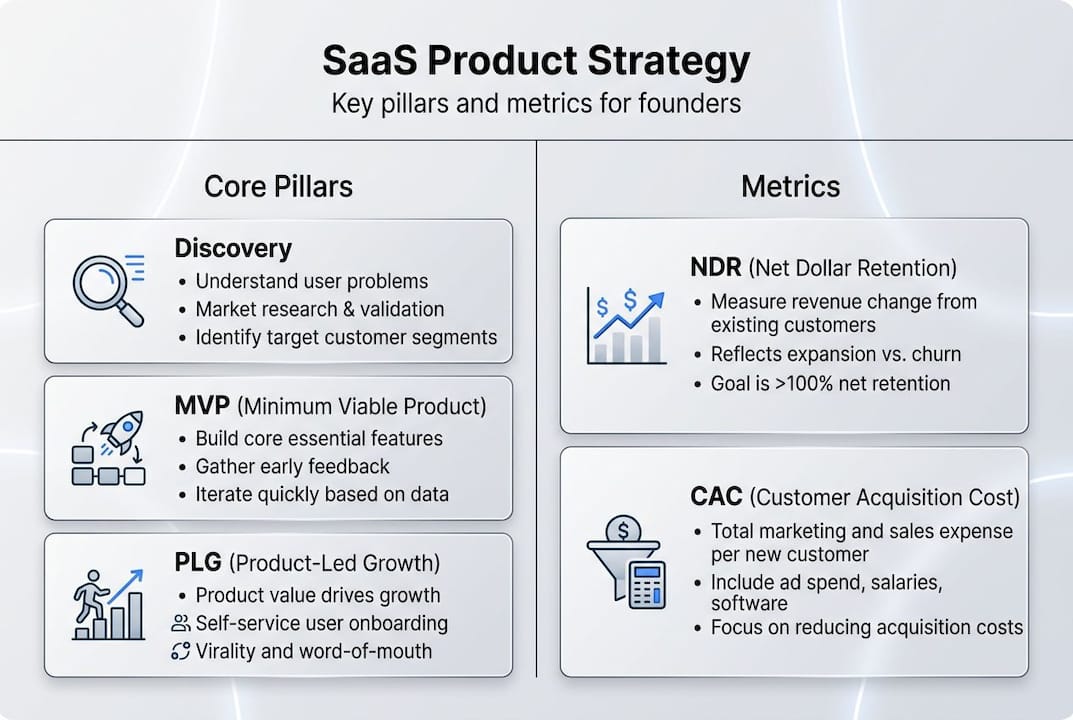
Every successful SaaS launch rests on three building blocks. Skip any one of them and you are guessing.
1. Customer discovery
Before you build anything, talk to real people. Not your friends. Not your co-founders. Actual potential users who have the problem you think you are solving. The recommended minimum is 20 or more discovery calls before you write a single spec. These conversations reveal whether your assumptions are right, which features matter most, and what language customers use to describe their pain. That language becomes your marketing copy.
2. Minimum Viable Product (MVP)
An MVP is not a half-built product. It is a focused product that delivers one core value so well that users pay for it or recommend it. The goal is 90% of the value with 10% of the effort. If you are non-technical, you can launch an MVP without coding using tools like Webflow, Bubble, or Glide. The point is to get something real in front of users as fast as possible.

3. Product-Led Growth (PLG)
PLG means your product does the selling. Users sign up, experience value, and convert to paying customers without a sales call. Freemium tiers, free trials, and frictionless onboarding are the engine. PLG works especially well in Europe, where buyers are skeptical of aggressive sales tactics and prefer to evaluate tools on their own terms.
Here is a simple sequence to follow:
- Run 20 or more customer discovery calls and document the patterns.
- Build the smallest version of your product that solves the top-ranked pain.
- Design your onboarding so users hit the “aha moment” within the first session.
- Add a freemium or trial tier that removes the barrier to trying.
- Track activation, not just signups.
Pro Tip: Your onboarding flow is your most important product feature. If users do not reach value in the first five minutes, they churn before they ever see your best functionality. Study the lean MVP fast-tracking approach to keep scope tight while maximizing that first-session impact.
Metrics that matter: Benchmarks and tracking
Once your MVP is live and your PLG engine is running, you need numbers to tell you whether it is working. Four metrics matter most in the early stage.
| Metric | What it measures | Year 1 benchmark |
|---|---|---|
| NDR (Net Dollar Retention) | Revenue growth from existing customers | 85 to 105% |
| Logo churn | Percentage of customers who cancel | Under 5% |
| LTV:CAC ratio | Lifetime value vs. cost to acquire | 3:1 or higher |
| CAC payback period | Months to recover acquisition cost | 12 to 18 months |
These Year 1 SaaS benchmarks are not aspirational targets. They are the floor for a business that can sustain itself. If your logo churn is above 5% in year one, you have a product problem, not a marketing problem.
For European bootstrapped founders, the CAC payback window is especially important. Venture-backed competitors can afford 24 or 36 month payback periods because they have runway. You probably do not. Keep payback under 18 months or your cash flow will strangle growth before it starts.
PLG also changes the conversion math in your favor. Free-to-paid conversion with a standard freemium model runs at a median of 9 to 10%. Add Product-Qualified Leads (PQLs), which are users who have already hit key activation milestones inside your product, and that conversion rate can triple. A PQL is simply a user who has done the thing that predicts payment. Find that action in your data and build your sales motion around it.
Here is what to track every week:
- Activation rate: What percentage of signups complete the core action in session one?
- Free-to-paid conversion: How many trial users become paying customers?
- Churn rate: Who is leaving and why?
- Expansion revenue: Are existing customers upgrading?
Use the SaaS app launch guide to set up your tracking infrastructure before launch, not after. And if you want a checklist format, the founder tech checklist covers the technical setup in detail.
Bootstrapping vs. VC: Strategies and trade-offs
How you fund your SaaS shapes every product decision you make. Speed, scope, team size, and risk tolerance all change depending on whether you take outside money.
| Factor | Bootstrapping | VC funding |
|---|---|---|
| Equity retained | 100% | Diluted (typically 15 to 25% per round) |
| Growth speed | Slower, organic | Faster, capital-driven |
| Decision control | Full founder control | Board and investor input |
| Sustainability | High, revenue-driven | Dependent on next round |
| Pressure | Internal | External milestones |
Bootstrapped SaaS companies reach $1M ARR about four months slower than VC-funded peers, but they are more sustainable and retain full equity. That same data point reveals something striking: 99.95% of startups are bootstrapped. Venture capital is the exception, not the rule.
For most European non-technical founders, bootstrapping is the right starting point. EU grant programs, revenue-based financing, and local accelerators offer capital without the dilution or pressure of traditional VC. You can always raise later once you have traction to negotiate from a position of strength.
Pro Tip: Do not raise VC money to figure out product-market fit. Raise it to accelerate growth you have already proven. If you are still guessing what users want, outside capital just lets you guess faster and more expensively.
If you do pursue funding, having a technical co-founder or a credible technical partner significantly improves your odds. The technical co-founder impact on fundraising is real and well-documented.
What most founders get wrong and how to fix it
After watching dozens of SaaS launches, the same mistakes show up repeatedly. None of them are technical. All of them are strategic.
The first mistake is over-planning. Founders spend months on roadmaps, decks, and feature lists before talking to a single user. Ship something small. Get it in front of real people. The feedback you get in week one of a live product is worth more than six months of internal planning.
The second mistake is ignoring PLG. Most non-technical founders default to outbound sales because it feels controllable. But PLG is dramatically more efficient, especially for SaaS products under €100 per month. If your product cannot onboard a user to value without a human, that is a product problem worth fixing before you hire a salesperson.
The third mistake is trusting metrics over conversations. Numbers tell you what is happening. Users tell you why. YC emphasizes user truth over dashboards because execution under pressure requires understanding the human behind the data point.
If you do not have a technical co-founder, stop treating that as a blocker. No-code tools and PLG-first onboarding let you validate a real business before you write a line of code. Read the non-technical founder launch guide for a practical path from idea to paying customers without a technical partner.
Next steps: Launch your SaaS strategy with expert support
Knowing the framework is one thing. Executing it under time and budget pressure is another.
If you are a non-technical founder who is ready to move from strategy to a working product, working with an experienced MVP builder cuts months off your timeline and removes the guesswork from technical decisions. Hanad Kubat builds production-ready SaaS products in 4 to 12 weeks, directly, with no agency overhead. Everything covered in this guide, from scoping your MVP to setting up PLG onboarding, is part of the build process. Start with the startup product development steps to map your launch sequence before your first conversation.
Frequently asked questions
How does product-led growth (PLG) benefit SaaS startups?
PLG lets users experience value before they pay, which removes friction from the buying decision. Freemium conversion rates run at 9 to 10% on average, and adding PQL strategies can triple that number.
What is the typical CAC payback period for bootstrapped SaaS startups in Europe?
Top-performing bootstrapped SaaS startups aim for a CAC payback under 18 months to keep cash flow healthy without outside capital.
Is bootstrapping or VC funding better for first-time SaaS founders?
Bootstrapping gives you full control and is the path 99.95% of startups actually take; VC is faster but costs equity and adds external pressure that can distort early product decisions.
How many customer discovery calls should I do before launching?
Run at least 20 discovery calls before you finalize your MVP scope. That volume gives you enough signal to separate real patterns from individual opinions.
Can I launch a SaaS MVP without technical skills?
Yes. No-code tools and a PLG-first onboarding approach let non-technical founders ship a working SaaS MVP and validate it with real users before investing in custom development.