

TL;DR:
- Lean product creation focuses on building minimal, validated solutions through rapid iteration and customer feedback.
- Validating before coding, using simple specs and customer interviews, is crucial to avoid building unwanted products.
- In 2026, successful MVPs balance speed with polish, prioritize user obsession, and measure key traction metrics.
Most SaaS founders spend six to twelve months building a product, burn through their savings, and launch to silence. No users. No revenue. Just a polished app nobody asked for. The brutal truth is that speed alone does not save you. Building the right thing, in the right order, with the right feedback loop does. Lean product creation is the proven formula for getting there fast, without a massive team or a technical co-founder. This guide gives you a practical, step-by-step playbook covering validation, build, launch, and iteration so you can ship a real SaaS MVP in weeks, not months.
Table of Contents
- What is lean product creation? The mindset and mechanics
- Step 1: Prepare — validation before code
- Step 2: Build and launch your MVP — tools, stacks, and sprints
- Step 3: Measure, iterate, and win early traction
- Modern MVPs in 2026: Polished, lovable, or just ‘lean’?
- Why the real MVP superpower is user obsession, not just shipping fast
- Supercharge your SaaS MVP with expert technical partnership
- Frequently asked questions
Key Takeaways
| Point | Details |
|---|---|
| Validate before coding | Customer interviews and a clear, testable hypothesis are essential before building anything. |
| Sprint efficiently with the right tools | Modern tech stacks and structured sprints allow non-technical founders to launch MVPs quickly and affordably. |
| Measure real usage, not opinions | Early traction and iterative feedback from actual users determine if your MVP succeeds or needs a pivot. |
| Balance speed and polish | In 2026, users expect more than minimum features—craft an MVP that’s lovable, not just lean. |
What is lean product creation? The mindset and mechanics
Lean product creation is not about cutting corners. It is about cutting waste. The core idea is simple: build only what you need to prove your riskiest assumption, then measure what happens, then learn from it. Repeat. That is it.
This approach follows the Build-Measure-Learn loop from Eric Ries’s Lean Startup methodology, which uses Minimum Viable Products (MVPs) to test hypotheses with minimal resources. Harvard research on lean startup practices confirms that founders who iterate based on real user data dramatically outperform those who rely on upfront planning alone.
For a SaaS founder, this translates into three phases:
| Phase | Timeframe | Goal |
|---|---|---|
| Customer validation | Days 0–30 | Confirm the problem is real |
| MVP build | Days 31–60 | Ship the smallest working version |
| Early traction | Days 61–90 | Measure, iterate, and find signal |
The mindset shift matters as much as the process. Most founders get stuck in analysis paralysis, debating features, tech stacks, and pricing before they have spoken to a single potential customer. Lean thinking kills that habit fast.
Here is what lean product creation actually looks like in practice:
- Build only what tests your core hypothesis, not what sounds cool
- Talk to users constantly, not just at launch
- Measure behavior, not opinions
- Kill features that do not serve the business without hesitation
- Iterate in days, not sprints of six weeks
The goal of fast MVP validation is not a perfect product. It is a learning machine. You are not shipping software. You are running an experiment. The faster you run experiments, the faster you find what works.
Stat: Startups that iterate based on validated learning are significantly more likely to achieve product-market fit than those that build in isolation.
Step 1: Prepare — validation before code
Understanding the mindset, your first step is critical preparation and validating you are on the right path before writing any code.
This phase is where most non-technical founders have a massive advantage they never use. You do not need to code to validate. You need to talk. The core mechanics for validation are straightforward: conduct 10 to 100 customer interviews before building anything, define one core feature or hypothesis, and create a simple spec covering two to six screens or user flows.
Here is how to structure your first 30 days:
- Identify 10 to 20 potential customers in your target segment. LinkedIn, Slack communities, and Reddit threads are your best starting points.
- Run 30-minute problem interviews. Do not pitch your idea. Ask about their current workflow, biggest frustrations, and what they have already tried.
- Look for patterns. If at least 7 out of 10 people describe the same pain in the same words, you have signal.
- Write a one-sentence product hypothesis. Example: “I believe [user type] struggles with [problem] and will pay for [solution] because [reason].”
- Sketch two to six user flows. No wireframing tools needed. A napkin works.
“The best founders I have seen do not start with a product idea. They start with a problem they cannot stop thinking about.”
Y Combinator is consistent on this point: clear specs and founder execution focus equal MVP success, not the tech stack you choose. The founders who skip this phase and jump straight to code are the ones who end up with a beautiful product and zero users.
Pro Tip: Record your customer interviews (with permission). You will catch insights you missed live, and the exact words customers use become your marketing copy later.
To avoid MVP pitfalls that kill early-stage products, treat this validation phase as non-negotiable. It is the cheapest insurance policy you will ever buy.
Step 2: Build and launch your MVP — tools, stacks, and sprints
Validated your idea? It is time to turn your spec into a real MVP fast, using the right tech and process.
Most SaaS MVPs built with lean principles launch in 4 to 12 weeks, with costs ranging from $7K to $50K depending on complexity. In 2026, AI-assisted development has pushed quality builds toward the lower end of that range without sacrificing reliability.

The modern recommended stack for a fast, production-ready SaaS MVP looks like this:
| Layer | Tool | Why it works |
|---|---|---|
| Frontend | Next.js, TypeScript, Tailwind | Fast, scalable, SEO-friendly |
| Backend/DB | Supabase, Prisma, Postgres | Managed infra, less ops overhead |
| Auth/Billing | Clerk, Stripe | Plug-and-play, battle-tested |
| Hosting | Vercel | Zero-config deploys |
This recommended SaaS tech stack is not just popular, it is practical. Each tool handles one job well, reduces the surface area for bugs, and lets a single senior engineer move fast without a DevOps team.
For non-technical founders working with a technical partner, the sprint model is your best friend:
- Week 1 to 2: Core user flow only. Login, main action, basic output.
- Week 3 to 4: Billing integration and basic onboarding.
- Week 5 to 6: Feedback loop tools, error handling, and polish where it matters.
- Week 7 to 8: Soft launch to your 10 to 20 validation interview participants.
Review progress weekly. Not monthly. Weekly. If something is off-track, you catch it in days, not after six weeks of wasted work.
Pro Tip: Use a Wizard of Oz MVP approach where you manually fulfill the “automated” parts of your product behind the scenes. Users think it is software. You learn what they actually want before building the real automation.
Check out this rapid MVP tech checklist before you finalize your stack. And if you are wondering whether you can launch without a technical co-founder, the short answer is yes, with the right partner. Here is a full breakdown of how to launch your SaaS MVP efficiently.
Step 3: Measure, iterate, and win early traction
MVP shipped. Now the goal is traction, measurement, and smart iteration.
Days 61 to 90 are where lean product creation either pays off or exposes a wrong assumption. This is not the time to add features. It is the time to watch, measure, and make hard decisions.
The empirical benchmarks for a successful SaaS MVP are clear: 10 to 50 early adopters, $1K to $8K MRR at launch, and in strong cases, enough signal to raise a seed round. One documented case raised a $2M Series A after an eight-week MVP.
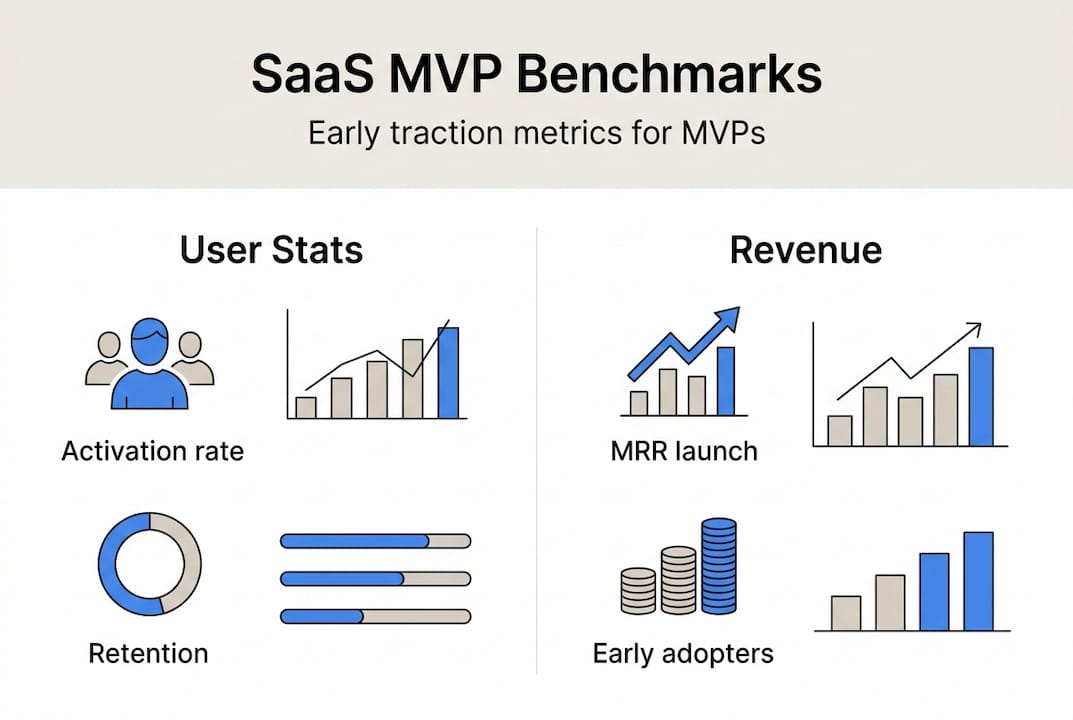
Here are the metrics that actually matter:
| Metric | Target | What it tells you |
|---|---|---|
| Activation rate | Over 60% | Users complete the core action |
| Willingness to pay | Any paying user | Problem is real and urgent |
| Retention (week 2) | Over 30% | Product delivers recurring value |
| “Very disappointed” NPS | Over 40% | Strong product-market fit signal |
The MVP success framework is built around one core truth: your MVP tests your riskiest assumption, not a scaled-down version of your final product. If over 40% of users say they would be very disappointed if your product disappeared, you have real signal. Below that threshold, you need to pivot or kill.
Here is how to make the call:
- Persevere if activation is above 60% and at least some users are paying.
- Pivot if users activate but do not pay, or pay once and churn fast.
- Kill it if fewer than 30% activate and nobody pays after 30 days of real usage.
“The data does not lie. Your users’ behavior is the only honest feedback you will ever get.”
For a breakdown of what features to prioritize during this phase, the guide on must-have MVP features is worth reading before you start adding to your backlog.
Modern MVPs in 2026: Polished, lovable, or just ‘lean’?
With the basics covered, it is vital to understand new expectations and contrasting expert perspectives in 2026.
The software market is more crowded than ever. Users in 2026 have seen thousands of apps. They have zero patience for clunky interfaces or confusing onboarding. The traditional “barebones MVP” is facing serious pushback from product experts, and for good reason.
The case against raw MVPs argues that traditional MVPs are too crude for today’s market. Users expect polish. Concepts like the Minimum Lovable Product (MLP) and Exceptional Value Product (EVP) are gaining traction because they acknowledge that delight matters, not just function. There is also a broader critique that founders misapply lean by focusing too much on the product and not enough on the market.
Here is how MVP, MLP, and EVP compare:
| Concept | Focus | Risk |
|---|---|---|
| MVP | Hypothesis testing | May feel too rough for users |
| MLP | Delight plus validation | Slower to ship |
| EVP | Exceptional value delivery | Higher build cost upfront |
The practical takeaway for founders:
- Polish the one thing users touch most, not everything
- Avoid the no-code trap where your demo looks great but breaks under real usage
- UX is not a luxury if your product requires trust, like fintech or health tech
For a deeper look at how design decisions affect early traction, the guide on MVP UX for founders covers this well. And if you are thinking about long-term scalability, MVP architecture decisions made early have outsized consequences later.
Why the real MVP superpower is user obsession, not just shipping fast
Here is the contrarian view most lean guides skip: shipping fast is table stakes. The founders who actually win are the ones who are obsessed with their users in a way that feels almost uncomfortable.
Y Combinator’s core lesson is consistent across every batch: ship fast, use manual hacks to simulate automation, and talk to users obsessively. Non-technical founders succeed through clear specs and relentless execution focus, not by learning to code.
The real leverage is not in your tech stack. It is in how quickly you can close the loop between shipping something and understanding what users actually do with it. Not what they say they will do. What they do.
I have seen founders spend three months debating their database choice and six weeks on a landing page. Meanwhile, the founders who win are texting their first ten users at 11pm asking why they dropped off during onboarding. That obsession is the actual competitive advantage.
Polish matters when it is core to trust. If you are building anything that handles money or sensitive data, a rough UI kills conversion. But outside of that, data trumps opinion every time. Kill ideas fast when the signal is weak. Protect your time ruthlessly. The feedback loop should be so tight that you can ship, measure, and learn in days. For more hard-won SaaS insights from real builds, the blog covers what actually works in production.
Supercharge your SaaS MVP with expert technical partnership
Ready for hands-on help bringing your MVP to life?
Lean product creation is a powerful framework, but executing it well requires more than a checklist. You need someone who has shipped real products under real constraints and knows exactly where to cut scope without killing the product.
That is exactly what working with Hanad Kubat looks like. As a senior full-stack engineer who has built his own SaaS products and delivered for Fortune 500 companies, Hanad brings both the technical depth and the founder mindset to your MVP. No agency overhead. No project manager in the middle. Just direct execution from the person writing the code. If you are ready to launch your MVP faster with a proven technical partner, or want to start with the guide to rapid MVP launch, both are the right next step.
Frequently asked questions
How long does it really take to build a lean SaaS MVP?
Most SaaS MVPs built with lean methods launch in 4 to 12 weeks, depending on complexity and how aligned your team is on scope before the build starts.
Do non-technical founders really need a tech co-founder to launch an MVP?
No. With lean principles and the right technical partner, you can spec, test, and ship without a co-founder. Y Combinator confirms that clear specs and execution focus matter far more than having a technical co-founder on your cap table.
What is the difference between MVP and Minimum Lovable Product (MLP)?
An MVP is the smallest version that tests your riskiest hypothesis. An MLP adds intentional polish to create stronger user delight early on. In competitive 2026 markets, the line between the two is narrowing.
What metrics prove a SaaS MVP is working?
Watch activation rate, retention, willingness to pay, and whether over 40% of users say they would be very disappointed if your product disappeared. That last one is the most honest signal you will find.
Why do most SaaS MVPs fail despite following lean?
Most failures come from building for the wrong user, ignoring actual usage data, or misapplying lean by obsessing over the product instead of the market problem it solves.