

TL;DR:
- Lean product development emphasizes validated learning through rapid build-measure-learn cycles.
- It focuses on building only the core MVP and releasing early to gather real user data.
- Successful lean teams prioritize discipline, shipping fast, and continuous knowledge reuse over bureaucracy.
Most early-stage startups don’t die because they lack ideas. They die because they spend months building the wrong thing, then run out of runway before they ever hear honest feedback from a real user. The assumption that more features equals faster product-market fit is one of the most expensive beliefs a founder can hold. Lean product development (LPPD) is a systems-based methodology that flips this script entirely, integrating people, process, and technology to eliminate waste, deliver real customer value, and create sustainable momentum from day one.
Table of Contents
- What is lean product development?
- The mechanics of lean product development for startups
- Lean product development vs. Agile and traditional methods
- Common pitfalls and advanced tips for founders
- Proven results: Lean product development in action
- Why most startups misuse lean—and what actually works
- Need expert help with lean product development?
- Frequently asked questions
Key Takeaways
| Point | Details |
|---|---|
| Lean builds only what matters | Focus on validated customer needs and eliminate wasted features for faster, cheaper MVPs. |
| Faster feedback loops | Lean product development encourages launching early and learning from real user data quickly. |
| Systems thinking wins | Applying LPPD means optimizing your entire process, not just building more features. |
| Avoid validation paralysis | Move ahead after learning—don’t get stuck in endless cycles without shipping something real. |
| Proven business results | Lean adoption can dramatically boost conversion rates and delivery speed for both startups and enterprises. |
What is lean product development?
To build on this foundation, we need to clarify exactly what lean product development means beyond the buzzwords.
LPPD is not a project management tool. It is not a sprint board with sticky notes. It is a complete operating philosophy for how a team builds, learns, and ships products. As lean methodology defines it, the core focus is integrating people, process, and technology to eliminate waste, deliver customer value, and create sustainable value streams across the entire organization.
The roots go back to Toyota. In the 1980s and 1990s, Toyota’s product development system produced vehicles faster, with fewer defects, and at lower cost than almost every competitor on the planet. Researchers studying Toyota discovered it wasn’t just about the assembly line. The entire development system, from concept to market, was built around structured learning, knowledge reuse, and cross-functional collaboration.
That same logic translates directly to software and startup product builds. The core LPPD principles include putting people first, using a chief engineer system (one person responsible for the product vision end-to-end), team-based product development, synchronizing workflows, building in learning and knowledge reuse, and designing the value stream from end to end.
Here’s a quick breakdown of what each principle actually means in startup terms:
| LPPD Principle | What it means for startups |
|---|---|
| People first | Invest in team skills before buying more tools |
| Chief engineer system | One founder or lead owns the product vision fully |
| Team-based development | Cross-functional squads, not siloed specialists |
| Synchronized workflows | Reduce handoffs, align timelines across functions |
| Knowledge reuse | Document learnings; don’t solve the same problem twice |
| End-to-end value stream | Design from user problem through to shipped product |
“The LPPD approach forces you to ask the uncomfortable question: Is this work actually creating value for the customer, or are we just staying busy?”
When startups apply LPPD, the results show up in three concrete ways. First, validation happens faster because the whole team is aligned on what question they are trying to answer. Second, failed launches become less frequent because waste gets cut before it gets built. Third, development becomes sustainable rather than a chaotic sprint that burns teams out before Series A. For practical guidance on this, the product development best practices for non-technical founders is worth reading alongside this guide.
The mechanics of lean product development for startups
With the foundation of LPPD in mind, let’s break down how startups actually apply its mechanics from MVP to iteration.
The engine of lean product development is the Build-Measure-Learn feedback loop. You start with a clearly stated hypothesis, something like “users will pay for a tool that saves them 30 minutes a day on X task.” You build the smallest possible version that can test that hypothesis. You measure actual user behavior, not surveys, not opinions, actual clicks and drop-offs and activation rates. Then you learn and decide: pivot, iterate, or double down.
The key mechanics startups need are practical and sequential:
- Define one core problem. Not five. One. The biggest mistake founders make is trying to solve every pain point in version one, which guarantees none of them get solved well.
- Build the minimum viable product (MVP). This is the smallest thing you can ship that lets real users engage with your core value proposition. It does not need to be beautiful.
- Deploy fast, even if it’s rough. A landing page that collects emails validates demand before you write a single line of backend code. A Figma prototype validates UX before you build any interface.
- Eliminate waste ruthlessly. Every feature, meeting, and document that does not directly serve your current hypothesis is waste. Cut it.
- Map your value stream. Identify exactly where the delays and inefficiencies live in your development pipeline. Fix those before adding more capacity.
- Tighten feedback loops. The smaller your team and the tighter your communication, the faster you learn. One Slack channel, one weekly review, one prioritized backlog.
The 72-hour SaaS launch case is a perfect example of this in practice. A small team, a single problem worth solving, an existing tech stack, and a willingness to ship something ugly first. The result was a live product with real users generating real feedback within three days. Polish came later. Learning came immediately.

Pro Tip: Define your MVP scope by writing this sentence before you start building: “We are testing the assumption that [user type] will [do specific action] because [core value]. Everything that does not directly test this assumption gets cut from v1.”
Cross-functional team structure matters enormously here. When designers, developers, and the person closest to customers all sit in the same conversations, you eliminate the handoff delays that kill lean workflows. A decision that takes three days of email chains in a siloed team takes three minutes when the right people are in the room together.
For more on how to validate fast without overbuilding, the MVP validation best practices guide covers the exact approach in detail. And if you are working specifically in SaaS, the fast-track SaaS MVP framework is directly applicable.
The statistic that should matter to you: Most startup MVPs sit in development for four to six months before launch. The lean approach compresses this to weeks. The difference is not technical skill. It is scope discipline.
Lean product development vs. Agile and traditional methods
Applying lean successfully starts with understanding how it differs from, and complements, other popular approaches.
The three main methodologies founders encounter are Waterfall, Agile, and Lean. They are not interchangeable, and using the wrong one at the wrong stage of your company is a real problem.
| Approach | Core question | Best used when | Risk |
|---|---|---|---|
| Waterfall | What do we build? | Requirements are fixed and known | Zero flexibility; late-stage rework is expensive |
| Agile | How do we build iteratively? | Post-validation, scaling delivery | Can become “Agile theater” without discipline |
| Lean | Should we build it at all? | Pre-PMF, validating assumptions | Risk of endless validation paralysis |
According to Lean vs. Agile analysis, the fundamental difference is this: Lean asks “should we build it?” while Agile asks “how should we build iteratively?” Lean Startup methodology is focused on pre-product-market-fit validation, while Agile is most valuable for delivery post-validation. LPPD takes a more holistic, systems-oriented view than sprint-based Agile alone.
Here is why this distinction matters practically for early-stage founders:
- Before you have product-market fit, Lean is your primary tool. You are running experiments, not building features.
- After you have validated demand, Agile delivery methods help you ship consistently and manage growing complexity.
- Traditional Waterfall should almost never be your choice as an early-stage startup. The cost of building the wrong thing in full before getting feedback is too high.
The biggest traps founders fall into are what practitioners call “Agile theater” and “Lean paralysis.”
Agile theater is when a team adopts sprint ceremonies, daily standups, and backlogs without internalizing the actual purpose of iterative delivery. You end up with more meetings and a false sense of progress while shipping nothing meaningful.
Lean paralysis is the opposite failure. You spend so much time mapping value streams, validating hypotheses, and building the perfect feedback system that you never actually ship. Real learning requires real products in the hands of real users.
For a practical look at how agile frameworks for MVPs can work alongside lean principles rather than against them, that resource breaks down the integration in detail.
The practical rule is simple: use Lean for discovery, use Agile for delivery. They are not competing systems. They are sequential stages of a mature product organization.
Common pitfalls and advanced tips for founders
With the differences in mind, it is critical to highlight the key mistakes to avoid and the advanced lessons that separate successful early-stage teams from the rest.
Lean falls apart the moment it becomes a process that people comply with rather than a mindset the team genuinely holds. Leadership support and culture change are prerequisites, not nice-to-haves. If your lead engineer or co-founder thinks lean is just a buzzword, your team’s behavior will reflect that, and the results will follow.
The most common pitfalls to watch for:
- Overbuilding before feedback. You build a full onboarding flow, dashboard, and settings page before a single user has confirmed they need any of it.
- Ignoring UX early. Lean does not mean ugly forever. It means ugly until validated. After that, UX becomes a competitive differentiator, not an afterthought.
- Endless validation without execution. The risk of infinite validation loops is real. At some point, you need to ship and let actual behavior teach you what surveys never can.
- People last, tools first. Many founders buy a new project management platform, set up a new analytics stack, and reorganize their Notion workspace before they invest in developing their team’s actual skills. Tools without capable people are expensive decoration.
- Single-person knowledge silos. When one engineer holds all the context for a critical system, you lose lean’s knowledge reuse principle. Document as you go.
Pro Tip: After every sprint or build cycle, run a 30-minute “kill meeting.” Ask one question: which features or processes here would we not build again knowing what we know now? Cut those things from the next cycle. This keeps waste from compounding.
Advanced founders know that cross-functional teams are not just faster. They are also smarter. When a designer hears customer interviews directly instead of through a brief, the design decisions change. When a developer sits in a sales call once a quarter, the technical priorities shift. Knowledge reuse across functions is where lean teams build compounding advantages over siloed competitors.
The common MVP pitfalls guide covers the operational mistakes in detail. If you are still mapping out your UX strategy, the UX role in MVP resource explains exactly when and how to bring design thinking into a lean build cycle without letting it slow you down.
One more thing that gets underestimated: team learning velocity. In lean product development, the goal is not just a faster product. It is a faster-learning organization. Every iteration should leave your team with better mental models, sharper intuitions, and cleaner processes than the iteration before. That accumulated intelligence is the real moat for early-stage companies.
Proven results: Lean product development in action
To show it’s not just theory, let’s look at hard numbers and case studies where lean product development moved the needle.
The most immediate benchmark is speed. A dedicated team applying lean principles can ship a complete SaaS MVP in 72 hours. That number sounds extreme until you understand what made it possible: single problem focus, existing stack, pre-built components, and a willingness to launch without polish.
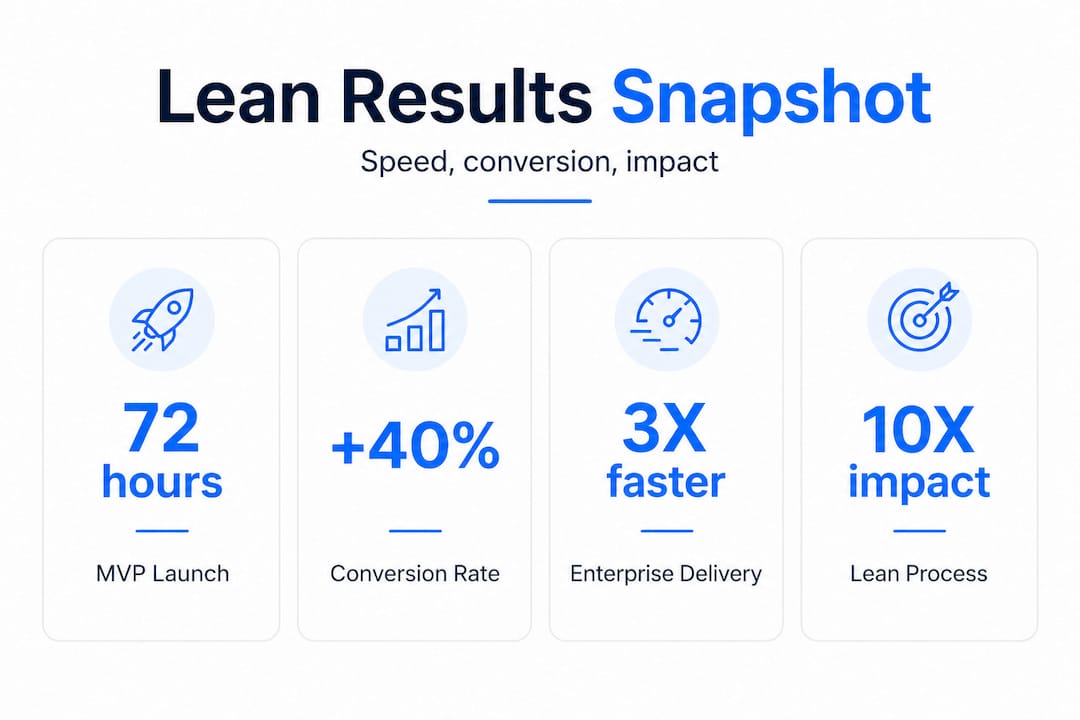
The UX audit data is equally compelling. One SaaS startup applied a lean-style UX audit to their existing product and saw trial-to-paid conversions rise 40%, moving from a 12% rate to 17%. That is not a minor tweak. That is a fundamental shift in revenue efficiency without building a single new feature.
At enterprise scale, the results are even more dramatic. A Fortune 200 company that adopted lean operational practices reported a 50% throughput increase and 80% fewer failures across their systems. Small startups should read these numbers carefully. If a company with thousands of people and legacy infrastructure can achieve those gains, a small, agile team applying the same principles from day one has an enormous structural advantage.
Here is a summary of documented lean outcomes:
| Outcome | Result | Context |
|---|---|---|
| MVP shipping speed | 72 hours | SaaS product, lean execution, small team |
| Trial-to-paid conversion | +40% (12% to 17%) | Lean UX audit on existing product |
| Throughput increase | +50% | Fortune 200 lean ops adoption |
| System failures reduced | 80% fewer | Enterprise lean operational practices |
What this means for you: You do not need to be a large organization with a dedicated process improvement team to get these results. You need the discipline to apply lean thinking consistently, the humility to cut scope aggressively, and the patience to let real user data drive decisions rather than internal opinions.
The why MVP validation matters article ties these numbers directly to the validation cycle that makes lean so effective. The speed and conversion gains are not random. They come from a systematic commitment to learning fast and acting on what you learn.
Why most startups misuse lean—and what actually works
Now that we’ve covered the data, it is time for a hard look at what founders actually experience in the field.
Here is the uncomfortable truth: most founders who say they are doing lean are doing paperwork with extra steps. They have a Notion template called “hypothesis tracker,” weekly lean reviews where everyone talks about learning without actually deciding anything, and a product roadmap full of features that have never been validated by a paying customer.
The mistake is treating lean as a framework to install rather than a discipline to practice. Frameworks feel productive. They generate artifacts, meetings, and visible motion. Discipline is quieter. It shows up in the decision to not build the notification system in v1. It shows up in shipping the thing that feels embarrassingly simple. It shows up in the willingness to kill a feature that users never actually use, even if the team spent two weeks building it.
What actually works comes down to three behaviors that I have seen separate successful lean teams from the rest. First, you build only the core. Not the core plus the “quick wins” plus the things your investor mentioned once. Just the core. The thing that directly tests whether your central hypothesis is true or false. The minimal viable product validation framework is built around this exact constraint.
Second, you launch before you are ready. The version of “ready” that lives in your head is a fantasy. Users will surprise you, break things, use features in ways you never imagined, and ignore the things you spent the most time building. The only way to access that information is to ship. Every day spent perfecting something in private is a day you are not learning.
Third, you use actual customer behavior as your compass, not opinions. Surveys lie. User interviews are useful but incomplete. What users do when real money or real time is on the line is the only signal that matters. Set up analytics before you launch, even basic ones. Watch what users actually do in the product. Let that behavior tell you what to build next.
The systematization of knowledge reuse is where lean compounds over time. Every time your team solves a hard problem, documents the decision, and reuses that pattern in the next build cycle, you are getting smarter faster than any competitor who starts from scratch each time. This is the Toyota advantage translated directly to your startup.
The final trap to avoid: do not let your lean efforts become another bureaucratic layer on top of your real work. If you spend more time talking about your lean process than you spend shipping and learning, something has gone wrong. Lean should make you faster and clearer. If it is making you slower and more confused, strip it back to the essentials and start again.
Need expert help with lean product development?
Lean product development can fundamentally change how fast you ship and how efficiently you learn, but knowing the principles and actually executing them under founder pressure are two very different things.
If you are an early-stage founder who needs a senior technical partner to build your MVP the lean way, without an agency layer, without project management overhead, and without months of back-and-forth, that is exactly what MVP development support at hanadkubat.com is built for. Production-ready MVPs in 4 to 12 weeks, built with the same discipline you just read about, tested on real SaaS products first. You work directly with the engineer writing your code. No account managers. No guessing games. Just execution.
Frequently asked questions
What are the core principles of lean product development?
Lean product development is grounded in people-first culture, a chief engineer system, team-based work, synchronized workflows, building in learning and knowledge reuse, and designing value streams end-to-end from customer problem to shipped product.
How do I apply lean product development if my team is non-technical?
Even non-technical teams can apply lean by focusing on rapid validation, clear feedback loops, and prioritizing only core MVP features. Shipping a landing page or paper prototype before writing code is a fully valid lean first step.
How is lean product development different from Agile?
Lean vs. Agile comes down to this: lean asks whether you should build the solution at all, while Agile focuses on how to deliver iteratively once you have validated the problem. Use lean for discovery, use Agile for delivery.
What kind of results can lean product development deliver?
Startups can ship MVPs in 72 hours, see 40% more trial-to-paid conversions with lean UX audits, and large organizations have reported 50% throughput increases and 80% fewer system failures after lean adoption.
What’s the biggest mistake founders make with lean?
Many founders confuse motion for progress, loading up on lean ceremonies and templates without shipping. The real risk, as lean research confirms, is endless validation without execution. Real learning only happens when real users touch a real product.