

TL;DR:
- Product validation ensures startups build solutions users actually want, reducing costly mistakes.
- Frameworks like Customer Development help test assumptions and validate demand efficiently.
- Non-technical founders often excel at validation by leveraging no-code tools and customer interviews.
Most founders assume the biggest risk in building a startup is writing bad code or hiring the wrong engineer. It’s not. The real killer is building something nobody wants. Product validation is the structured process of testing whether your idea solves a real problem for real users before you spend a dollar on development. Skipping it is how startups burn through runway chasing imaginary customers. This guide breaks down exactly how to validate your product idea, which frameworks work, how to measure results, and what mistakes will send you back to square one.
Table of Contents
- Why product validation matters: Beyond guessing and hoping
- Core frameworks for product validation: Customer Development and beyond
- Validation tactics for MVPs: Real methods for real evidence
- Measuring product-market fit: The 40% rule and real-world benchmarks
- Validation mistakes to avoid: Biases, user segments, and cycles
- Why product validation is the startup superpower non-technical founders underuse
- Turn your product validation into launch-ready MVPs with expert support
- Frequently asked questions
Key Takeaways
| Point | Details |
|---|---|
| Test assumptions early | Validating your idea with real users prevents wasted time and money on unwanted products. |
| Use proven frameworks | Following structured processes like Customer Development boosts your startup’s odds of success. |
| No-code makes it fast | You can validate MVPs rapidly without technical skills using interviews and toolkits. |
| Measure the right metrics | Seek evidence like engagement and the 40% ‘very disappointed’ benchmark to confirm demand. |
| Avoid common pitfalls | Beware of bias and overbuilding; segment users and seek real feedback for meaningful validation. |
Why product validation matters: Beyond guessing and hoping
Let’s be direct. Most early-stage founders believe in their idea so deeply that they treat validation as optional. They build, launch, and then wonder why nobody signs up. The pattern is painfully predictable.
Product validation is the structured process of testing whether a product idea, feature, or MVP solves a real problem for target users before full development. It uses real user interactions to confirm demand, usability, and willingness to pay. That last part matters. Willingness to pay is not the same as “people said it sounds cool.”
When you skip validation, here’s what actually happens:
- You build features users never asked for
- You launch months late because scope kept growing
- You spend money targeting the wrong customer segment
- You mistake polite feedback from friends for real market demand
Top accelerators like Y Combinator treat validation as a prerequisite, not a bonus step. They know that startup validation tactics done early save founders from the most expensive mistake in the startup playbook: building for imaginary users.
“The goal of validation isn’t to prove you’re right. It’s to find out if you’re wrong before it costs you everything.”
For non-technical founders especially, validation is your biggest competitive advantage. You don’t need to write code to talk to customers, run a landing page test, or measure whether people actually click “buy.” Understanding why startups need an MVP starts with understanding why validation comes first. The MVP is the tool. Validation is the goal.
Validation reduces risk at every level. It confirms you’re solving a real pain point, not just an interesting one. It measures both demand (do people want this?) and usability (can people actually use it?). Done right, it turns your assumptions into evidence.
Core frameworks for product validation: Customer Development and beyond
Frameworks exist because smart people made expensive mistakes so you don’t have to. The most important one for early-stage founders is Customer Development, created by Steve Blank.
Customer Development follows four steps: Discovery (test your hypotheses via interviews), Validation (sell your MVP to verify repeat business), Creation (build demand), and Company Building (scale the organization). For most early-stage founders, you only need to care deeply about the first two.
Here’s how to apply Customer Development as a non-technical founder:
- Write down your top 5 assumptions. What must be true for your business to work? Who is the customer? What problem do they have? How much would they pay?
- Design 10 to 20 targeted customer interviews. Ask about their current behavior, not about your solution. “How do you handle X today?” beats “Would you use my app?”
- Build the smallest possible MVP. A landing page, a prototype, or even a manual process works. The goal is to test your core assumption, not impress anyone.
- Sell before you build. If you can get a pre-sale, a letter of intent, or even a paid pilot, you’ve validated demand in the most honest way possible.
- Iterate based on what users do, not what they say. Behavior is truth. Words are polite.
Here’s how validation-first development compares to traditional approaches:
| Approach | Time to first feedback | Cost risk | Accuracy |
|---|---|---|---|
| Traditional development | 6 to 12 months | Very high | Low |
| Validation-first (MVP) | 2 to 6 weeks | Low | High |
| Customer Development | Ongoing | Minimal | Very high |
If you want to go deeper, Steve Blank’s original framework is worth reading. And before you start building, make sure you know how to validate your SaaS idea properly, and how to avoid common MVP pitfalls that trip up even experienced founders.
Validation tactics for MVPs: Real methods for real evidence
Frameworks give you structure. Tactics give you data. Here are the methods that actually work for non-technical founders who need answers fast.
MVP-based validation means building the minimal version that delivers core value, launching quickly (Y Combinator recommends 2 to 4 weeks), measuring engagement, and iterating based on feedback. The methods include landing pages, fake door tests, concierge MVPs, user interviews, and prototypes.

| Tactic | Cost | Speed | What it proves |
|---|---|---|---|
| Landing page | Very low | 1 to 3 days | Demand and messaging |
| Fake door test | Low | 3 to 7 days | Feature interest |
| Concierge MVP | Low to medium | 1 to 2 weeks | Usability and value |
| User interviews | Free | Ongoing | Pain points and behavior |
| Prototype test | Low | 1 to 2 weeks | UX and flow |
A fake door test is when you advertise a feature that doesn’t exist yet and measure how many people click to learn more or sign up. It sounds almost dishonest, but it’s one of the most honest signals you can get. Real clicks from real strangers mean real interest.
A concierge MVP means you manually deliver the service your product will eventually automate. You do the work by hand to prove the value before writing a single line of code. It’s slow, but it teaches you more than any survey ever will.
Pro Tip: Don’t test with friends and family. Their feedback is filtered through their desire not to hurt your feelings. Find 10 strangers who match your target customer profile. Their honest indifference will teach you more than 100 supportive comments from people who love you.
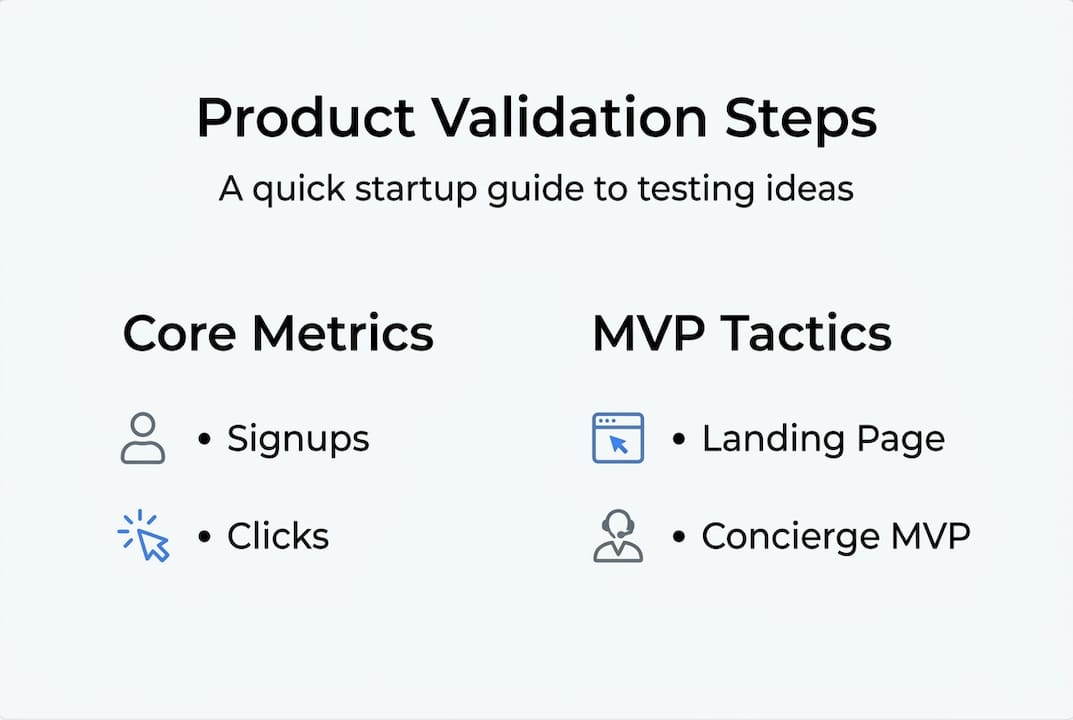
Key metrics to track during validation: email signups, click-through rates on calls to action, pre-sale conversions, and time-on-page. These are leading indicators of real demand. If you want a structured approach, learn how to build your MVP fast and review MVP best practices before you start. Understanding how MVPs validate startup ideas will also sharpen your thinking. For more on
Measuring product-market fit: The 40% rule and real-world benchmarks
Running validation tests is only half the job. The other half is knowing what the numbers actually mean.
The most reliable benchmark in early-stage validation is the Sean Ellis test. You ask your users one question: “How would you feel if you could no longer use this product?” The answer choices are “very disappointed,” “somewhat disappointed,” or “not disappointed.” If 40% or more say “very disappointed”, you have strong product-market fit. Below that, you have work to do.
40% is the threshold. It’s not a suggestion.
Superhuman’s case is the most famous example of this framework in action. They started at 22%, which sounds discouraging. But by segmenting their users, focusing on the people who said “very disappointed,” and asking what those users loved most, they improved their score to 58%. That’s not luck. That’s disciplined measurement.
Here’s how to run the Sean Ellis test yourself:
- Send the survey after users have experienced real value. Don’t survey someone who signed up yesterday.
- Segment your results. Separate power users from casual ones. Focus on the people who would be most disappointed.
- Ask a follow-up. “What’s the main benefit you get from this product?” The answers will tell you exactly how to position your messaging.
- Act on the gap. If you’re at 28%, look at what the “very disappointed” users love and double down on that. Remove friction for everyone else.
Pro Tip: Don’t chase revenue as your first signal of product-market fit. Revenue is a lagging indicator. Leading indicators include daily active usage, organic referrals, and users who return without being prompted. Use the MVP validation checklist to track these systematically, and pay attention to how UX affects your MVP as you iterate. The Superhuman case study is worth reading in full.
Validation mistakes to avoid: Biases, user segments, and cycles
You can run every tactic in this guide and still get it completely wrong. Here’s how.
Confirmation bias is the biggest threat to honest validation. It means you unconsciously seek out feedback that confirms what you already believe and dismiss evidence that challenges it. The fix is simple but uncomfortable: actively look for reasons your idea is wrong. Design your interviews to disprove your assumptions, not prove them.
According to research on validation pitfalls, founders consistently make the same errors: relying on friends and family, building too much before testing, and ignoring feedback from semi-interested users. That last one is sneaky. The “somewhat disappointed” group often contains your most actionable insights.
Common mistakes to avoid:
- Testing with people who know you. They want you to succeed. That bias contaminates every answer.
- Building a full product before validating. If you’ve spent three months coding before talking to a single stranger, you’ve already made the mistake.
- Asking leading questions. “Don’t you think this would be useful?” is not a validation question.
- Running one long feedback cycle. Short cycles of 1 to 4 weeks force faster learning and cheaper corrections.
- Treating all users the same. Segment early. Power users and casual users will give you completely different signals.
No-code tools like Bubble, Glide, and Webflow make rapid validation accessible to any founder, regardless of technical background. Use them. The founder tech checklist covers which tools fit which validation stage. And for a broader view of avoiding validation errors, the fundamentals haven’t changed.
Write falsifiable hypotheses. “I believe that busy professionals will pay $29 per month to automate X” is testable. “People will love this” is not.
Why product validation is the startup superpower non-technical founders underuse
Here’s the counterintuitive truth most people won’t tell you: non-technical founders are often better at product validation than technical ones.
Technical founders want to build. It’s their instinct. When in doubt, they ship a feature. Non-technical founders don’t have that escape hatch. They’re forced to talk to customers, observe behavior, and ask hard questions. That constraint is actually a superpower.
Product validation is fundamentally about listening, not coding. It’s about spotting patterns in what users do versus what they say. It’s about resisting the urge to build until the signal is clear. These are human skills, not engineering skills.
The fewer resources you have, the more validation matters. A $500 landing page test that kills a bad idea in two weeks is worth more than six months of development on the wrong product. Non-technical founders who embrace this reality and follow MVP best practices consistently outpace technical teams that skip validation entirely. The playing field is more level than you think.
Turn your product validation into launch-ready MVPs with expert support
Validation tells you what to build. Execution determines whether it ships. For non-technical founders who’ve done the hard work of confirming demand, the next challenge is turning that validated idea into a production-ready product without wasting months or burning budget on the wrong technical decisions.
At hanadkubat.com, I work directly with early-stage founders to build MVPs in 4 to 12 weeks, using the same validation-first approach covered in this guide. No agency overhead, no project manager in the middle, no guesswork. If you’ve already done your validation work and want to understand how MVPs validate and launch startup ideas, the next step is a direct conversation about your product, your timeline, and what it actually takes to ship.
Frequently asked questions
What is product validation in startups?
Product validation is testing with real users to confirm whether your startup idea solves a real problem and has demand before building the full solution. It replaces assumptions with evidence.
How do you validate a product idea without coding?
You can validate using no-code tools and interviews like Bubble or Glide, customer interviews with 10 to 20 targeted users, landing pages, and pre-sales to test demand before any development begins.
What is the Sean Ellis test for product-market fit?
The Sean Ellis test asks users if they’d be very disappointed without your product. Reaching 40% or higher on that response indicates strong product-market fit and is the most widely used early benchmark.
What mistakes should founders avoid during product validation?
Avoid confirmation bias and over-reliance on friends and family for feedback, overbuilding before testing, and ignoring feedback from semi-interested users who often hold your most useful insights.
How long does product validation typically take?
Effective validation cycles run 2 to 4 weeks, following Y Combinator’s guidance, allowing for fast feedback and quick iteration before any major investment in development.