

TL;DR:
- % of developers experience burnout in startups driven by relentless deadlines and unclear requirements.
- Founder behavior and communication norms significantly influence engineer stress and team sustainability.
- Implementing simple operational practices can reduce burnout and improve MVP delivery speed and quality.
82% of developers experience burnout driven by fast startup cycles and blurred work-life boundaries. That number should stop any founder cold. You’re not just building a product. You’re building an environment where the person writing your code either thrives or quietly breaks down. In early-stage SaaS startups, engineer stress is one of the most overlooked risks to MVP delivery, and founders are far more responsible for it than they realize. This article breaks down what causes that stress, what it costs your product, and exactly what you can do about it, starting today.
Table of Contents
- Understanding the roots of engineer stress in startups
- The impact of stress and burnout on SaaS MVP delivery
- Tactics to minimize stress: The founder’s practical toolkit
- Balancing speed and sustainability: A mindset shift for MVP teams
- A founder’s hidden advantage: Shaping the engineering environment
- Build resilient MVP teams with expert guidance
- Frequently asked questions
Key Takeaways
| Point | Details |
|---|---|
| Burnout is widespread | Over 80% of startup engineers face significant stress, impacting product delivery. |
| Technical debt balance | Strategic debt speeds MVPs but becomes dangerous if unmanaged post-launch. |
| Founders shape team health | Your communication, priority setting, and habits directly impact engineering stress. |
| Actionable prevention steps | Clear backlogs, respectful boundaries, and transparent check-ins help prevent burnout. |
Understanding the roots of engineer stress in startups
To fully address the problem, let’s first clarify what causes most stress for engineers in early-stage startups. The answer is rarely a single bad week. It’s a pattern.
The most common stress drivers are:
- Relentless deadlines with no buffer for technical complexity
- Unclear or shifting requirements that force engineers to rebuild the same feature multiple times
- Constant pivots that make previous work feel wasted
- Lack of technical leadership that leaves engineers making business-critical decisions alone
- Founder pressure that’s well-intentioned but lands as micromanagement
The European context makes this even sharper. 83% of European founders report high stress, with 54% experiencing burnout. That stress flows downhill. When a founder is anxious, engineers feel it in every Slack message, every sprint review, every “can we just ship it faster?” conversation.
There’s also a gender dimension worth noting. Female founders and engineers in European startups report disproportionately higher stress levels, often carrying both technical and interpersonal weight simultaneously. This isn’t a soft issue. It’s a structural one.
“The myth that extreme hours equal extreme output is one of the most expensive beliefs a startup founder can hold.”
Here’s a useful comparison of stress drivers by team structure:
| Stress factor | Solo engineer | Small team (2-4 engineers) |
|---|---|---|
| Unclear requirements | Very high | High |
| Deadline pressure | Extreme | Moderate to high |
| Lack of peer review | High | Low |
| Founder communication gaps | High | Moderate |
| Technical debt accumulation | Very high | Manageable |
When you’re working with a single engineer, as many early-stage startups do, every one of these factors is amplified. Understanding the co-founder role and stress dynamic is critical here. Founders who treat their technical partner as a vendor rather than a collaborator create the conditions for burnout before the first sprint is done.
The founder tech checklist approach, where founders take responsibility for defining scope and priorities clearly, directly reduces the ambiguity that engineers find most draining. And why technical partners matter goes beyond just writing code. They need to be able to push back, ask questions, and set realistic expectations without fear.
The impact of stress and burnout on SaaS MVP delivery
Building on these roots of stress, what does it cost startups if stress and burnout go unchecked? More than most founders expect.
The most visible cost is speed. Burnt-out engineers don’t move slower because they’re lazy. They move slower because their decision-making degrades, their error rate climbs, and their motivation to solve hard problems drops sharply. Feature velocity dropped 60% in teams where technical debt was left unmanaged. That’s not a minor setback. That’s a product that takes twice as long to ship.
The second cost is quality. Stressed engineers cut corners, not out of carelessness but out of survival. They skip tests. They merge code that isn’t ready. They defer the hard architectural decisions until later, and “later” becomes a mountain of technical debt that slows every future feature.

Here’s how sustainable teams compare to crunch-culture teams:
| Metric | Sustainable pace team | Crunch-culture team |
|---|---|---|
| Feature velocity | Consistent | High then crashes |
| Bug rate | Low | Increases over time |
| Engineer retention | High | Low |
| Technical debt | Managed | Accumulates fast |
| Founder satisfaction | High | Short-term gains only |
Post-layoff environments are especially brutal. 76% of scale-up layoff survivors face unsustainable workloads as responsibilities redistribute across fewer people. If you’ve recently downsized or restructured, your remaining engineer is almost certainly carrying more than they’re saying.
The guide to SaaS app launches makes clear that launch timelines are almost always affected by team health, not just technical complexity. And if you’re building mobile features, the pressure compounds. Resources on how to ship mobile apps faster consistently point to team structure and communication as the real bottleneck, not the technology.
The goal of an MVP is to launch MVP fast and learn. But “fast” built on a burnt-out engineer is a false economy. You ship, then you stall.
Tactics to minimize stress: The founder’s practical toolkit
So how can founders change their company’s approach to engineer stress for measurable improvements? The good news: most of the highest-impact changes cost nothing except intention.
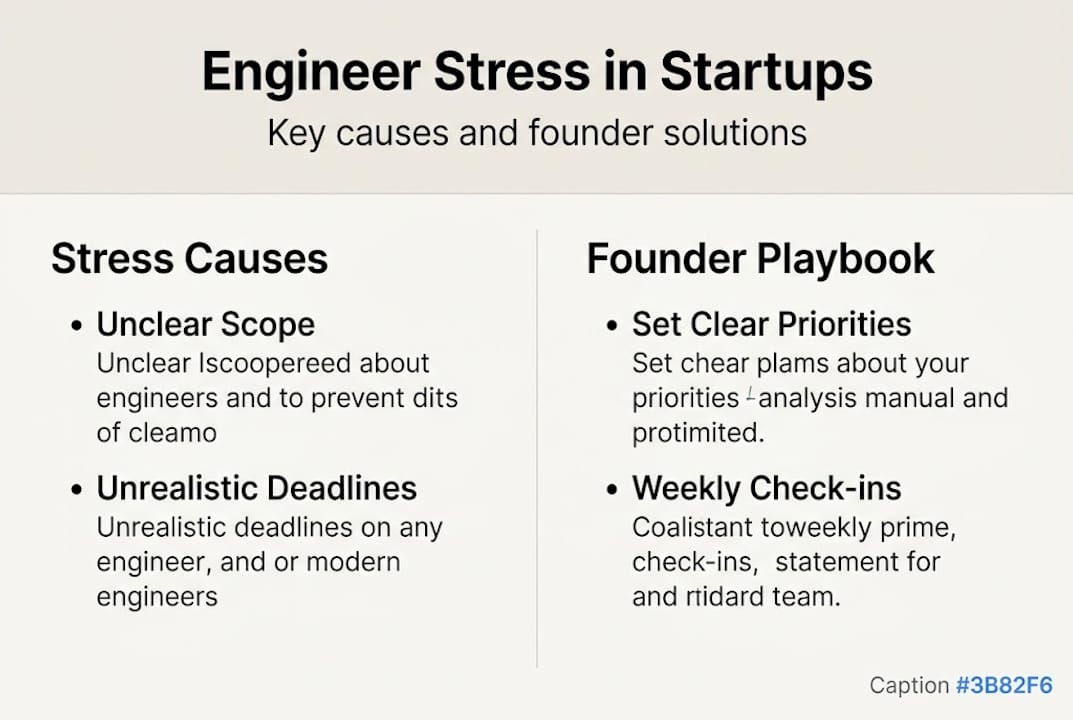
- Create a focused, prioritized backlog. Every item in the backlog should answer one question: does this serve the product’s core value right now? If not, it waits. A bloated backlog is a stress factory.
- Limit work in progress. Engineers context-switch constantly in startups. Each switch costs cognitive energy. Cap active tasks per sprint and protect deep work time.
- Respect work-life boundaries. Don’t send Slack messages at 11 PM and expect no reply. Don’t celebrate engineers who work weekends as heroes. That behavior sets a norm that everyone else has to match.
- Foster transparent, two-way communication. Ask your engineer what’s blocking them, not just what they’ve shipped. Create space for honest answers.
- Set technical debt guardrails early. Decide together: what shortcuts are acceptable now, and what’s off the table? This removes the ambiguity that forces engineers to make judgment calls alone.
Process changes and boundary setting are among the most effective interventions for reducing engineer burnout. These aren’t HR policies. They’re operational decisions that directly affect your product’s output.
Pro Tip: Schedule a 20-minute check-in with your engineer at the start of each sprint, before any pressure builds. Ask about blockers, energy levels, and priorities. This one habit catches problems weeks before they become crises.
For founders building their first product, the lean product creation framework is a natural fit here. Lean thinking isn’t just about features. It’s about protecting the team’s capacity to keep shipping. The SaaS guide for non-technical founders covers the communication structures that make this sustainable. And for ongoing learning, SaaS development insights offers practical perspectives from founders who’ve navigated this exact tension.
Balancing speed and sustainability: A mindset shift for MVP teams
Once tactics are in play, consider how mindset, yours and your team’s, truly drives long-term scale and success.
The “hustle harder” narrative is deeply embedded in startup culture. But the data doesn’t support it. Extreme hours at AI startups like Cognition, where 80-hour weeks were the norm, didn’t yield the user adoption founders expected. The output looked impressive internally. The market didn’t care.
For SaaS MVPs specifically, the goal is learning speed, not feature speed. You want to ship the smallest thing that teaches you something real. That requires a clear head, not an exhausted one.
“Sustainable pace isn’t a luxury for well-funded startups. It’s a competitive advantage for lean ones.”
Here’s what a mindset shift looks like in practice:
- Replace “can we ship this faster?” with “what can we cut to ship this well?”
- Treat engineer pushback as signal, not resistance
- Celebrate learning from a failed experiment as much as a successful launch
- Recognize that retention of a great engineer is worth more than any single sprint
Pro Tip: Before you validate your SaaS idea, agree with your engineer on what “done” looks like for the MVP. Undefined success criteria are one of the biggest hidden stress drivers in early-stage teams.
Strategic technical debt, meaning shortcuts you take consciously and document, is a legitimate tool in early-stage development. The key word is consciously. Debt you don’t track becomes debt that owns you. As your MVP matures and you start acquiring real users, the rules change. What was acceptable at week two is a liability at month six.
A founder’s hidden advantage: Shaping the engineering environment
Here’s the uncomfortable truth most startup content won’t tell you: you, the non-technical founder, have more influence over your engineer’s stress levels than any tool, process, or salary adjustment.
Founders shape unspoken norms. When you respond to Slack at midnight, you signal that midnight responses are expected. When you praise shipping over quality, you signal that quality is optional. When you skip the weekly check-in because you’re busy, you signal that your engineer’s wellbeing is a low priority.
Engineering partners notice all of it. They replicate it, or they leave.
The founders who build high-performing SaaS teams aren’t necessarily the ones with the best technical instincts. They’re the ones who take the co-founder impact on teams seriously from day one. They set boundaries visibly, communicate clearly, and treat their engineer’s sustainability as a product metric, not a soft concern.
Early vigilance on these norms routinely separates startups that scale from those that stall at the MVP stage. The environment you build in the first 90 days becomes the culture you’re stuck with at year two.
Build resilient MVP teams with expert guidance
If you’re a non-technical founder navigating these pressures, you don’t have to figure it out alone. Working directly with a senior engineer who’s also built SaaS products means you get someone who understands both sides of this equation.
At hanadkubat.com, the focus is on building production-ready MVPs without the overhead, miscommunication, or burnout cycles that slow most early-stage teams down. You work directly with one senior engineer, no project managers, no telephone game. For founders who want a structured, sustainable approach from the start, the lean MVP creation framework is a practical place to begin. Real support, real code, real results.
Frequently asked questions
What are the top warning signs of engineer burnout in startups?
Watch for missed deadlines, decreased enthusiasm, and communication drop-offs. These patterns often surface weeks before full burnout hits, giving founders a window to act. 82% of developers experience burnout in startup environments, so early signals matter.
Does allowing technical debt reduce or increase team stress?
Permitting some debt accelerates early progress, but unmanaged debt quickly becomes a stress amplifier. Unmanaged technical debt led to a 60% drop in feature velocity in documented cases, turning a short-term shortcut into a long-term drag.
How can non-technical founders help prevent engineer burnout?
Set clear priorities, respect work-life boundaries, and create space for honest communication. Process changes and boundary setting are among the most effective tools for reducing burnout, and both are fully within a founder’s control.
Why is founder behavior so influential on team health?
Founders unconsciously set the tone around work habits and expectations. When founder culture and expectations normalize overwork, engineering teams follow suit, often without anyone explicitly asking them to.