

TL;DR:
- Most founders waste their first €30K on unsuitable agencies or inexperienced developers.
- Hiring a senior mobile developer early helps avoid feature creep and accelerates MVP testing.
- Working directly with a vetted senior freelancer in Europe offers faster, clearer, and more reliable results.
Most founders burn their first €30K building the wrong thing with the wrong people. They hire an agency, get a project manager who’s never written a line of code, and watch their launch date slip by three months while the feature list grows. Or they hand over equity to a developer who disappears after the first prototype. The good news: both traps are completely avoidable. If you pick the right senior mobile developer early, you skip the bloat, keep your equity, and ship something real users can actually test. This guide gives you a practical framework to do exactly that.
Table of Contents
- Why most MVP projects stall: Hidden pitfalls for non-technical founders
- What sets a senior mobile developer apart
- How to evaluate and select your MVP mobile developer
- First 30 days: Working with your senior mobile developer
- A founder’s advantage: The truth behind ‘just hire a dev’
- Ready to launch smarter? Work with a Fortune 500 engineer
- Frequently asked questions
Key Takeaways
| Point | Details |
|---|---|
| Limit MVP scope | Build only the 3-5 must-have features for your first release to avoid costly delays. |
| Prioritize senior talent | A true senior mobile developer accelerates launches, avoids tech debt, and guides founders with clarity. |
| Validate fast with users | Test your prototype with 3-5 users to confirm market fit before going all-in. |
| Cut intermediaries | Bypassing agencies and junior teams keeps you agile, cost-efficient, and in control. |
| Vetting matters most | Assess candidates for hands-on MVP launch success, not just technical buzzwords. |
Why most MVP projects stall: Hidden pitfalls for non-technical founders
The number one killer of early-stage mobile apps isn’t bad ideas. It’s bad process. Founders who haven’t shipped software before tend to underestimate how quickly small decisions compound into expensive disasters.
Agencies are the most common trap. You pay a premium for a team you don’t control, filtered through a project manager who translates your vision into something slightly different at every handoff. Feedback loops stretch from days to weeks. By the time you see a screen, the context has already shifted. And the invoices keep coming.
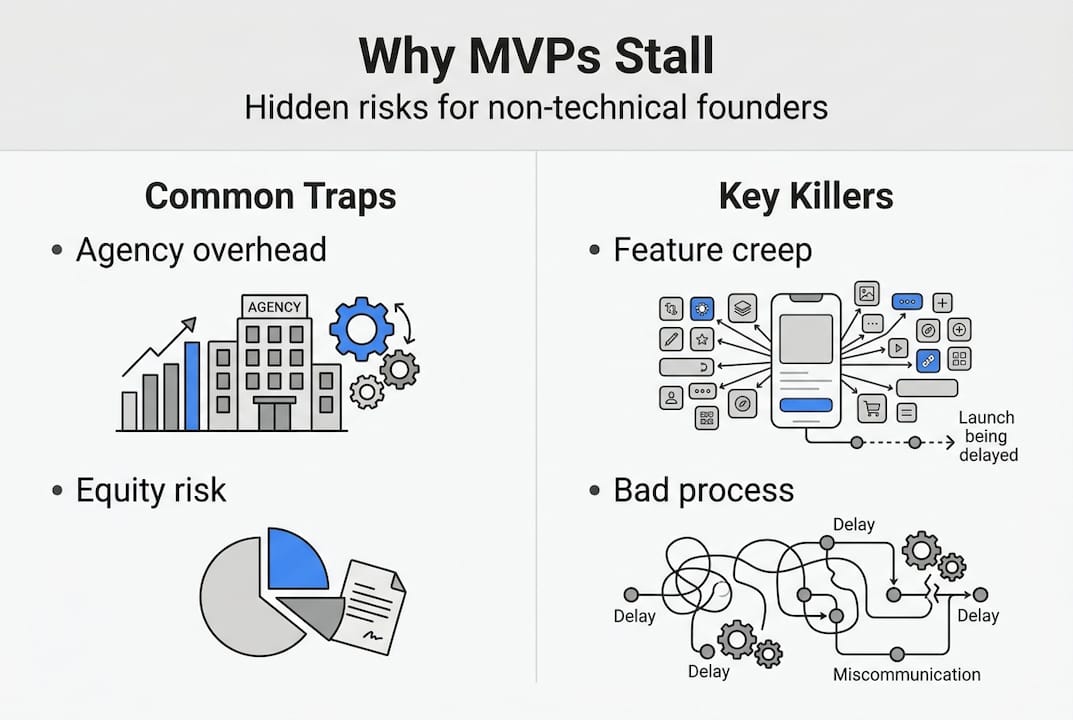
Equity-based hiring feels like a shortcut, but it’s often worse. Giving away 5 to 15 percent of your company to a developer who hasn’t proven they can deliver under founder pressure is a gamble most early-stage companies can’t afford. You lose leverage before you’ve even validated your idea.
Then there’s feature creep. It’s the quiet killer. Every stakeholder has “just one more thing” that sounds reasonable in isolation. But feature creep pitfalls are well documented: complexity multiplies, timelines blow up, and the product you launch looks nothing like the lean test you needed.
Hiring junior or intermediate developers to save money is another false economy. They’re learning on your dime. Edge cases that a senior developer spots in five minutes can take a junior two weeks to debug. That’s not a knock on junior talent; it’s just the wrong tool for the job when speed and clarity matter most.
Here’s what actually works:
- Define 3 to 5 core features before writing a single line of code
- Get MVP validation best practices locked in before you commit your full budget
- Use step-by-step product validation to pressure-test your assumptions early
- Avoid any developer or agency that pushes scope before understanding your user
“Avoid feature creep and validate with 3-5 users first for MVP success.”
Pro Tip: Before your first developer call, write down the one problem your app solves and the one action a user must complete. If you can’t do that in two sentences, you’re not ready to build yet.
What sets a senior mobile developer apart
Understanding the problems is critical, but what actually distinguishes a developer who can steer your MVP to launch safely and intelligently?

The short answer: judgment. Senior developers have seen enough projects fail to know what not to build. They don’t just execute tickets; they push back when a feature will cost three weeks and deliver zero user value. That kind of friction is exactly what non-technical founders need.
Here’s a direct comparison of what you actually get:
| Capability | Junior/Intermediate | Senior developer |
|---|---|---|
| Edge case detection | Misses most | Catches early |
| Communication | Technical jargon | Plain business language |
| Scope management | Adds complexity | Cuts to essentials |
| GDPR/EU compliance | Needs guidance | Built-in awareness |
| MVP delivery speed | Slow, iterative | Fast, focused |
For European founders specifically, the nearshore advantage is real. A senior developer based in the EU understands GDPR by default, works in your timezone, and doesn’t require a 48-hour lag on every question. Offshore teams are cheaper on paper, but the communication overhead and compliance risk often erase those savings fast.
True seniors also know how to prioritize faster mobile app development without cutting corners that matter. They understand that UX’s role in MVPs isn’t decoration; it’s the difference between a product users return to and one they abandon after two minutes.
The market reflects this. Top senior developers are heavily favored in today’s bimodal European mobile market, where demand clusters at the very top and very bottom of the skill curve, leaving intermediates in a difficult spot.
- Seniors reduce rework by catching architecture mistakes before they’re baked in
- They explain decisions in plain language, so you stay informed without needing a CS degree
- They know which React Native patterns cause long-term pain and avoid them from day one
Pro Tip: When vetting candidates, skip the resume buzzwords. Ask them to walk you through a time they killed a feature to save a project. If they can’t give you a concrete example, keep looking.
How to evaluate and select your MVP mobile developer
To move from theory to decisive action, here’s a practical process for evaluating and hiring your ideal senior mobile developer.
Start before you hire. Run 3 to 5 user interviews to validate your core assumption. This does two things: it sharpens your brief and it filters out developers who can’t engage with user problems. If a candidate isn’t curious about your users, that’s a red flag before the contract even starts.
Here’s how the three main hiring paths compare:
| Path | Cost | Speed | Control | Risk |
|---|---|---|---|---|
| Agency | High | Slow | Low | High overhead |
| Direct hire | Medium | Slow | Medium | Long ramp-up |
| Senior freelancer | Medium | Fast | High | Low if vetted |
For most early-stage European startups, a vetted senior freelancer is the fastest path to a working product. You get direct access, no layers, and full transparency on where your money goes.
Key interview questions to ask:
- How do you handle scope changes mid-sprint when a user test reveals something unexpected?
- Walk me through how you’d manage app state for a feature with three edge cases.
- What’s the last feature you recommended cutting, and why?
- How do you keep a non-technical founder informed without drowning them in detail?
- Can you show me a prototype you built under time pressure?
Red flags to watch for:
- Jargon-heavy answers with no plain-language follow-up
- Immediate push for a larger team before understanding your scope
- No examples of rapid prototyping or MVP-specific work
Vetting is crucial because intermediates struggle in today’s market; top seniors provide repeatable rapid wins. Before signing anything, check references from recent MVP launches specifically, not enterprise projects. Ask the reference: “Did they push back on anything? Was that pushback right?”
Also spend time validating your SaaS idea and reviewing an MVP validation checklist before your first paid sprint. It protects your budget and gives your developer a sharper target.
Pro Tip: Ask candidates to demo how they’d handle a “simple” feature like a login flow with social auth and error states. The answer tells you everything about how they think under real conditions.
First 30 days: Working with your senior mobile developer
Once you’ve secured the right senior developer, the first month is the launchpad for long-term success.
The first week is about alignment, not output. Define your 3 to 5 critical features in writing before any code is written. Set up a shared project board. Agree on communication norms: how often you check in, what format updates take, and what “done” means for each feature.
Here’s a practical onboarding sequence:
- Day 1 to 3: Scope document, feature prioritization, and tech stack confirmation
- Day 4 to 7: First working prototype of the core user flow, no polish
- Week 2: Internal review, identify any hidden complexity before it compounds
- Week 3: User testing with 3 to 5 real people, collect raw feedback
- Week 4: Iterate on the single most important finding, lock scope for next sprint
Weekly check-ins should be short and structured. Fifteen minutes is enough if you ask the right question: “What did we learn this week that changes what we build next week?” That one question keeps the team honest and the scope tight.
The statistic that should guide your entire first month: validate your MVP prototype with 3 to 5 real users before expanding scope. Most founders skip this and pay for it later with a product that’s technically complete but commercially irrelevant.
Watch for these early warning signs during iteration:
- User feedback triggers a cascade of new feature requests instead of refinements
- “Small” changes keep appearing that weren’t in the original scope
- Week two check-in reveals the developer is blocked on something they didn’t flag earlier
Ask your developer at the end of week two: “How will we know we’re on track?” If they can’t answer with a specific, measurable outcome, reset the conversation before week three. Resources on launching your MVP fast and accelerating SaaS MVP deployment can help you structure this phase with more precision.
A founder’s advantage: The truth behind ‘just hire a dev’
“Just hire a developer” is the most expensive advice in the startup world. It treats hiring as a commodity decision when it’s actually a strategic one. The wrong developer doesn’t just slow you down; they make decisions that take months to undo.
Here’s the uncomfortable truth most articles won’t say: the real cost of a bad hire isn’t the day rate. It’s the three months of rework, the architectural debt, and the founder energy spent managing someone who needed managing in the first place. That’s the cost that sinks early-stage companies.
Seasoned founders who’ve been through one failed build know this instinctively. They go direct, run lean, and protect their equity for the rounds that actually matter. They don’t want a team; they want a partner who’s already solved the problem they’re facing.
Intermediates struggle to deliver in today’s market, while top seniors provide repeatable rapid wins. That gap is where founders either gain leverage or lose months. A true senior isn’t just faster; they’re a forcing function for clarity. They’ll tell you what not to build, and that’s worth more than any feature.
If you want a deeper look at what this looks like in practice, the custom app development guide breaks down exactly how direct senior engagement changes the trajectory of an early product.
Ready to launch smarter? Work with a Fortune 500 engineer
If this framework resonates, the next step is straightforward. You need a senior technical partner who’s built production-ready mobile apps, understands what European founders actually need, and won’t hide behind a project manager or bloated team.
At hanadkubat.com, you work directly with a senior full-stack engineer who has shipped products for BMW, Deutsche Bahn, and IBM, and then applied that same discipline to his own SaaS products. No equity required. No agency overhead. Just focused execution from someone who’s been on both sides of the founder-developer relationship. MVPs start at €15K and ship in 4 to 12 weeks. If you’re ready to stop planning and start shipping, reach out for a direct consultation.
Frequently asked questions
What core skills should a senior mobile developer have for MVPs?
A senior mobile developer should excel in rapid prototyping, managing app state, and clear communication with non-technical founders. They should also handle edge cases and keep scope locked to 3 to 5 essential features in the first build.
How can I quickly validate if my MVP is on the right track?
Test your prototype with 3 to 5 real users before expanding features or budget. Validating with real users early prevents wasted resources and reveals product-market fit before you’ve over-invested.
Why is a senior freelancer better than using an agency for my MVP?
A senior freelancer removes communication layers, cuts agency overhead, and lets you retain full equity. Nearshore EU alignment also means shared timezones and built-in GDPR awareness, which offshore teams rarely offer by default.
What’s the risk of hiring an intermediate developer for my startup MVP?
Intermediates often miss hidden complexity and struggle to scale MVPs under real pressure. Vetting for senior delivery experience, not just credentials, is the only reliable way to avoid this risk.