

TL;DR:
- The founder-first development process involves founders leading product decisions while engineers focus on execution.
- Success relies on clear problem statements, prioritized features, and direct collaboration with technical partners.
- Effective founder-first projects are fast, transparent, and avoid common pitfalls like feature creep and poor communication.
You’re a non-technical founder with a clear product idea, real user pain, and zero coding skills. You’ve talked to agencies that quoted six-month timelines and five-figure retainers. You’ve considered finding a technical co-founder, but that means giving up equity before you’ve proven anything. The result? You’re stuck. The founder-first development process is a direct answer to that stalemate. It puts you in the driver’s seat as the product lead while pairing you with an engineer who executes your vision without the overhead, the middlemen, or the guesswork. This guide walks you through every step.
Table of Contents
- What is the founder-first development process?
- Essential preparations before you start
- Founder-first development: step-by-step process
- Common pitfalls and how to avoid them
- The real reason founder-first works (and when it doesn’t)
- Ready to build? Founder-first MVP help from an expert partner
- Frequently asked questions
Key Takeaways
| Point | Details |
|---|---|
| Founders drive vision | You can guide product direction without technical skills by clarifying your goals and user problem. |
| Preparation speeds MVPs | Gathering clear requirements and setting priorities before building ensures rapid progress. |
| Close collaboration wins | Regular direct contact with your technical partner keeps feedback fast and decisions actionable. |
| Watch for common pitfalls | Avoid feature creep and unclear communication to ensure your MVP ships efficiently. |
| Expert partners matter | Choosing the right engineering partner maximizes the value of the founder-first process. |
What is the founder-first development process?
The founder-first development process is a model where the founder drives product decisions and a senior engineer handles technical execution. No project managers translating your vision into broken requirements. No agency layers adding cost and delay. Just two aligned people moving fast toward a working product.
This is fundamentally different from traditional outsourcing, where you hand over a spec document and hope the output matches your mental image. It’s also different from the co-founder model, where you split equity with someone before you know if the product will work. In the founder-first model, you own the vision. Your technical partner owns the execution. Both of you are accountable to the same goal: shipping something real users can test.
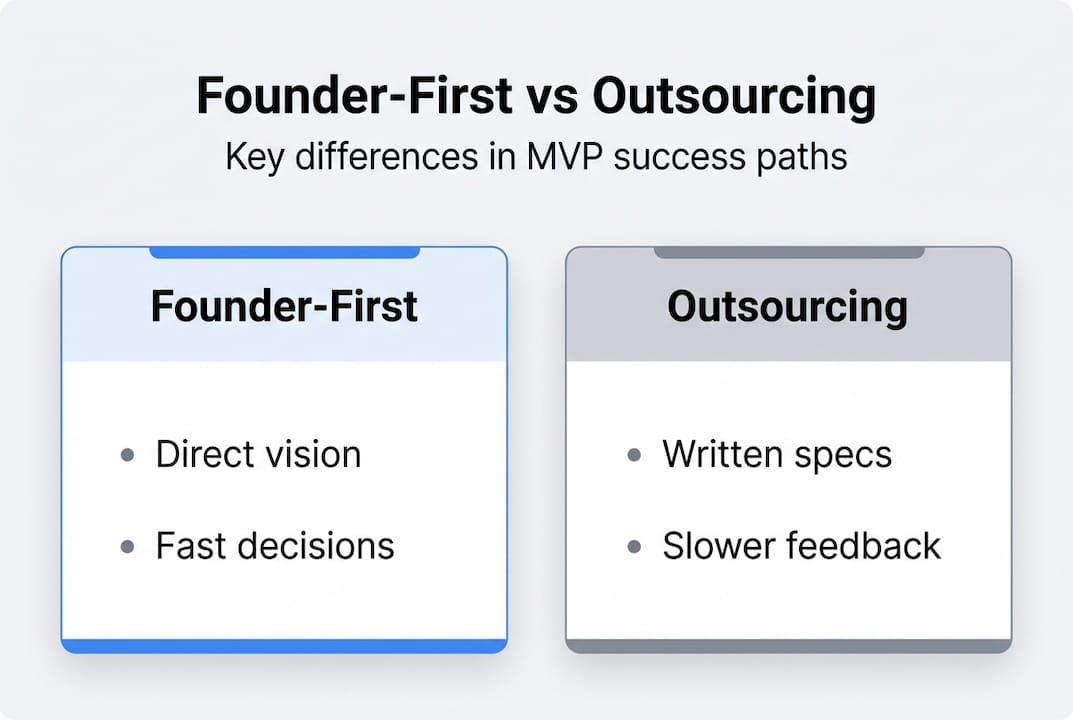
Founder-led early product stages yield clearer vision and faster execution in SaaS businesses. That’s not an accident. When the person who understands the user problem is directly involved in every product decision, the product reflects reality instead of a game of telephone.
Here’s how the two models compare:
| Factor | Founder-first model | Traditional agency/outsourcing |
|---|---|---|
| Decision speed | Fast, founder-driven | Slow, approval-dependent |
| Communication | Direct, daily | Filtered through PMs |
| Cost structure | Transparent, scoped | Bloated retainers |
| Equity impact | None | None, but higher cash cost |
| Product alignment | High | Low to medium |
The founder-first model works because it removes the translation layer between vision and code. When you can speak directly to the engineer building your product, misunderstandings get caught in minutes, not weeks.
Key advantages for non-technical founders:
- You don’t need to write technical specs. You describe the user problem and the outcome.
- Decisions happen fast because there’s no approval chain.
- You stay in control of scope, which is where most projects bleed money.
- Your startup product strategy stays coherent because one person owns it: you.
Pro Tip: Stop trying to communicate features. Communicate the user problem and the desired outcome. A good technical partner will figure out the right features. Your job is to protect the vision.
Essential preparations before you start
With an understanding of the founder-first difference, here’s how to set yourself up for success before a single line of code gets written.
Most founders rush to start building before they’ve answered three basic questions: What specific problem does this solve? Who exactly has that problem? And why is your solution meaningfully better than what already exists? If you can’t answer those clearly in two sentences each, you’re not ready to build.
A founder tech checklist and focused preparation enable rapid MVP success. Technical checklists aren’t bureaucracy. They’re the difference between a project that ships in eight weeks and one that drags on for six months because the scope kept shifting.

Here’s your MVP starter kit:
| Preparation item | What it looks like in practice |
|---|---|
| Problem statement | One paragraph describing the pain, who has it, and how often |
| Target user profile | Job title, context, and what they currently use instead |
| Value proposition | Why your solution beats the status quo |
| Core feature list | Maximum 5 features that prove the concept |
| Success metric | One measurable outcome that tells you the MVP worked |
Notice that none of these require technical knowledge. They require founder clarity. That’s the whole point.
Before you engage a technical partner, make sure you have these locked down:
- A written problem statement (not a pitch deck, a plain description)
- A prioritized list of must-have vs. nice-to-have features
- A clear definition of what “done” looks like for version one
- At least three real potential users willing to give you feedback
- A realistic budget and timeline expectation
The steps for fast MVP launch always start with founder clarity, not technical decisions. You cannot outsource your understanding of the problem. Everything downstream depends on it.
If you walk into a founder-first engagement without these inputs, you’ll waste the first two weeks of a paid engagement figuring out what you should have known before you started.
Founder-first development: step-by-step process
With your essentials in place, let’s walk through the concrete steps of founder-first development from kick-off to real users testing your product.
Step 1: Clarify your MVP outcome and success criteria. Before anything gets built, write down what success looks like. Not “users love it.” Something measurable: 50 signups in the first two weeks, or three paying customers within 30 days of launch. This single step prevents scope creep and gives both you and your technical partner a shared target.
Step 2: Collaborate on feature prioritization and scope. Sit down with your engineer and go through your feature list together. Direct founder-technical collaboration accelerates validation and minimizes misunderstandings. Your engineer will flag which features are expensive to build relative to the value they deliver. Listen to that input. Cut ruthlessly.
Step 3: Hold short, regular check-ins. Daily standups or weekly syncs keep decisions moving. The goal isn’t status reporting. It’s catching blockers early and making quick calls. If a feature turns out to be technically complex, you need to know in day three, not week six.
Step 4: Use direct feedback loops for rapid iteration. When your engineer shows you a working screen or a prototype, give real feedback immediately. Not “looks good.” Specific reactions: “This button placement confuses me” or “Users won’t understand this label.” Fast, direct feedback is what makes founder-first faster than any other model. When finding a mobile developer or any technical partner, look for someone who actively asks for this kind of feedback.
Step 5: MVP handoff and user validation. Once the core product is built, get it in front of real users immediately. Don’t polish. Don’t add features. Ship and watch.
Rapid feedback is more valuable than perfect plans. The market will tell you things no amount of internal planning ever could.
Pro Tip: Ask your engineer to explain trade-offs in plain language. “We can build X in two days or Y in two weeks. Here’s the difference.” That conversation, done regularly, keeps you in control of scope and cost.
Common pitfalls and how to avoid them
Once you’re executing, it’s just as critical to spot and avoid common founder pitfalls before they derail your project.
Poor collaboration and unclear expectations can derail SaaS projects, leading to stress and wasted resources. The mistakes aren’t usually technical. They’re human.
Here are the most common ones:
- Not communicating the real user problem. Founders often describe features instead of problems. Your engineer builds what you ask for, not what users actually need. Always anchor conversations to the user pain, not the solution.
- Feature creep. Every week, new ideas feel urgent. They rarely are. If a feature isn’t in your original success criteria, it goes on a backlog. Not in the current sprint.
- Micromanaging technical execution. You hired an engineer because they know how to build software. Let them. Your job is to own the product decisions, not the implementation details. Telling your engineer how to write code is like a client telling a surgeon which scalpel to use.
- Neglecting feedback and iteration. Some founders launch and then wait. Real learning comes from watching users struggle with your product in real time. Schedule feedback sessions before you launch.
- Skipping documentation of decisions. When you make a scope change or kill a feature, write it down. Verbal agreements disappear. Written decisions create accountability for both sides.
The technical co-founder role in a traditional setup often absorbs these communication failures silently. In a founder-first model, there’s nowhere to hide them, which is actually a feature, not a bug.
Pro Tip: Set communication protocols on day one. Agree on how decisions get documented, how scope changes get approved, and how blockers get escalated. Ten minutes of setup saves weeks of confusion.
The real reason founder-first works (and when it doesn’t)
Here’s what most guides won’t tell you: founder-first development isn’t a magic process. It’s a forcing function. It forces you to have clarity before you spend money. It forces your technical partner to stay aligned with real user needs. And it forces both of you to make decisions fast instead of hiding behind process.
Startups with engaged technical partners see up to 160% higher funding rates. That’s not because the process is clever. It’s because aligned teams build better products, faster.
But here’s the honest caveat: founder-first breaks down when the founder is indecisive, unclear about the problem, or changes direction every week. If you can’t commit to a scope, no process will save you. The model also struggles when founders have toxic communication habits, dismissing technical input or treating engineers as order-takers.
The best products emerge when founder vision and technical execution are directly aligned.
Ownership is the real differentiator. In founder-first, you own the product. That ownership creates urgency, clarity, and accountability that no agency arrangement can replicate.
Ready to build? Founder-first MVP help from an expert partner
The founder-first process gives you a clear path from idea to shipped product. But the process is only as strong as the technical partner executing it. Many founders succeed with this framework once they find someone who builds with the same urgency they feel.
If you want hands-on MVP development for founders backed by Fortune 500 engineering experience at BMW, Deutsche Bahn, and IBM, this is where that partnership starts. You work directly with the engineer writing your code. No project managers. No agency overhead. No equity dilution. Just fast, production-ready execution from someone who has built his own SaaS products and knows exactly what it takes to ship.
Frequently asked questions
How is the founder-first process different from hiring a traditional agency?
Founder-first puts you in the product driver’s seat, partnering directly with an engineer who adapts to your vision. Founder-focused methodologies empower founders to direct early product development without layers of managers filtering your decisions.
Can I use this process if I have zero technical skills?
Yes. Your main job is to clarify your user problem, not write code. Founder-first processes enable non-technical founders to rapidly launch SaaS products by keeping technical decisions where they belong: with the engineer.
What mistakes do most non-technical founders make during MVP development?
The most common mistakes are unclear priorities, overloading features, and micromanaging the engineering partner. Feature creep and poor communication lead to stress and wasted resources on both sides of the partnership.
How fast can a founder-first process launch an MVP?
A tightly run founder-first project often produces a working MVP in weeks, not months. Rapid MVP launches are enabled when founders come prepared and collaboration stays direct and focused.
What happens after MVP launch?
You iterate quickly using real user feedback, which is exactly what founder-first keeps you positioned to do. Real-world user validation post-launch accelerates product-market fit faster than any amount of pre-launch planning.