

TL;DR:
- Technical consulting offers non-dilutive, expert guidance for early MVP development, avoiding equity loss. It provides strategic input, accountability, and ownership preservation, making it ideal for validation and pivot phases. Founders should treat consultants as partners, ensuring alignment, knowledge transfer, and fostering durable, user-focused products.
You don’t have to give away equity to get good technical help. That’s the myth holding too many non-technical founders back from building something real. The assumption is binary: either find a technical co-founder and split ownership, or pay an agency and lose control of the product. But there’s a third path that most startup advice ignores. Technical consulting gives you a senior engineer in your corner, a clear plan for your MVP, and zero dilution from day one. This article breaks down exactly how that works and why it’s often the smartest move an early-stage founder can make.
Table of Contents
- What is technical consulting — and why does it matter?
- How technical consultants accelerate MVP development
- Technical consulting vs other paths: What’s best for non-technical founders?
- When is technical consulting the right move? Key signals and pitfalls
- A fresh perspective: What most founders miss when choosing a technical partner
- Ready to build? Technical consulting that puts founders first
- Frequently asked questions
Key Takeaways
| Point | Details |
|---|---|
| No equity dilution needed | Technical consulting lets founders retain ownership while benefiting from expert help. |
| Faster MVP launch | Structured consulting engagements and agile practices make MVP development quicker and more reliable. |
| Investor credibility boost | Startups with consulting support raise more funding and avoid common red flags. |
| Strategic, founder-centric guidance | Consultants align technical decisions with business goals, reducing wasted effort and costly pivots. |
What is technical consulting — and why does it matter?
Technical consulting, in the startup context, means hiring an experienced engineer or technical strategist on a contract basis to guide and build your product. Not as a co-founder. Not as a vendor you hand a spec sheet to. More like a senior technical partner who works with your vision, asks the hard questions, and executes with real accountability.
This is meaningfully different from other options you’ve probably already considered.
A technical co-founder role sounds appealing on paper. You get someone committed, skin in the game, motivated by the same upside. But the real cost is steep: you’re often handing over 15 to 30 percent of your company before a single user has validated your idea. You’re also betting on long-term alignment with someone you may have just met. Founders underestimate how badly misaligned co-founder relationships can derail a startup.
Agencies are the other common alternative. They’re fast to engage, they have teams, and they’ll build exactly what you spec. The problem is, they’re optimizing for billable hours, not for your business outcomes. You get what you pay for, and what you often get is technical debt.
Technical consulting sits in the middle. The engagement structure avoids equity until trust is built, using cash retainers instead, which makes it genuinely non-dilutive. You pay for expertise. You keep ownership. And you get someone whose reputation depends on your success.
Here’s what a well-structured consulting relationship looks like in practice:
- Clear scope and deliverables: No ambiguity about what you’re getting and when
- Direct communication: You talk to the person writing the code, not a project manager
- Strategic input, not just execution: A good consultant tells you when your idea has a flaw
- Flexible engagement: You’re not locked into a 12-month retainer if your needs shift
- No equity required: You protect your cap table from day one
The misconception that consulting equals low commitment is just wrong. A technical consultant who works with founders regularly knows their reputation is built on results. One bad engagement and the referrals dry up. That incentive structure actually creates more accountability than a salaried hire.
“The best technical consultants aren’t just builders. They’re the person who tells you what not to build — and that saves you more money than anything else.”
When does consulting make the most sense? Early-stage validation, first MVP build, navigating a pivot, or any moment where you need senior judgment without the overhead of a full-time hire. If you’re still figuring out whether your idea has legs, a technical consultant is exactly the right level of commitment.
Some argue that technical co-founders bring irreplaceable dedication and that 95% of non-technical solo founders struggle to scale. That’s a real stat. But it doesn’t mean equity is the only answer. It means you need genuine technical partnership, and consulting can deliver that without the long-term entanglement.
Technical partners can also boost your funding profile more than most founders expect, especially when the consultant has a track record that investors recognize.
How technical consultants accelerate MVP development
Now that the “what” is clear, let’s get into the “how.” The consulting engagement process for an MVP typically follows four phases: discovery, definition, execution, and transfer.
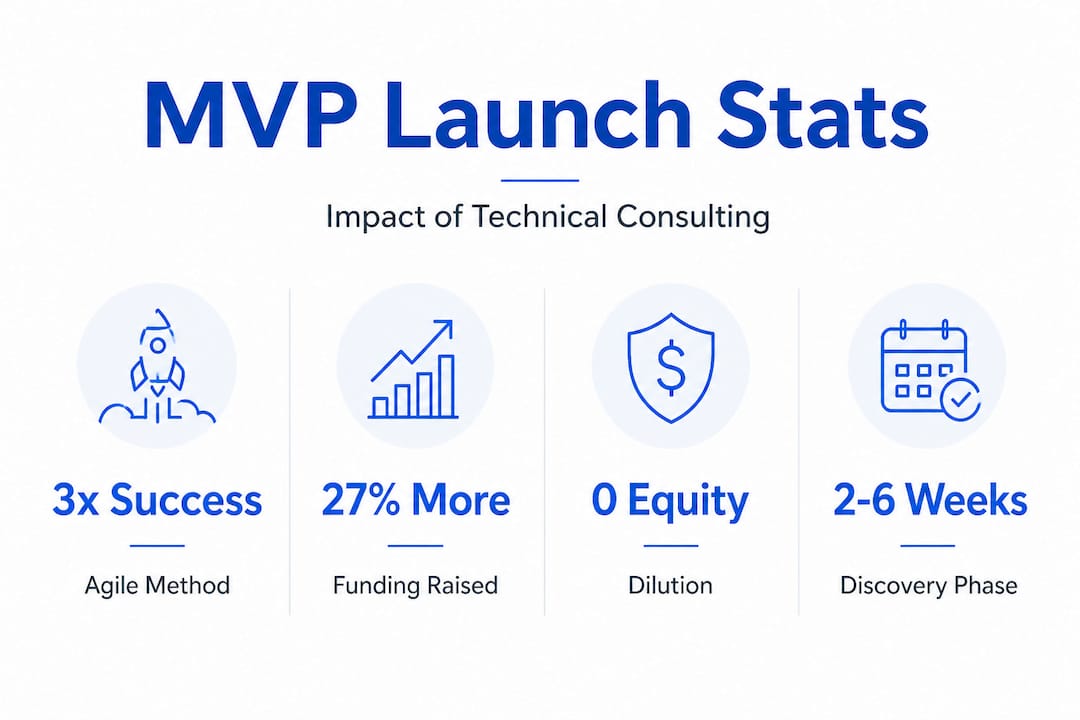
Phase one: Discovery. This is where a lot of projects get skipped, and it’s the single most expensive mistake founders make. Discovery typically runs two to six weeks and costs around $10,000. What you get is a deep diagnostic of your idea, your users, your tech constraints, and your competitive landscape. At the end, you have a real technical roadmap, not just a vague estimate.
This phase is where a good consultant earns their fee before writing a single line of production code. They identify scope creep risks, flag assumptions that could kill the product post-launch, and give you something concrete: a prioritized feature list and a realistic timeline.

Phase two: Definition. You lock down scope, agree on tech stack, define what “done” looks like for each feature. This isn’t sexy, but it prevents the single biggest cause of failed MVP launches: scope drift. Most MVPs fail not because of bad code, but because the goalposts kept moving.
Phase three: Execution. This is where the build happens. Agile methodology keeps things adaptive. Agile frameworks for MVPs break the build into short cycles called sprints, usually one to two weeks each. At the end of each sprint, you see working software. You give feedback. The next sprint adjusts. You stay in control of the direction without micromanaging the code.
The numbers on this are hard to ignore. Tech projects using agile are 3x more successful than those using traditional waterfall methods. Waterfall means you spec everything upfront, go dark for three months, then surface with something that may already be wrong. Agile means you course-correct every two weeks.
Phase four: Transfer. The product is yours. Code, documentation, credentials, architecture decisions. A responsible consultant leaves you with assets you can hand to any future engineer without chaos.
Here’s a practical breakdown of what founders typically get from this process:
- A working MVP deployed to production, not just a staging environment
- Clear documentation any future developer can read without a three-hour call
- A prioritized backlog for phase two based on real user feedback
- No equity given, no cap table touched
Pro Tip: Before you sign any consulting agreement, ask to see a sample discovery deliverable from a past engagement. A consultant who can’t show you a real technical scope document is not someone you want executing your MVP.
The financial side is also worth mapping out clearly:
| Engagement phase | Typical duration | Approximate cost | What you get |
|---|---|---|---|
| Discovery | 2 to 6 weeks | $8,000 to $12,000 | Technical roadmap and scope |
| MVP build | 4 to 12 weeks | $15,000 to $60,000+ | Production-ready product |
| Post-launch support | Ongoing, flexible | Retainer varies | Bug fixes, iteration, strategy |
| Full handover | 1 to 2 weeks | Included in project | Code, docs, and deployment |
Agile development strategies applied consistently throughout this process are what separate a consultant who ships from one who disappears into their editor.
Technical consulting vs other paths: What’s best for non-technical founders?
Let’s put the options side by side, because the abstract conversation only takes you so far.
| Option | Speed | Cost | Dilution | Investor appeal | Flexibility |
|---|---|---|---|---|---|
| Technical co-founder | Medium | Equity (15 to 30%) | High | Strong if aligned | Low |
| Agency | Fast to start | High cash cost | None | Weak | Low |
| Outsourcing | Fast | Low to medium | None | Red flag | Medium |
| Technical consulting | Fast | Medium cash | None | Increasingly strong | High |
The rapid SaaS MVP checklist most successful founders use points to one clear priority: retain ownership of the business as long as possible. Every percentage point you give away in the early stages compounds in value lost as your startup scales.
Outsourcing is worth calling out specifically, because it’s gotten popular as a cost-cutting strategy. It sounds smart: find a dev shop in a lower-cost market, save 60 percent on build costs, ship faster. Here’s the problem. Outsourcing your MVP is now a red flag for investors in 2026. It signals that you don’t have the technical depth in-house to own your own product. That’s not a narrative you want entering a seed round.
Technical co-founders bring real commitment, no question. But the equity cost is enormous, and alignment risk is underrated. If your co-founder wants to build a certain way and you want to go in a different direction, you’re suddenly in a governance dispute before you have a single paying customer.
Startups with consulting backgrounds raise 27% more funding according to YC data. The reason is credibility without the cap table complexity. An investor looks at your startup and sees that you engaged a senior technical partner with a track record, moved quickly, launched something that works, and still own 100 percent of your equity. That’s an appealing story.
Here’s what technical consulting gives you that nothing else does as cleanly:
- Clean cap table: No equity gone before product-market fit
- Senior judgment on tap: Not a junior dev farm executing your spec blindly
- Speed with accountability: Defined timelines and deliverables
- Honest pushback: A good consultant kills bad features before they waste your runway
- Transferable assets: Everything built is yours, fully documented
The founder-focused engineering guide that separates successful MVP launches from expensive failures almost always comes back to one factor: the founder had a real technical partner, not just a build-for-hire relationship.
When is technical consulting the right move? Key signals and pitfalls
Not every situation calls for a consultant. Here’s how to know when it’s the right fit and when it’s not.
Signs you need a consultant right now:
- You have a validated idea but no idea how to build it, and you don’t want to dilute your equity to get there
- You hired a developer or small agency and the project stalled, broke, or went over budget
- You’re pre-seed and need to show investors a working product without the complexity of a co-founder split
- You’ve built something but it’s held together with duct tape and you know it won’t scale
- You want strategic input on your tech decisions, not just someone to execute a spec sheet
When consulting might not be right:
If you’re well past product-market fit, generating significant revenue, and ready to hire an in-house engineering team, a full-time CTO might be a better fit. Consulting scales with your early-stage needs. It’s not a replacement for internal engineering at Series A and beyond.
The most common pitfall is what experienced engineers call the “tool-first” trap. You come in with a predetermined tech stack because you read about it on Twitter. You want to build in a specific framework, or use a specific AI tool, because it sounds cutting-edge. A consultant asks the uncomfortable question: does this tool actually solve your user’s problem? 58% of first AI analytics deployments fail due to poor methodology, not lack of technical sophistication. The tool wasn’t the problem. The thinking before the tool was.
Question-first thinking means starting with: what does my user actually need to do? Then working backward to the right technology. Tool-first thinking starts with “I want to use X” and builds a product around that choice. This kills startups quietly and expensively.
Founder-developer alignment is the foundation of any consulting engagement that actually ships something useful. When founders and their technical partners are not aligned on what success looks like, scope creep and costly pivots follow.
Pro Tip: Before you start any technical engagement, write down the three things your MVP absolutely must do for a user to tell their friend about it. If your consultant can’t explain how the architecture supports those three things specifically, keep looking.
Agreement structures matter too. Always clarify upfront: who owns the IP? What happens if you need to pause the engagement? Is documentation included in scope? These aren’t defensive questions. They’re the difference between a clean handover and a hostage situation where your code lives on someone else’s server.
Founder communication tips from experienced technical partners consistently point to one behavior that separates fast-moving founders from slow ones: write things down. Every major decision made verbally is a future disagreement waiting to happen.
A fresh perspective: What most founders miss when choosing a technical partner
Here’s the part most articles don’t say.
The founders who get the most out of technical consulting are the ones who treat it like a partnership, not a transaction. They don’t show up with a 40-page spec and say “build this.” They show up with a problem and a user, and they’re open to having their assumptions challenged.
Most founders overvalue speed and undervalue strategic alignment. I’ve seen it repeatedly. A founder comes in hot, wants an MVP in four weeks, and gets one. It ships. It crashes. Not because the code was bad, but because the assumptions behind the feature set were never tested. Speed without direction is expensive.
The founders who build durable startups treat their technical consultant like a co-pilot. They share context, they ask for opinions, and they push back on technical recommendations with business logic rather than emotional attachment to features. That dynamic produces something a solo build never does: a product designed around what the business actually needs, not what looked cool in a competitor’s interface.
There’s also a pattern I notice around ownership of technical vision. Founders who delegate all technical thinking to their consultant tend to end up with products they don’t fully understand. Then when the engagement ends, they’re lost. The best consulting relationships transfer knowledge alongside code. A custom app development engagement done right means the founder walks away understanding what they have, why it was built the way it was, and how to explain it to their next hire.
The uncomfortable truth is this: if you’re hiring a consultant to avoid thinking about the technical side of your business, you’re solving the wrong problem. Consulting works best when you stay engaged, ask questions, and build your own understanding as the product gets built. You don’t need to learn to code. But you do need to understand the decisions being made about your product.
Alignment and clarity of vision prevents the costly pivots that drain runway and demoralize teams. Founders who treat technical consultants as trusted advisors, rather than service vendors, build products that survive contact with real users.
Ready to build? Technical consulting that puts founders first
If this article made you rethink the equity-or-nothing assumption, that’s the point.
Hanad Kubat works directly with non-technical founders at hanadkubat.com to build production-ready MVPs and SaaS products in 4 to 12 weeks. No agency layer. No project managers playing telephone between you and the code. Fortune 500 engineering discipline from BMW, Deutsche Bahn, and IBM, applied at founder speed. Every recommendation comes from first-hand experience building real SaaS products. Engagements are non-dilutive and structured to protect your vision and your cap table. If you’re done planning and ready to ship, a discovery call is the right first step.
Frequently asked questions
Is technical consulting only for large startups or can small teams benefit?
Small teams benefit the most from technical consulting because it delivers senior, non-dilutive guidance via cash retainers, making strategic engineering accessible without giving up equity at the earliest and most valuable stage.
Won’t investors prefer technical co-founders over consultants?
Some investors do prefer co-founders, but startups with consulting backgrounds raise 27% more funding on average, and a clean cap table with a demonstrated working product often tells a stronger story than a complex equity split without validation.
How does technical consulting actually speed up MVP development?
Structured discovery phases map out scope, risks, and timeline before a single line of code is written, while agile’s 3x success rate over waterfall means the build phase stays adaptive, reducing wasted effort and late-stage surprises.
Is outsourcing MVP development a good idea in 2026?
Outsourcing MVPs has become a red flag for investors, signaling lack of technical ownership. Technical consulting gives you the same cost flexibility with the credibility investors actually want to see.
What’s the main risk of skipping technical consulting for founders?
Founders who skip structured consulting often fall into tool-first thinking, choosing technology before strategy, and 58% of those first deployments fail due to poor methodology rather than bad code. Consulting replaces guesswork with a question-first approach.