

TL;DR:
- Non-technical founders can build and launch MVPs faster by focusing on clear goals and essential features.
- Using no-code tools for validation and collaborating directly with senior engineers accelerates MVP success.
- Cultural differences in Europe favor direct founder-engineer collaborations over traditional agency-based development.
You have a SaaS idea that could genuinely solve a real problem, but every time you try to move forward, you hit a wall of technical jargon, agency quotes that would sink a Series A, and engineers who seem to speak a completely different language. You’re not alone. Most non-technical founders spend months stuck in this exact loop, burning cash and confidence while competitors ship. This guide breaks that cycle. You’ll get a practical, no-fluff blueprint covering how to define your MVP, pick the right tools, collaborate with engineers effectively, avoid the most costly mistakes, and measure whether your process is actually working.
Table of Contents
- Identifying your MVP target: What founders need to know
- Assembling your founder-centric MVP toolkit
- How to work with engineers as a non-technical founder
- Mistakes founders make and how to avoid them
- Benchmarks and signals of a successful founder-focused MVP
- Real take: Why most founder-engineering partnerships stall in Europe (and what actually works)
- Get hands-on support for your founder-led MVP
- Frequently asked questions
Key Takeaways
| Point | Details |
|---|---|
| Start with a clear MVP goal | Defining your exact MVP target prevents costly feature bloat and ensures alignment. |
| Leverage founder-centric tools | Use pre-vetted stacks and simple tools to build faster and keep overhead low. |
| Prioritize communication and alignment | Frequent, clear check-ins with engineers speed up development and reduce roadblocks. |
| Avoid common founder pitfalls | Stay focused, build only what’s necessary, and correct course early when needed. |
| Measure process results | Monitor launch speed, feedback cycles, and user traction to ensure your engineering approach works. |
Identifying your MVP target: What founders need to know
With your serious intent to move quickly, the first hurdle is knowing exactly what problem you want your MVP to solve. An MVP, or minimum viable product, is not a half-finished app. It’s the smallest possible version of your product that proves your core assumption with real users. That distinction matters enormously because it determines how much time, money, and energy you spend before you know if your idea works.
Clear goals and value propositions are required before a single line of code gets written. Without them, you’re asking engineers to build a moving target, and that’s how projects double in cost and timeline before they ever reach a user.
Start by writing one sentence that completes this prompt: “My MVP helps [specific person] do [specific thing] so they can [specific outcome].” If you can’t finish that sentence clearly, you’re not ready to build yet. That’s not a failure. That’s the most valuable information you can have at this stage.
Must-have vs. nice-to-have features
Before you open any design tool or talk to any engineer, sort your feature ideas into two buckets:
- Must-have: Core functionality that directly proves your hypothesis. Without this, the product doesn’t work.
- Nice-to-have: Features that improve experience but don’t validate the core idea. These come later.
For MVP validation best practices, the rule is simple: if a feature doesn’t directly test your core assumption, it doesn’t belong in version one. Kill it for now.
Here’s a simple scope vs. complexity table to help you map your features before you start:
| Feature | Core assumption tested? | Complexity | MVP priority |
|---|---|---|---|
| User login and auth | No (but required) | Low | Include |
| Core workflow (main job) | Yes | Medium | Include |
| Dashboard analytics | Partially | Medium | Defer |
| Team collaboration | No | High | Defer |
| Custom branding | No | Low | Defer |
| Payment processing | Yes (if revenue-driven) | Medium | Include |
| Mobile app | No | High | Defer |
This table forces honest conversations. When you’re launching your first SaaS product, the temptation to add “just one more feature” is constant. Resist it every single time.
Pro Tip: Assign each feature a score from 1 to 5 for two things: how much it proves your hypothesis, and how much it costs to build. Features with a high hypothesis score and low build cost go in the MVP. Everything else waits.
Assembling your founder-centric MVP toolkit
Once you know what you’re building, it’s time to assemble everything needed in the leanest way possible. The good news is that the SaaS ecosystem in 2026 gives founders more leverage than ever. The bad news is that more options mean more ways to get distracted or overspend.
Pre-vetted SaaS stacks and experienced partners allow non-technical founders to move dramatically faster than trying to piece together tools from scratch. The key is knowing which category of tool to use for which job.
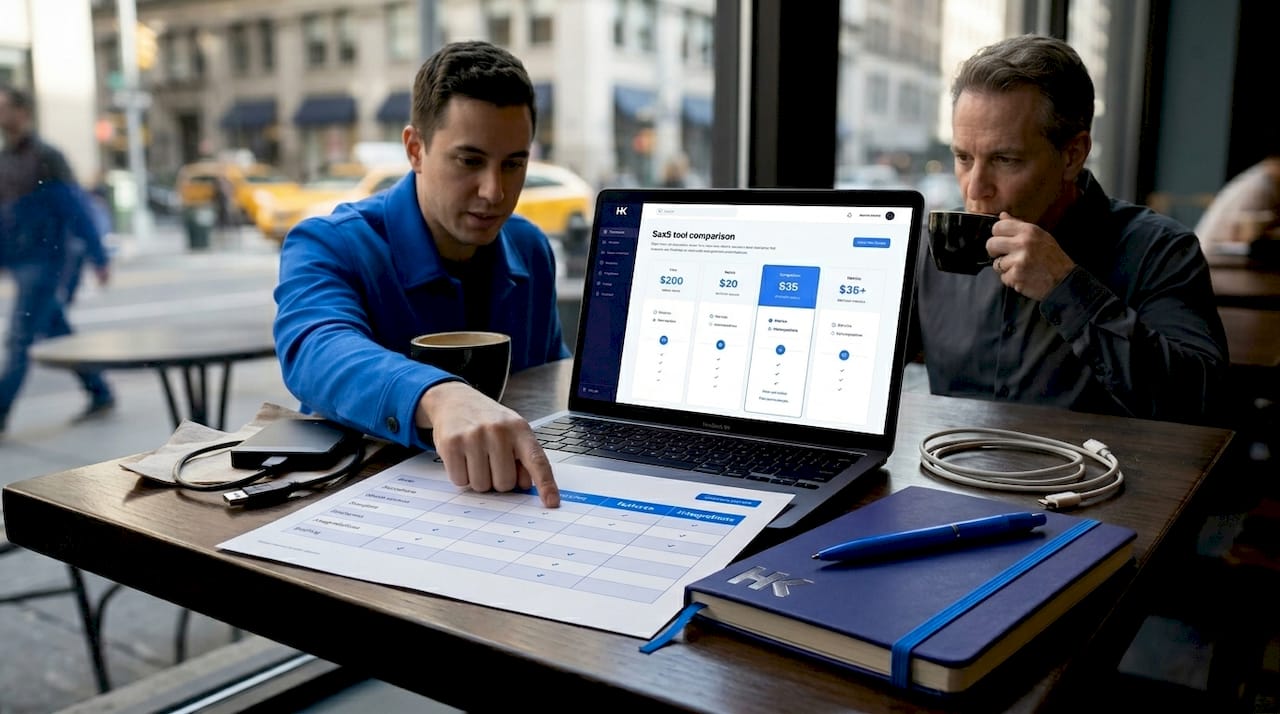
Here’s a comparison of the two main paths founders take:
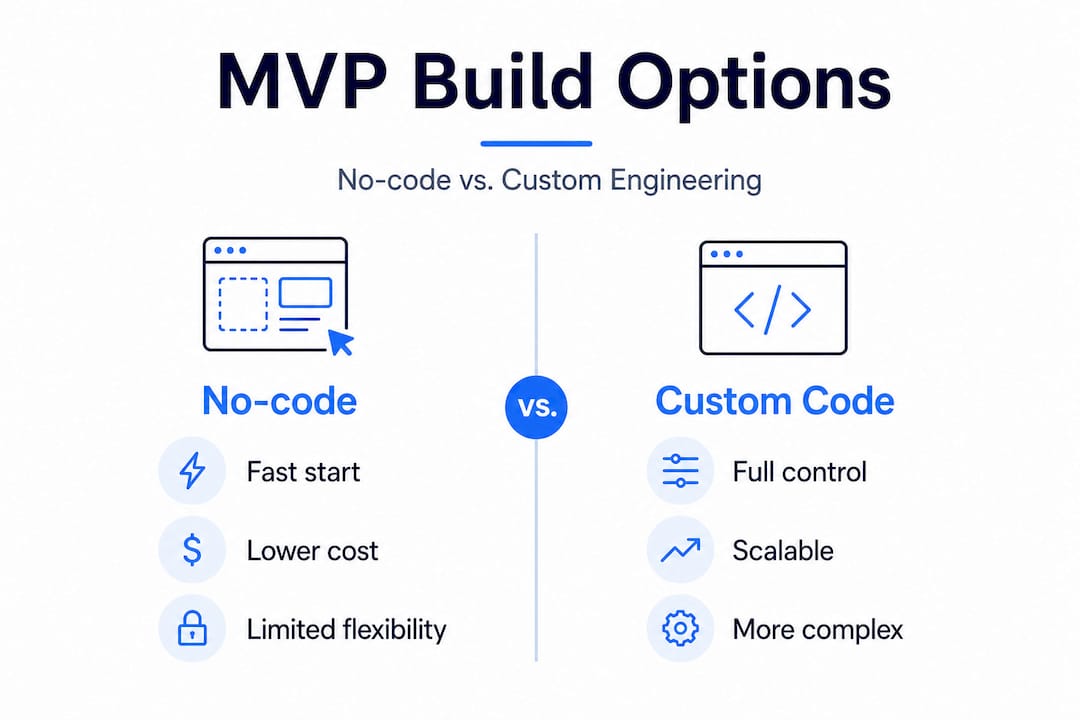
| Category | No-code/low-code tools | Custom engineering |
|---|---|---|
| Speed to prototype | Very fast (days) | Moderate (weeks) |
| Scalability | Limited | High |
| Cost upfront | Low | Medium to high |
| Flexibility | Low | Very high |
| Best for | Concept validation | Production-ready SaaS |
| Risk | Platform lock-in | Requires strong specs |
No-code tools like Webflow, Bubble, or Glide are excellent for testing whether anyone wants your product at all. But the moment you need real data logic, custom integrations, or a product that can scale past a few hundred users, you need custom engineering. The mistake most founders make is treating no-code as a permanent solution rather than a validation step.
The minimum viable team for an MVP launch
You don’t need a full product team. Here’s what a lean MVP launch actually requires:
- One senior engineer (full-stack preferred, or separate frontend and backend if needed)
- One product-focused founder (you, with clear requirements and decision-making authority)
- One UX designer (part-time or freelance is fine for MVP stage)
- One analytics tool (Mixpanel, PostHog, or even Google Analytics for early signals)
- One feedback channel (Intercom, Typeform, or direct user interviews)
Notice what’s missing: a project manager, a QA team, a DevOps specialist, and a marketing department. Those come later. At MVP stage, overhead kills speed.
The tech checklist for SaaS MVPs also includes infrastructure decisions: where you host, how you handle authentication, and which payment provider you use. These aren’t glamorous decisions, but getting them wrong early creates expensive rework later.
Research consistently shows that startups using established SaaS infrastructure components, rather than building everything custom, reach their first user milestone significantly faster. The value of a technical co-founder or a senior technical partner is precisely in making these infrastructure calls correctly the first time, so you don’t spend three months rebuilding what should have taken three weeks.
Essential non-technical tools founders overlook
Beyond the code itself, you need:
- Figma for wireframes and design handoffs
- Notion or Linear for requirement tracking
- Loom for async communication with your engineer
- Calendly for scheduling feedback sessions with early users
These tools cost almost nothing and eliminate enormous amounts of confusion between you and your technical team.
How to work with engineers as a non-technical founder
With your toolkit ready, everything hinges on effective collaboration between you and your technical team. This is where most founder-engineer relationships break down, not because either side is incompetent, but because they’re operating with completely different mental models of what “done” means.
Founder-developer alignment is the single biggest predictor of whether an MVP ships on time and within budget. When founders and engineers are misaligned, timelines slip, features get built wrong, and frustration builds on both sides.
Here’s a practical numbered process for setting up the relationship correctly from day one:
- Write a one-page product brief before any technical conversation. Include the problem, the target user, the core workflow, and what success looks like in 90 days.
- Define what “done” means for each feature in plain language. “User can log in” is not specific enough. “User can create an account with email, receive a verification email, and log in within 60 seconds” is.
- Establish a weekly sync of no more than 30 minutes. Use this to review what shipped, what’s blocked, and what’s next. No more, no less.
- Create a decision log where every significant technical or product decision gets recorded with the date and the reason. This eliminates “I thought we agreed” arguments.
- Separate feedback from requests. When you see something you want changed, first ask whether it affects the core hypothesis. If not, add it to a backlog. Don’t interrupt the sprint.
Sample kickoff script for your first engineer meeting
When you start working with a new technical partner, the first conversation sets the tone for everything. Here’s a script you can adapt:
“Here’s the problem we’re solving and who we’re solving it for. Here’s the one workflow that proves the idea works. Here’s what I need to see in 30 days to know we’re on track. Here are the decisions I’ll make, and here are the ones I need your expertise on. What questions do you have before we start?”
That’s it. No 40-slide deck. No feature wishlist. Clear problem, clear success metric, clear division of responsibility.
Alignment between founders and engineers isn’t a soft skill. It’s a technical accelerant. Every hour spent getting aligned upfront saves three hours of rework downstream.
The founder-first development process works because it treats the founder’s time and judgment as a core input to the engineering process, not an afterthought. When engineers understand the business context behind every feature, they make better technical decisions automatically.
Pro Tip: Use Loom videos to communicate complex feedback. A 90-second screen recording showing exactly what you mean eliminates three rounds of back-and-forth email that could delay your sprint by a full day.
One more thing: ask your engineer to explain technical constraints in business terms. A good technical partner will tell you, “That feature would add two weeks because of X, but we could get 80% of the value in two days if we do Y instead.” That kind of engineering-driven MVP success thinking is what separates a great technical partner from a code vendor.
Mistakes founders make and how to avoid them
Even with best practices, many founders repeatedly fall into avoidable traps. Learning from these missteps will save you time and money, and in some cases, save the entire product.
Feature creep, unclear requirements, and lack of MVP focus are the three most common ways non-technical founders derail their own builds. The frustrating part is that all three are entirely preventable.
The most common MVP mistakes and how to fix them
- Scope bloat: You start with five features and end up with fifteen before the first sprint is done. Fix this by requiring a written justification for any new feature added after kickoff. If it can’t be justified in one sentence tied to your core hypothesis, it doesn’t go in.
- No feedback loops: You build for eight weeks without showing anything to a real user. By the time you launch, you’ve built the wrong thing. Fix this by scheduling user interviews every two weeks, even if the product is rough.
- Skipping validation: You assume you know what users want instead of testing it. Fix this by defining one measurable assumption your MVP will prove or disprove, and designing the product specifically to test that assumption.
- Hiring the wrong engineer: You choose based on price rather than fit. A junior developer who needs constant direction costs more in your time than a senior engineer who works autonomously. Fix this by checking for SaaS-specific experience and asking for references from founders, not enterprise clients.
- Treating the MVP as the final product: You over-engineer for scale before you have users. Fix this by explicitly defining what “good enough for launch” looks like and holding that line.
The MVP validation traps that catch founders most often share a common root: they’re optimizing for the product they imagine rather than the information they need. Your MVP is a learning tool, not a portfolio piece.
Pro Tip: Set a hard checkpoint at the four-week mark. Ask yourself: “If I stopped building today and showed this to ten potential users, would I learn something useful?” If the answer is no, you’ve already drifted into over-building territory. Cut back immediately.
What repeat SaaS founders do differently is they treat every sprint as an experiment with a hypothesis, not just a to-do list. They define what they expect to learn, they build the minimum to test it, and they make decisions based on what users actually do, not what users say they’ll do.
Benchmarks and signals of a successful founder-focused MVP
After launch, it’s vital to know if your process actually delivered the results you hoped for. Too many founders launch and then wait passively for signals. The better approach is to define your success metrics before you build, so you know exactly what you’re measuring and why.
Aligned founder-engineer teams consistently reach launch faster and attract more early users than teams operating with misalignment or agency overhead.
Here’s a benchmark table based on lean SaaS MVP builds:
| Metric | Typical agency build | Founder-focused build |
|---|---|---|
| Time to first working prototype | 10-16 weeks | 3-5 weeks |
| Time to first real user | 16-24 weeks | 6-10 weeks |
| Cost to MVP launch | €50K+ | €15K-€30K |
| Feedback cycle time | 2-4 weeks | 3-7 days |
| Feature changes post-launch | High (30%+) | Low (under 15%) |
Key signals that your MVP process is truly founder-focused
- You can describe the product’s core workflow in under two minutes without technical help
- Your engineer proactively flags scope risks before they become timeline problems
- You’re talking to real users at least every two weeks during the build
- Every feature in the product maps directly to a business assumption you’re testing
- You launched something imperfect and learned from it, rather than waiting for perfect
Quick post-launch measurement checklist
- Activation rate: What percentage of signups complete the core workflow?
- Retention at day 7 and day 30: Are users coming back?
- Time to value: How long does it take a new user to get their first result?
- Support ticket themes: What are users confused about most?
- Net Promoter Score (NPS): Would users recommend this to someone with the same problem?
Startups that secure funding from technical partners and maintain strong engineering alignment show measurably better early metrics, which directly influences investor confidence at the seed stage. Investors don’t just fund ideas. They fund evidence. Your MVP metrics are that evidence.
Real take: Why most founder-engineering partnerships stall in Europe (and what actually works)
Here’s something most guides won’t tell you: the European startup ecosystem has a specific problem with founder-engineering partnerships that goes beyond technical skill. It’s cultural and structural.
Most development shops and consultancies in Europe, particularly in German-speaking markets, are built around process. They have project managers, discovery phases, specification documents, and approval gates. That structure works beautifully for enterprise clients who need compliance and documentation. It’s a disaster for founders who need to ship, learn, and pivot in weeks, not quarters.
When a founder with a lean budget and a tight timeline walks into a traditional agency, they get quoted for a process that was designed for a client with a 12-month runway and a dedicated internal product team. The founder ends up paying for overhead they don’t need, waiting for meetings that don’t move the product forward, and getting updates filtered through someone who has never written a line of code.
The result is predictable: the founder runs out of patience, money, or both before the MVP ships.
What actually works is a model where the person making technical decisions is the same person writing the code. No translation layer. No project manager playing telephone between you and the engineer. When you say “I want users to be able to do X,” the response you get is either “here’s how we’ll build it” or “here’s why that’s harder than it sounds, and here’s a simpler way to get the same result.” That’s the conversation that accelerates everything.
The contrarian truth is that less process drives faster launches. Founders don’t need weekly status reports and Gantt charts. They need a technical partner who understands the business goal and makes engineering decisions in service of that goal, not in service of a methodology.
I’ve seen this pattern across multiple SaaS builds. The founders who ship fastest are the ones who have direct access to their engineer, who can make a decision in a Slack message and see it implemented the next day, and who treat the technical partnership as a genuine collaboration rather than a vendor relationship.
The way founders shape healthier SaaS teams is by being present, decisive, and clear. Not by adding more process. The best technical partnerships in Europe aren’t happening in agencies. They’re happening between individual founders and senior engineers who’ve built their own products and know what it actually takes to ship.
Get hands-on support for your founder-led MVP
If you’ve read this far, you’re not looking for theory. You’re looking for a way to actually ship. The gap between a great idea and a working product is almost always execution, and execution requires the right technical partner, not just the right tools or the right framework.
At hanadkubat.com, the entire model is built around founder-focused engineering support. No agency overhead, no project manager in the middle, no team page with faces you’ll never actually work with. You get direct access to a senior full-stack engineer who has built his own SaaS products, worked at the Fortune 500 level, and knows how to cut scope without cutting value. MVPs start at €15K and ship in 4 to 12 weeks. If you’re ready to stop planning and start building, this is the next step.
Frequently asked questions
What does ‘founder-focused engineering’ actually mean?
It means tailoring the entire technical development process to the founder’s exact needs and speed, not a one-size-fits-all agency setup. Founder-first development emphasizes direct founder involvement and rapid iteration over rigid process.
Do I need a technical co-founder to start my MVP?
No, but having an experienced technical partner or engineer increases your success, even if you’re not ready to add a co-founder yet. Research shows a 164% funding boost with a technical co-founder, but a strong technical partnership delivers many of the same benefits without equity dilution.
How fast can a founder-focused process deliver an MVP?
With clear scope and alignment, many non-technical founders launch MVPs within 8 to 12 weeks. Aligned founder-engineer teams consistently launch faster than traditional agency setups.
What’s the most common mistake non-technical founders make with MVPs?
The biggest mistake is overscoping, which means trying to build too much too soon and losing focus on learning from real users. Feature creep and unclear priorities are the fastest ways to blow your budget before you’ve validated anything.
Is it possible for a solo founder to launch a SaaS MVP?
Yes, but it’s faster and more reliable with a lean team or part-time engineering partner. Solo founders can build MVPs effectively when they have the right technical tools and a senior partner who can make autonomous decisions.
Recommended
- How to launch a SaaS app: a practical guide for founders | HK
- SaaS MVP: Launch fast without a technical co-founder | HK
- How to Quickly Launch a SaaS MVP That Scales | HK
- Non-technical founder SaaS guide: Launch your first product | HK
- Small Startups (1-20 Employees) | Outsprinter
- Step by step app development guide for business founders 2026