

TL;DR:
- Nearly 50% of SaaS startups fail due to lack of market need rather than technical issues.
- Validation involves proving real customers have a problem, tried solutions, and are willing to pay.
- Effective validation uses methods like landing pages, customer interviews, and ongoing testing to reduce risk.
Nearly half of all SaaS startups fail not because of bad code or poor marketing, but because nobody wanted what they built. 42% of startup failures trace back to no market need. That’s not a technical problem. It’s a validation problem. If you’re a non-technical founder with a SaaS idea, the most expensive mistake you can make is skipping straight to development. This guide breaks down exactly what idea validation is, how to do it step by step, and which frameworks and tools actually work. No fluff, no theory for theory’s sake. Just a clear path from idea to evidence.
Table of Contents
- What is idea validation and why is it essential?
- The five-stage idea validation framework for SaaS founders
- Real-world validation methods: landing pages, customer interviews, and metrics
- Pitfalls and limits: vanity metrics, over-building, and the reality check
- A founder’s perspective: Why prioritizing problem validation trumps everything else
- Take the next step: Expert MVP validation for founders
- Frequently asked questions
Key Takeaways
| Point | Details |
|---|---|
| Validation reduces failure risk | Confirming real market need before building prevents most costly founder mistakes. |
| Follow a five-stage process | Using a structured framework cuts wasted time and boosts your product-market fit odds. |
| Practical tests matter | Landing pages and interviews with ideal customers reveal true demand and willingness to pay. |
| Beware vanity metrics | Focus on meaningful results, not empty signups or positive feedback from friends. |
What is idea validation and why is it essential?
Idea validation is the process of confirming that real people have a real problem, and that they’d actually pay for a solution before you write a single line of code. That’s it. It sounds obvious, but most founders skip it entirely or do a watered-down version that gives them false confidence.
The stakes are high. Building a SaaS product takes months and tens of thousands of dollars. If you’re bootstrapped, that’s your own money. If you’ve raised a small round, that’s your runway. Burning either on a product nobody wants is a mistake you can’t always recover from.
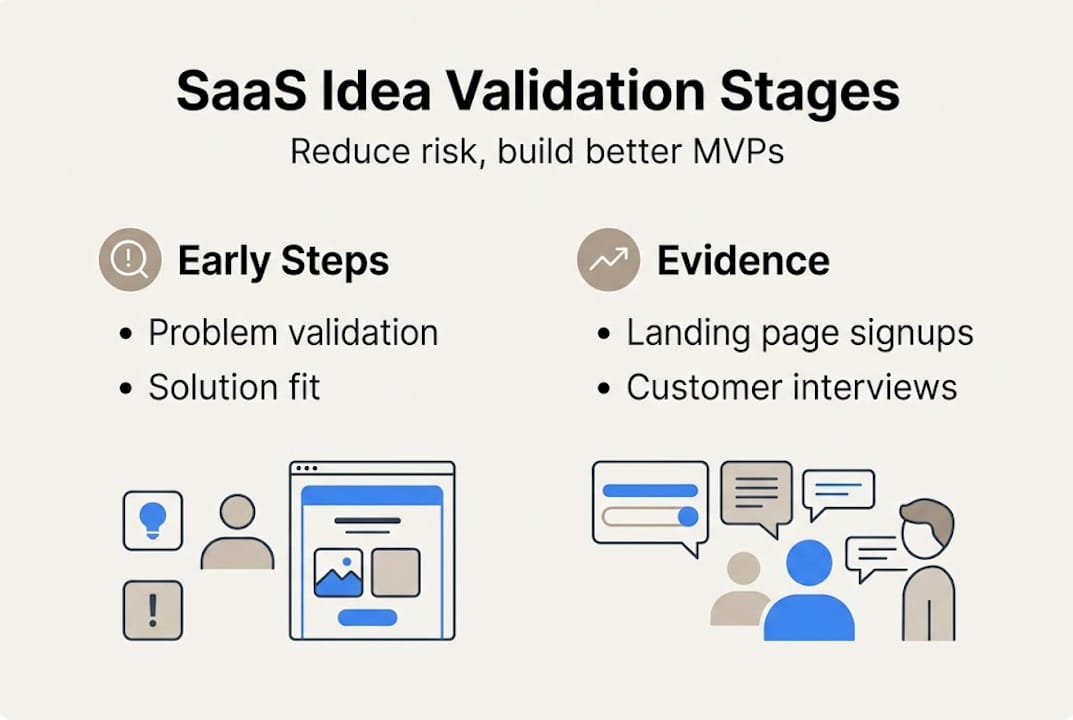
Here’s what idea validation reduces: wasted development time, wasted capital, and the emotional cost of building something for a year only to watch it fail at launch. Validation links directly to product-market fit, which is the single biggest predictor of SaaS survival. You can read more about the mechanics of this in this step-by-step product validation breakdown.
Before going further, let’s kill some myths:
- Asking friends if your idea is good is not validation. Friends lie to protect your feelings.
- Getting 10 survey responses is not validation. Surveys capture opinions, not behavior.
- Building an MVP first, then seeing if people use it is not validation. That’s just building with extra steps.
Real validation means getting evidence that a specific group of people has a painful, recurring problem, that they’ve tried to solve it and failed, and that they’re willing to pay for a better solution. That evidence has to come from strangers, not your network.
“42% of startups fail because they build something the market doesn’t need. Validation isn’t optional. It’s the only way to know if you’re solving a real problem before you’ve spent everything trying to solve it.”
The other thing founders get wrong is timing. Validation isn’t a one-time checkbox you tick before development. It’s an ongoing process. You validate the problem, then the solution concept, then the pricing, then the go-to-market approach. Each stage gives you more confidence and reduces the risk of building the wrong thing.
The five-stage idea validation framework for SaaS founders
There’s a proven five-stage framework that covers the full validation journey: problem validation, market sizing, competitor analysis, revenue model testing, and demand testing. Here’s how each stage works in practice.
- Problem validation. Talk to 10 to 30 people in your target market. Don’t pitch your idea. Ask about their current workflow, their biggest frustrations, and what they’ve already tried. You’re listening for pain, not applause.
- Market sizing. Estimate how many people have this problem and how often. Bottom-up math works best here. Start with a realistic slice of the market you can actually reach, not a top-down “1% of a billion-dollar market” fantasy.
- Competitor analysis. If there are no competitors, that’s a red flag, not a green one. It usually means there’s no market. Study what exists, where it falls short, and whether you can realistically differentiate.
- Revenue model testing. Before you build, figure out how you’ll charge. Monthly subscription? Usage-based? Freemium with upsells? Each model has different implications for customer acquisition cost and lifetime value.
- Demand testing. Run a landing page, a waitlist, or a prototype. Measure real behavior, not stated intent. This is covered in detail in the section below.
| Stage | Where most ideas die | Time estimate |
|---|---|---|
| Problem validation | Very high failure rate | 1 to 2 weeks |
| Market sizing | High failure rate | 3 to 5 days |
| Competitor analysis | Moderate failure rate | 3 to 5 days |
| Revenue model | Moderate failure rate | 2 to 3 days |
| Demand testing | Lower but still significant | 2 to 4 weeks |
For more on validating SaaS ideas before spending money on development, and how to apply Lean product creation principles to speed up the process, those resources go deeper on each stage.
Pro Tip: Don’t skip stage one. Problem validation is where most ideas break. If you can’t find 10 strangers who feel genuine pain around your problem, you don’t have a business yet.
Real-world validation methods: landing pages, customer interviews, and metrics
Frameworks are useful. But you need actual tools to generate evidence. Here are the three most effective methods for SaaS founders in 2026.
Landing page tests are the fastest way to measure real demand. Build a one-page site that describes the problem, your solution concept, and a clear call to action, usually an email signup or waitlist. Drive targeted traffic from Reddit, LinkedIn, or paid ads. If you’re spending $200 on ads and getting zero signups, that’s data. Painful data, but data.
Here’s a benchmark table to guide your expectations:
| Validation method | Target benchmark | Typical timeline |
|---|---|---|
| Landing page signups | 50 to 100 from ICP | 2 to 4 weeks |
| Customer interviews | 10 to 30 structured sessions | 1 to 2 weeks |
| Prototype click-throughs | 30% or higher engagement | 1 week |
| Willingness to pay signal | At least 20% express intent | Ongoing |
The Mom Test approach to customer interviews is the gold standard for avoiding bias. The core idea: never ask people if they like your product. Ask about their life, their current tools, their past behavior. “How much did you spend last year trying to solve this?” tells you more than “Would you use this app?”

The Lean Startup methodology formalizes this as build-measure-learn cycles, but the key insight is that you should be measuring behavior, not opinions.
Common mistakes founders make at this stage:
- Interviewing friends, family, or colleagues who want to be supportive
- Counting social media likes or comments as validation
- Treating a waiting list full of free-tier seekers as paying demand
- Asking leading questions that confirm their existing assumptions
- Skipping the MVP validation checklist and jumping straight to building
For a deeper look at MVP validation best practices that work in the real world, that resource covers the full process with specific examples.
Pro Tip: Aim for 50 to 100 signups from your ideal customer profile, not random traffic. One hundred signups from the wrong audience tells you nothing. Thirty signups from the exact person you’re building for tells you everything.
Pitfalls and limits: vanity metrics, over-building, and the reality check
Validation frameworks are powerful. They’re not magic. Even founders who follow every step can still get it wrong, usually because they’re measuring the wrong things or hearing what they want to hear.
The vanity metrics trap is the most common failure mode. You launch a landing page, get 500 signups, and feel validated. But if those signups came from a viral tweet with no targeting, and none of them match your ideal customer profile, you’ve learned nothing useful. Signups without intent to pay are just email addresses.
“The Lean Startup teaches validated learning through MVPs, but warns against over-relying on vanity metrics. The 90% startup failure rate persists even among founders who think they’ve validated their ideas.”
Here are the most common pitfalls to watch for:
- Over-building before validation. Spending three months building features nobody asked for.
- Ignoring your ICP. Validating with the wrong audience gives you false confidence.
- Not testing willingness to pay. Enthusiasm is free. Money is the real signal.
- Treating positive feedback as demand. “This is a great idea” is not a purchase order.
- Skipping the MVP validation impact analysis before committing to a full build.
There’s also a healthy dose of skepticism worth keeping in mind. Validation reduces risk. It doesn’t eliminate it. Markets shift. Timing matters. A well-validated idea in 2024 might face a crowded market by 2026. The goal isn’t certainty. It’s reducing the odds of catastrophic failure before you’ve spent your budget.
The founders who do this well treat validation as an ongoing conversation with the market, not a one-time gate to pass through. They stay curious and adjust as they learn. The ones who fail treat validation as a box to check so they can get back to building. That mindset is where the real danger lives. Check the validation realism discussion from real founders who’ve been through it.
A founder’s perspective: Why prioritizing problem validation trumps everything else
Here’s the uncomfortable truth most guides skip: the majority of failed SaaS founders didn’t lack technical skill or funding. They lacked obsession with the problem. They fell in love with their solution and worked backward, cherry-picking evidence that confirmed what they already wanted to build.
I’ve seen this pattern repeatedly. A founder has a clever idea, builds a polished MVP, launches to crickets, and then says validation “didn’t work.” But they never actually validated the problem. They validated their solution concept with people who were too polite to say no.
The fix is simple but uncomfortable. Before you think about features, pricing, or tech stack, you need to quantify the problem using structured hypothesis testing. How often does this problem occur? What does it cost people in time or money today? What have they already tried? That’s bottom-up economics, and it’s the only foundation worth building on.
For founders ready to move from validated problem to MVP validation for launching, the path gets clearer once the problem is truly confirmed.
Pro Tip: Write your hypothesis down before you start any validation activity. “I believe [this person] has [this problem] and will pay [this amount] to solve it.” Then go find evidence that proves or disproves it. That discipline alone will save you months.
Take the next step: Expert MVP validation for founders
Validation theory is only useful if you act on it. If you’ve read this far, you already know more than most founders who jump straight into building. The next step is turning that knowledge into a tested, evidence-backed plan before a single line of code gets written.
At hanadkubat.com, I work directly with non-technical founders to validate ideas and build production-ready MVPs in 4 to 12 weeks. No agency overhead, no equity dilution, no project manager playing telephone. You get Fortune 500 engineering discipline applied at founder speed. If you’re ready to stop theorizing and start shipping something the market actually wants, let’s talk.
Frequently asked questions
What is idea validation, and why do SaaS founders need it?
Idea validation confirms genuine customer demand before investing in development, reducing wasted resources and boosting odds of product-market fit. Without it, you risk building something the market doesn’t need, which is the single biggest cause of startup failure.
How many customer interviews are needed to validate a SaaS idea?
Aim for 10 to 30 structured interviews using unbiased, behavior-focused questions, and avoid interviewing friends or family who may skew results with polite encouragement.
Why isn’t just launching an MVP enough for validation?
Launching an MVP without prior validation risks building the wrong product entirely. Validated learning via MVPs only works when you’re testing a hypothesis grounded in confirmed market need, not guessing.
What benchmarks show an idea is validated for SaaS?
A strong signal is 50 to 100 qualified signups from your ideal customer profile via a landing page or smoke test, combined with at least a few conversations showing clear willingness to pay.