

TL;DR:
- Product validation tests whether real users will pay for your idea before extensive development.
- A structured process involves creating a hypothesis, launching a landing page, and analyzing feedback.
- Honest user feedback is crucial, and validation typically takes 2 to 4 weeks for early MVPs.
Imagine spending six months and €20,000 building your MVP, only to launch it and hear crickets. No signups. No feedback. Just silence. This scenario plays out for founders every single day, and the painful part is that it’s almost always preventable. A clear, repeatable product validation process is the difference between shipping something people actually want and burning your runway on assumptions. Most non-technical founders skip validation because they don’t know where to start technically. This guide fixes that. You’ll get a practical, step-by-step process you can follow right now, no coding required.
Table of Contents
- What is the product validation process and why does it matter?
- Preparation and setup: What you need before validating
- Step-by-step product validation process for MVPs
- Common mistakes and how to avoid them during validation
- How to know if your validation succeeded: measurable outcomes
- Our take: Why real validation hinges on honest user feedback
- Ready to validate your product idea quickly and confidently?
- Frequently asked questions
Key Takeaways
| Point | Details |
|---|---|
| Validate before building | Testing your idea saves time and prevents costly mistakes. |
| Follow a structured process | A step-by-step product validation process reduces risk and boosts investor confidence. |
| User feedback is essential | Honest reactions from real users steer your MVP in the right direction. |
| Track clear metrics | Concrete signups, pre-orders, or usage help you know if your idea is ready. |
| Iterate quickly | Fast cycles of learning and adjustment speed up market fit. |
What is the product validation process and why does it matter?
Product validation is the practice of testing your core assumptions with real evidence before you commit serious time or money to building. It’s not a survey you send to friends. It’s not a gut feeling. It’s a structured sequence of experiments designed to answer one question: do real people want this enough to pay for it?
Skipping this step is one of the most expensive mistakes a founder can make. You build features nobody asked for. You optimize an onboarding flow for users who don’t exist. You hire engineers to scale a product that hasn’t proven it deserves to exist yet. Validating products before investment is the single most effective way to reduce that risk.
Here’s what a proper validation process protects you from:
- Wasted development budget on features users don’t need
- Missed product-market fit because you assumed instead of tested
- Premature scaling before demand is confirmed
- Founder burnout from building in the wrong direction for months
- Investor skepticism when you can’t show evidence of real demand
The emotional benefit matters too. When you validate first, you build with confidence. Every decision is backed by data, not hope.
“The goal of validation is not to prove you’re right. It’s to find out fast if you’re wrong.”
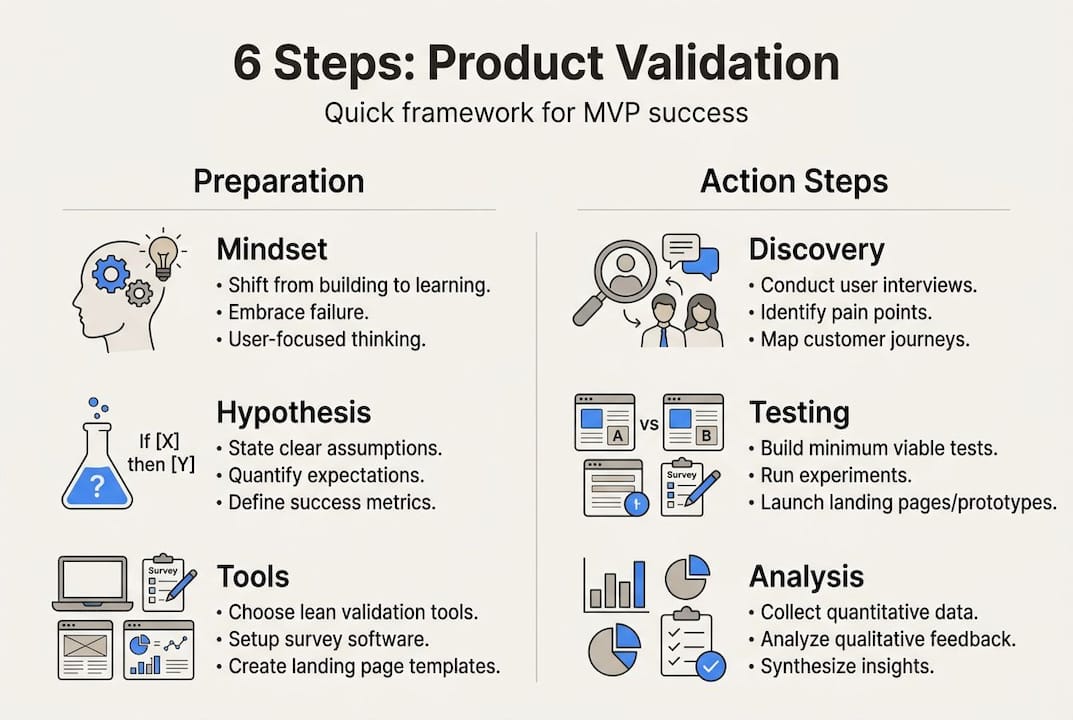
A typical validation process moves through discovery (identifying assumptions), testing (running experiments), and analysis (interpreting results). You can find a step-by-step guide to validation that maps this out clearly. The key insight is that validation is not a one-time event. It’s a loop you run until the signal is strong enough to justify building.
Preparation and setup: What you need before validating
Before you run a single experiment, you need to get your mindset and tools in order. The biggest mental shift is this: you are not trying to prove your idea is good. You are trying to find out if it’s wrong as fast as possible. Founders who fall in love with their idea before validating it almost always miss critical signals.

The good news is that lean MVP creation and proper preparation dramatically speed up validation. You don’t need a full product to start. You need a hypothesis and a way to test it.
Here are the core tools you’ll use:
- Landing page builder (Carrd, Webflow, or Framer) to capture interest
- Survey tool (Typeform or Google Forms) to collect structured feedback
- Analytics (Google Analytics or Plausible) to track real behavior
- Scheduling tool (Calendly) for user interviews
- Email list tool (Mailchimp or ConvertKit) to build a waitlist
| Tool | Purpose | Benefit |
|---|---|---|
| Carrd / Webflow | Landing page | Test messaging and capture signups |
| Typeform | Surveys | Gather structured user feedback |
| Google Analytics | Behavior tracking | See what users actually do |
| Calendly | Interview scheduling | Remove friction from user calls |
| Mailchimp | Email list | Build and nurture a waitlist |
One requirement non-technical founders often overlook is a clear, written hypothesis. Before you touch any tool, write down exactly what you believe to be true and what evidence would change your mind. This keeps you honest when the results come in.
Also review the tech checklist for rapid MVP success before you start. It covers technical decisions that can slow you down if you make them too late.
Pro Tip: Set a hard deadline for your validation phase before you start. Two to four weeks is enough for most MVPs. Without a deadline, preparation becomes procrastination.
Step-by-step product validation process for MVPs
Here is the repeatable sequence that works. Follow these steps in order and don’t skip ahead.
- Write your core assumption. State clearly who your user is, what problem they have, and why your solution is better. One sentence each.
- Build a simple landing page. Describe your solution and add a clear call to action, such as a signup or waitlist button. No product needed yet.
- Drive targeted traffic. Use Reddit, LinkedIn, niche communities, or small paid ads to get your target users to the page. Aim for at least 200 visitors.
- Run user interviews. Talk to 10 to 15 people who match your target profile. Ask about their current behavior, not your solution. Listen more than you talk.
- Analyze the data. Look at signup rates, interview patterns, and survey responses together. What do they confirm? What do they contradict?
- Iterate or pivot. Based on what you learn, adjust your hypothesis and run another loop, or commit to building if the signal is strong.
Using structured MVP validation checklists keeps each step accountable and reduces the chance of missing something important.
| Approach | Speed | Depth | Risk |
|---|---|---|---|
| Quick and dirty | 1 week | Low | Misses key signals |
| Thorough process | 3 to 4 weeks | High | Catches critical flaws |
For best practices on fast MVP validation, prioritize speed of learning over completeness. And remember, how MVPs validate ideas is about testing behavior, not collecting opinions.
Pro Tip: Record your user interviews (with permission). You will miss things in real time. Listening back reveals patterns you didn’t catch the first time.
Common mistakes and how to avoid them during validation
Even founders who commit to validation often derail themselves with predictable errors. Knowing these in advance is half the battle.
- Building in isolation. You spend weeks refining the product without talking to a single real user. Fix: schedule user interviews before you write a line of code.
- Overengineering the MVP. You add features to impress users instead of testing assumptions. Fix: strip the product down to one core action and test only that.
- Asking leading questions. You phrase interview questions to confirm what you already believe. Fix: ask open-ended questions like “Tell me about the last time you dealt with this problem.”
- Ignoring negative feedback. You dismiss critical responses as outliers. Fix: treat every negative signal as data worth investigating.
- Validating with the wrong audience. You survey friends and family who want to be supportive. Fix: find strangers who match your target profile exactly.
Premature scaling and ignoring user feedback are among the top reasons startups fail at the validation stage. The pattern is almost always the same: a founder gets excited, skips the hard conversations, and builds based on what they want to be true.
“Most failed startups had a product. What they didn’t have was proof that anyone needed it.”
The fix is not complicated. It just requires discipline. Follow the MVP launch steps in sequence and don’t advance to the next stage until you have real evidence from the current one.
How to know if your validation succeeded: measurable outcomes
Validation without measurement is just guessing with extra steps. You need clear signals to make an objective decision about what to do next.
Here are the metrics that actually matter:
- Waitlist signups: A 20% or higher conversion rate from visitors to signups is a strong early signal.
- Pre-sales or deposits: Someone paying money, even a small amount, is the strongest validation signal you can get.
- Demo bookings: If people are willing to give you 30 minutes of their time, they have a real problem.
- Active usage: If you have a prototype, are users coming back without being prompted?
- Feedback volume: Are users giving you detailed, unsolicited feedback? That signals genuine engagement.
Tracking clear validation metrics is what separates founders who make confident decisions from those who stay stuck in analysis paralysis.
Mixed signals are normal and don’t mean you’ve failed. If signups are high but interview feedback is lukewarm, dig into the gap. It usually means your messaging is stronger than your solution, which is fixable. If signups are low but interview feedback is passionate, your messaging needs work, not your idea.
Key stat: Studies suggest that products which go through structured validation are significantly more likely to reach product-market fit within their first year compared to those that skip the process.
Product-market fit is not a single moment. It’s a direction. Use why MVPs validate ideas to understand how each validation loop moves you closer to that direction. When the metrics line up and users start pulling the product forward instead of you pushing it, you’re there.
Our take: Why real validation hinges on honest user feedback
Here’s the uncomfortable truth most validation guides won’t tell you: the goal of validation is to get someone to tell you your idea is wrong. Not to collect enough “yes” answers to feel confident moving forward.
I’ve seen founders run 50 interviews and walk away with zero useful information because they never asked a hard question. They optimized for comfort, not truth. The MVP validation lessons that stick are always the ones that came from an uncomfortable conversation, not a polished survey.
Conventional wisdom says build something beautiful before showing it to users. In practice, the ugliest MVPs generate the most honest feedback. When your product looks unfinished, users critique the idea instead of the design. That’s exactly what you need.
Emotional attachment is the real enemy here. If you love your idea more than you love the truth, you will find a way to rationalize every negative signal. The founders who validate successfully are the ones who treat invalidation as a win. Finding out fast that something doesn’t work is worth more than six months of building something that won’t.
Ready to validate your product idea quickly and confidently?
You now have the full framework: the mindset, the tools, the steps, and the metrics. But knowing the process and executing it under pressure are two different things.
If you want a hands-on technical partner to help you move from idea to validated MVP without wasting time or budget, that’s exactly what I do at hanadkubat.com. I’ve built and validated my own SaaS products, so I know where founders get stuck and how to get through it fast. No agency overhead, no project manager in the middle. Just direct, senior-level execution built around your validation goals. Let’s cut the guesswork and ship something real.
Frequently asked questions
What is the difference between product validation and market research?
Product validation confirms real user interest and willingness to act, while market research explores general trends and preferences. Validation tests what people actually do, not just what they say they might do.
How long does the product validation process take for a new MVP?
Rapid MVP validation can take as little as 2 to 4 weeks with focused effort and feedback-driven iteration. Fast MVP validation is possible when you use lean methodologies and avoid scope creep during the testing phase.
What are examples of good product validation metrics?
Common metrics include waitlist signups, pre-sales, demo bookings, and active usage statistics. Tracking concrete validation metrics like signups helps founders assess readiness before committing to a full build.
Can I validate a product idea without technical skills?
Yes, many MVP validation steps like interviews and landing pages require no coding, just the right process and tools. Validation doesn’t require advanced technical skills for the majority of early-stage experiments.
What should I do if validation results are mixed or unclear?
Review your metrics, get direct user feedback, and iterate your MVP to test adjustments before committing further. Mixed validation results can be clarified by isolating one variable at a time and re-testing with a tighter hypothesis.