

TL;DR:
- Building a web app is essential for turning startup ideas into testable, user-facing products.
- Rapid, focused MVP development within 5 to 8 weeks increases chances of product-market fit.
- Success relies on strict scope, early user feedback, and continuous iteration rather than technical complexity.
You’ve got a great idea. You’ve mapped it out on a whiteboard, pitched it to friends, and maybe even built a landing page. But here’s the uncomfortable truth: the idea is the easy part. What separates funded, growing startups from the graveyard of abandoned side projects is the ability to turn that idea into a real, working web app that users can actually touch, test, and pay for. Understanding web app development, even at a high level, is one of the most valuable things you can do as a non-technical founder building toward product-market fit.
Table of Contents
- What is web app development?
- Why startups choose web apps for MVPs and SaaS
- The web app MVP process: milestones and timelines
- Critical mistakes and how to avoid them
- Your checklist for a successful web app MVP
- The truth most founders miss about web app development
- Need expert help building your MVP web app?
- Frequently asked questions
Key Takeaways
| Point | Details |
|---|---|
| Web apps enable fast startup testing | Launching your idea as a web app MVP lets you reach users quickly and learn what works. |
| Simplicity and speed drive success | Focusing on 3-5 features and iterating fast gives your MVP a much better chance of finding real market fit. |
| User adoption is the real hurdle | Most web app MVPs fail due to lack of user engagement, not technology problems—put user research first. |
| Rapid iteration beats ‘perfect’ launches | Founders who launch early and adapt fast see much higher success rates than those who delay for perfection. |
What is web app development?
To understand how to build a winning startup, let’s first clarify what web app development truly means and what it isn’t.
A web app is not a website. A website is mostly static. It shows information. Think of a company’s homepage or a blog. A web application, on the other hand, is interactive. Users log in, take actions, create data, and get personalized results. Gmail, Notion, Stripe, and Shopify are all web apps. They run in a browser, but they behave more like desktop software. You can read more about the web development overview to see how the field has evolved.
Web app development is the process of designing, building, and deploying these interactive applications. It involves several layers working together:
- Frontend: This is everything the user sees and interacts with. Buttons, forms, dashboards, navigation. Built with technologies like React or Next.js.
- Backend: This is the server-side logic. It processes requests, runs business rules, and talks to the database. Built with Node.js, Python, or similar tools.
- Database: This is where your data lives. User accounts, transactions, content. Common choices are PostgreSQL, MongoDB, and MySQL.
- APIs (Application Programming Interfaces): These are the bridges between different parts of your app or between your app and third-party services like Stripe for payments or Twilio for SMS.
“Most founders think of their product as a screen. The real product is the system behind the screen. Build the system right, and the screens almost take care of themselves.”
Modern tools have made this dramatically more accessible. Platforms like Vercel, Supabase, and Render let you deploy a working app in hours, not weeks. No-code tools like Bubble or Webflow cover simpler use cases. But for anything with real business logic, user authentication, or payment flows, you need actual code. The good news is that you don’t need to write it yourself. You just need to understand what you’re asking for and why it matters.
Web apps are the natural foundation for MVPs (Minimum Viable Products) and SaaS (Software as a Service) products. They run on any device with a browser. No App Store approval. No download required. You push an update and every user sees it instantly. For a startup that needs to move fast and learn faster, that’s a massive advantage.
Why startups choose web apps for MVPs and SaaS
Now that you know what a web app is, let’s see why startups consistently pick this route for MVPs and scalable SaaS tools.
Speed and reach are the two biggest reasons. A web app works on any device, any operating system, without the user doing anything except opening a browser. Compare that to a native mobile app, which requires separate builds for iOS and Android, App Store review processes, and users who have to download and install something before they even try your product. For a deeper look at this tradeoff, the comparison of web app vs mobile app is worth reading before you commit to a platform.
Here’s why web apps win for early-stage startups specifically:
- No installation barrier. Users can access your product through a link. Lower friction means more signups and faster feedback.
- Instant updates. You fix a bug or add a feature and it’s live for everyone immediately. No waiting for users to update their app.
- Lower initial cost. One codebase serves all users on all devices. You’re not paying to build and maintain separate apps.
- Easier user testing. You can run A/B tests, change flows, and swap out features without going through an app store.
- Faster time to market. A focused web app MVP can be live in five to eight weeks. That speed matters more than most founders realize.
On cost and timelines, the 2026 MVP benchmarks are clear: a simple web app MVP runs $8K to $20K and takes five to eight weeks to build. A SaaS MVP with more complex features lands between $15K and $30K over six to ten weeks. Those same benchmarks show that timelines under eight weeks correlate with a 39% product-market fit rate, compared to just 22% for projects that stretch past twelve weeks. Speed is not just a preference. It’s a competitive advantage with measurable impact.
If you’re wondering how to launch without a technical co-founder, the guide on SaaS MVP fast launch walks through exactly how to structure that process.
Pro Tip: When scoping your MVP, ask yourself: “What is the single action my user needs to take to get value?” Build only what enables that action. Everything else is a distraction until you have paying users.
The web app MVP process: milestones and timelines
After seeing why web apps suit MVPs, let’s map out what the actual building process looks like for founders.
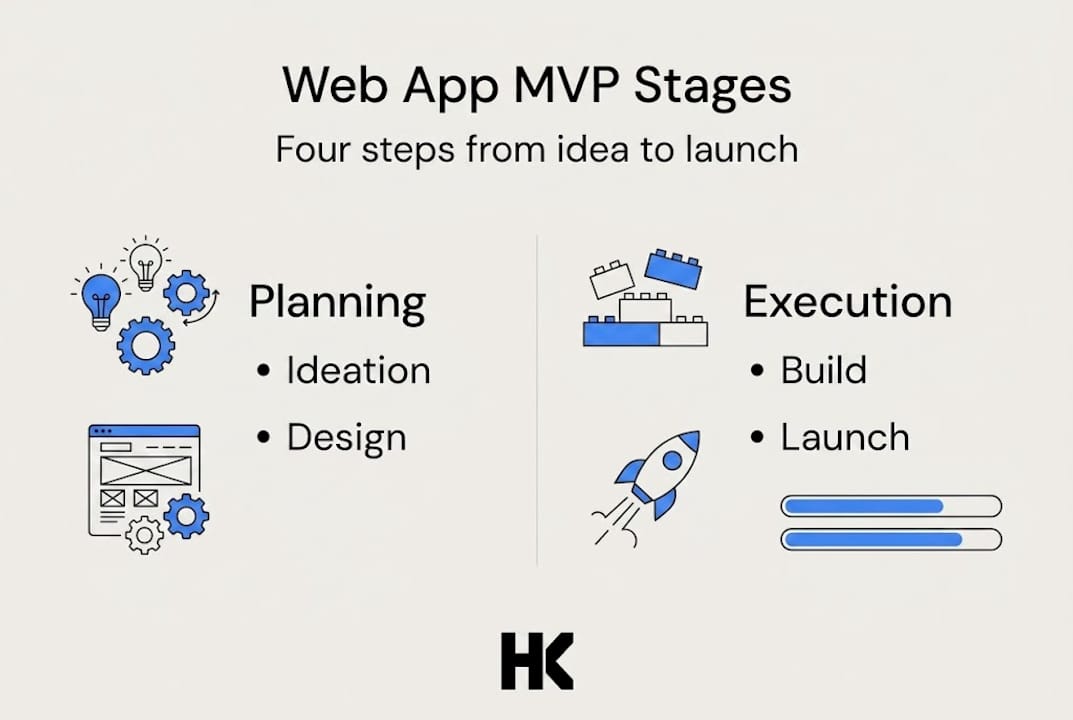
The MVP journey has four main stages. Each one builds on the last, and skipping any of them is how founders end up three months in with a product nobody wants.
Stage 1: Ideation and scoping. This is where you define the problem, identify your target user, and decide what the MVP actually includes. The goal is not to plan a perfect product. The goal is to identify the smallest version of your product that delivers real value and can be tested with real users. This stage should take one to two weeks, not months.
Stage 2: Design and architecture. This covers UX flows, wireframes, and technical planning. What screens does the user see? What does the backend need to support? What third-party tools will you integrate? Getting UX right in your MVP is often underestimated. A confusing interface kills adoption faster than a missing feature.

Stage 3: Building. This is the actual development work. Frontend, backend, database, integrations. For a focused MVP, this is where most of the timeline lives.
Stage 4: Launch and iteration. You ship to real users, collect feedback, and make rapid changes. This stage never really ends. It just evolves into your product roadmap.
Here’s how those stages map to realistic timelines and costs, based on 2026 MVP cost data:
| Stage | Simple web app MVP | SaaS MVP |
|---|---|---|
| Ideation and scoping | 1 week | 1 to 2 weeks |
| Design and architecture | 1 week | 1 to 2 weeks |
| Building | 3 to 5 weeks | 4 to 6 weeks |
| Launch and first iteration | 1 week | 1 to 2 weeks |
| Total timeline | 5 to 8 weeks | 6 to 10 weeks |
| Typical cost | $8K to $20K | $15K to $30K |
The data is clear: projects that finish in under eight weeks are nearly twice as likely to find product-market fit compared to those that drag on past twelve weeks. The reason is simple. Shorter cycles mean faster learning. You get real user feedback before you’ve burned through your budget or your runway.
Pro Tip: Treat your first launch as a learning event, not a product launch. Set a specific question you want answered, like “Will users complete the onboarding flow?” and measure that before anything else.
Rapid iteration is not a buzzword. It’s the actual mechanism by which good products get built. Every week you spend building without user feedback is a week you might be building the wrong thing.
Critical mistakes and how to avoid them
Knowing the process is only half the battle. Let’s tackle the most common and costly mistakes founders make.
The statistics here are sobering. MVP failure rates sit between 60% and 68%, and 73% of those failures come down to user adoption problems, not technical issues. The app worked. People just didn’t use it. That’s a product and strategy failure, not an engineering failure.
Here are the traps that catch most founders:
- Overbuilding. You add feature after feature before talking to a single real user. By the time you launch, you’ve spent $50K building something nobody asked for.
- Skipping user research. You assume you know what users want. You don’t. Neither do I. Neither does anyone until they watch real people try to use the product.
- Slow iteration. You launch, get feedback, and then spend three weeks debating what to change. Meanwhile, your users forget you exist.
- Ignoring the core action. You build a beautiful dashboard but the core workflow that delivers value is clunky and confusing.
- Treating launch as the finish line. Shipping is the starting gun, not the trophy. The real work starts after users touch your product.
“60 to 68% of MVPs fail. Nearly three quarters of those failures have nothing to do with the technology. They fail because nobody wanted to use what was built.”
The fix for most of these is ruthless scoping. Limit your MVP to three to five features, maximum. Not ten. Not seven. Three to five. Each feature should directly enable the core user action. Everything else goes on a backlog and stays there until you have evidence that users need it.
For a detailed breakdown of how to avoid these pitfalls, the guide on avoiding MVP pitfalls covers the most common failure patterns with specific fixes. And if you want to go deeper on process, product development best practices is written specifically for non-technical founders navigating this for the first time.
The MVP product development landscape has changed significantly. The founders who win are not the ones with the most features. They’re the ones who learn the fastest. That requires shipping small, measuring honestly, and killing features that don’t move the needle.
Your checklist for a successful web app MVP
Finally, let’s turn everything you’ve learned into an actionable checklist for launching a web app MVP the lean way.
This is not a theoretical framework. It’s the actual sequence that separates MVPs that ship and get validated from ones that sit in development forever. Research confirms that success requires ruthless scoping, with three to five core features, real user research, and post-launch iteration happening within days, not weeks.
- Define the core problem. Write one sentence describing the problem you’re solving and who has it. If you can’t do this in one sentence, you’re not ready to build yet.
- Identify your primary user. Not “everyone.” One specific type of person with one specific pain. The more specific, the better your product decisions will be.
- List every feature you think you need. Get it all out of your head and onto paper.
- Cut that list to three to five features. Ask for each one: “Does this directly help the user solve the core problem?” If the answer is no or maybe, cut it.
- Validate before you build. Talk to ten potential users. Show them wireframes. Ask if they’d pay for it. Listen more than you talk.
- Choose your tech stack with your developer. For most SaaS MVPs, React or Next.js on the frontend with Node.js on the backend is a proven, fast combination.
- Set a hard launch date. Eight weeks from kickoff. No extensions. Constraints force good decisions.
- Launch to a small group first. Twenty to fifty users who match your target profile. Not a public launch. A controlled learning event.
- Collect feedback within 48 hours of launch. Use short surveys, user interviews, or session recording tools like Hotjar. You need signal fast.
- Ship your first iteration within one week of launch. Fix the biggest friction point users hit. Show them you’re listening.
Pro Tip: Set up a simple feedback channel before you launch. A Typeform survey, a Calendly link for user calls, or even a WhatsApp group. The easier you make it for users to tell you what’s broken, the faster you learn.
For more structured guidance on this process, the MVP best practices guide covers validation frameworks in detail. And if you’re building a SaaS product specifically, the SaaS app launch guide walks through the go-to-market side of things that most technical guides skip entirely.
The checklist above works because it forces you to make decisions before you spend money. Every item is a decision point. The founders who skip steps one through five and jump straight to building are the ones who end up in the 60 to 68% failure bucket.
The truth most founders miss about web app development
Here’s the perspective most articles won’t give you, because it’s uncomfortable.
Technical complexity is not what kills startups. I’ve seen founders with no coding background build products that generate real revenue. I’ve also seen technically brilliant teams spend eighteen months building something nobody uses. The difference is not the code. It’s the discipline to stay focused on what users actually need and the willingness to kill your own ideas when the data says they’re wrong.
Perfectionism is the real enemy. Not your tech stack. Not your developer. Not the fact that you don’t know how to code. When you obsess over getting every feature perfect before launch, you’re really just avoiding the moment when real users tell you that your assumptions were wrong. That moment is painful. It’s also the most valuable thing that can happen to your startup.
The most durable SaaS products you know started embarrassingly simple. Notion was a basic notes tool. Stripe’s first version was a few hundred lines of code. Slack started as an internal tool for a gaming company. They didn’t win because they built the most sophisticated product. They won because they launched fast, listened hard, and adapted constantly.
The concept of rapid MVP deployment is not just about saving time or money. It’s about compressing your learning cycles. Every week you shorten your build cycle is a week you get feedback earlier, which means you make better decisions with less money spent.
If you’re a non-technical founder, your job is not to understand every line of code. Your job is to be obsessively clear about the problem, ruthlessly focused on scope, and fast enough to iterate before your runway runs out. A good technical partner handles the execution. You handle the learning. That’s the division of labor that actually works.
The founders who win are not the ones who build the most. They’re the ones who learn the fastest.
Need expert help building your MVP web app?
If you’ve read this far and you’re thinking “I know what I need to build, I just need someone to actually build it,” that’s exactly where I come in.
I’m Hanad Kubat, a senior full-stack engineer and SaaS founder based in Vienna. I build production-ready MVPs and SaaS products in four to twelve weeks using React, Next.js, and Node.js. No agency overhead, no project manager playing telephone, no junior developers learning on your dime. You work directly with me, the person writing the code. My background includes engineering work at BMW, Deutsche Bahn, and IBM, and I’ve built my own SaaS products using the exact same process I’d use for yours. If you’re ready to stop planning and start shipping, visit hanadkubat.com to see how we can work together.
Frequently asked questions
How long does it take to build a web app MVP?
Most MVP web apps take five to eight weeks to build. SaaS MVPs with more complex features typically take six to ten weeks, based on 2026 benchmarks.
Why do so many web app MVPs fail?
MVP failure rates sit between 60% and 68%, with 73% of failures caused by poor user adoption, not technical problems. Overbuilding and skipping user research are the most common culprits.
What features should I include in my MVP?
Limit your MVP to three to five core features that directly solve your users’ main problem. Ruthless scoping combined with early user research is the single biggest predictor of MVP success.
Is it possible to launch a web app MVP without a technical co-founder?
Yes. Many successful founders hire senior developers or specialized builders and focus their own energy on user research and rapid iteration. The key is finding someone who has built products before, not just code.
How much does web app MVP development cost?
Based on 2026 cost data, simple web app MVPs typically cost between $8,000 and $20,000. SaaS MVPs with more features and complexity range from $15,000 to $30,000.