

TL;DR:
- An MVP is a process of learning through repeated small experiments, not just shipping quickly.
- Strategic engineering ensures the MVP is scalable, maintainable, and built for growth from the start.
- Using proper patterns and avoiding common pitfalls helps MVPs succeed and evolve effectively.
Most founders think MVP engineering is about moving fast and shipping something, anything, before the competition does. That instinct is understandable but wrong. An MVP is not a race to a finish line. As MVP is a process of repeated small experiments, the real goal is learning quickly, not launching quickly. The difference between a startup that scales and one that rebuilds from scratch six months in almost always comes down to how engineering decisions were made at the very beginning. This guide will show you exactly how to think about engineering as a strategic tool, not just a build button.
Table of Contents
- Why MVP success starts with strategic engineering
- Choosing the right engineering approach for your MVP
- Engineering patterns for rapid MVP validation
- How engineering avoids common MVP pitfalls
- A founder’s perspective: What most guides miss about engineering for MVPs
- Take your MVP to the next level with expert engineering
- Frequently asked questions
Key Takeaways
| Point | Details |
|---|---|
| Engineering drives strategic MVPs | Expert engineering ensures MVPs are evolvable, scalable, and validated through repeat experiments. |
| Choose partners over pure no-code | Technical partnerships safeguard against costly mistakes and enable production-ready MVPs that grow with your business. |
| Iterative patterns unlock speed | Agile engineering and incremental builds accelerate MVP launches and provide rapid feedback. |
| Avoid pitfalls with expert guidance | Experienced engineers help you sidestep common MVP traps and support long-term product success. |
Why MVP success starts with strategic engineering
There is a common trap that catches non-technical founders early: confusing a prototype with an MVP. A prototype is a throwaway. You build it to test a concept visually or functionally, then you throw it away. An MVP is different. It is a real product, running in production, designed to collect real user feedback and evolve based on what you learn. According to the contrast: throwaway prototypes vs. evolvable MVPs, good engineering teams think in terms of a “minimum evolvable product,” not just a minimum viable one. That single shift in thinking changes everything about how you build.
When engineering is treated as a strategic lever, your MVP becomes something you can actually build on. Features can be added without rewriting the core. The database can handle growth. The codebase stays readable when a second developer joins. None of that happens by accident. It happens because an engineer made deliberate decisions early about architecture, data modeling, and technical boundaries.
Here are the most common misconceptions founders bring into their first MVP build:
- “Faster is always better.” Speed matters, but speed without structure creates debt you pay back with interest.
- “We can fix the tech later.” Later rarely comes. You end up patching a leaking boat instead of building a new one.
- “No-code is good enough to start.” Sometimes true, but often a ceiling you hit at the worst possible moment.
- “An MVP just needs to work.” It needs to work and teach you something. If it can’t be measured, it can’t be validated.
Here is a simple comparison to make the distinction concrete:
| Feature | Prototype | Evolvable MVP |
|---|---|---|
| Purpose | Concept testing | Market validation |
| Code quality | Throwaway | Production-ready |
| Scalability | None required | Built-in from day one |
| Feedback loop | Visual/UX only | Real user behavior data |
| Cost of change | Low | Managed and predictable |
“An MVP is not a product with fewer features. It is a learning machine with the minimum structure needed to generate real signal from real users.”
For founders who want to go deeper on this, validating MVP ideas fast is a practical place to start before you write a single line of code.
Choosing the right engineering approach for your MVP
Once you understand what an MVP actually is, the next question is: who builds it? You have three real options today: a technical partner, supervised AI-assisted development, or no-code tools. Each has a place, but they are not interchangeable.
No-code tools like Bubble or Webflow are fast and cheap for simple use cases. If you are validating a landing page or a basic workflow, they work fine. The problem starts when you need custom logic, third-party integrations, or any real data complexity. No-code platforms hit a ceiling fast, and migrating off them is painful.
AI-assisted development is increasingly powerful, but engineering partnerships or supervised AI builds are what actually produce reliable, production-grade MVPs. Unsupervised AI builds, where a founder pastes prompts into a code generator and ships the output, create systems that work until they don’t. Security gaps, poor error handling, and untestable code are common results.
Here is a comparison of the three approaches:
| Approach | Time to launch | Cost range | Scalability |
|---|---|---|---|
| No-code tools | 1-2 weeks | $0-$5K | Low |
| Supervised AI build | 1-4 weeks | $5K-$50K | Medium-High |
| Technical partner | 4-12 weeks | $15K-$100K+ | High |
Pro Tip: If your MVP involves payments, user data, complex permissions, or any kind of API integration, do not go no-code. The short-term savings become long-term rebuilds. Get a technical partner involved early, even if only for architecture review.
Here is how to choose the right path for your situation:
- Define your validation goal first. What specific question does your MVP need to answer?
- Assess technical complexity honestly. Does your product require custom logic, real-time data, or integrations?
- Estimate your runway. How long can you afford to build before you need revenue or investor signal?
- Evaluate your options against complexity. Match the tool to the problem, not to your comfort zone.
- Get a technical opinion before committing. Even one hour with a senior engineer can save weeks of wrong turns.
For a deeper look at this decision, the comparison between technical partners vs. no-code tools is worth reading. And if you want to move fast without writing code yourself, there is a practical breakdown of fast MVP building without coding that covers the realistic options in 2026.
Engineering patterns for rapid MVP validation
Choosing the right partner or tool is only step one. The how of building matters just as much as the who. The engineering teams that consistently ship fast MVPs are not cutting corners. They are using specific patterns that reduce waste and increase learning speed.
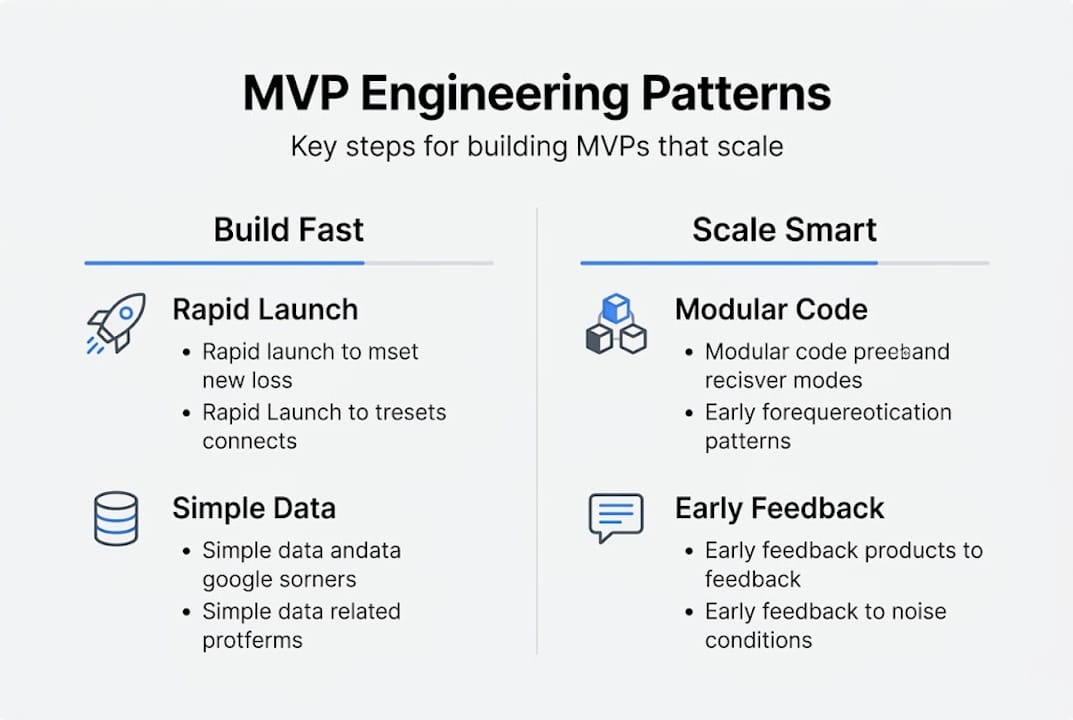
Agile development, when done properly, is not about daily standups and sticky notes. It is about shipping the smallest testable unit of value, getting feedback, and deciding what to build next based on evidence. This aligns directly with the idea that MVP is a process of repeated small experiments. Each sprint is a hypothesis test, not a feature delivery.
Here are the engineering patterns that consistently produce faster, more reliable SaaS MVP launches:
- Feature flags: Deploy code without activating it for all users. Test with a small group first.
- Modular architecture: Build components that can be swapped or extended without touching the core system.
- Automated testing from day one: Catching bugs early is ten times cheaper than catching them in production.
- Continuous deployment pipelines: Push code to production in minutes, not days. Feedback loops shrink dramatically.
- Instrumentation and analytics baked in: If you can’t measure user behavior from launch day, you are flying blind.
For complex SaaS products, forward-deployed engineers enhance MVP success by embedding directly into the product context, customizing solutions to the specific market and user workflow rather than applying generic patterns. This approach is especially valuable when your product sits at the intersection of technical complexity and niche user behavior.

Pro Tip: If your MVP has more than three user roles or involves multi-step workflows, invest in a proper data model before writing any feature code. A bad data model is the single most expensive mistake to fix later.
For founders who want to understand the full framework, agile frameworks for MVP explains how these patterns apply in practice. And if you want a checklist-style breakdown, fast MVP validation best practices covers the most important steps in plain language.
How engineering avoids common MVP pitfalls
Even with the right approach and the right patterns, MVPs fail. The reasons are almost always predictable. Non-technical founders tend to encounter the same set of traps, and experienced engineers know exactly where to look.
The most common pitfalls include:
- Scope creep: Adding features before validating the core ones. Every addition is a delay and a distraction.
- Skipping authentication and security basics: A data breach at MVP stage can kill a startup before it starts.
- No error logging or monitoring: You will not know something is broken until a user tells you, which is too late.
- Ignoring mobile responsiveness: Over 60% of web traffic is mobile. An MVP that breaks on a phone is not an MVP.
- Building for the happy path only: Real users do unexpected things. Engineering for edge cases is not optional.
Here is how experienced engineers address each of these risks systematically:
- Scope creep: Define a locked feature list before development starts. Any new idea goes into a backlog, not the current build.
- Security gaps: Use established auth libraries, enforce HTTPS, and never store plain-text passwords. These are non-negotiable defaults.
- Monitoring blind spots: Set up error tracking and uptime monitoring on day one, before launch.
- Mobile issues: Build mobile-first or use responsive frameworks from the start, not as an afterthought.
- Edge case failures: Write tests for the broken flows, not just the working ones.
As MVP is a process of repeated small experiments, each iteration is an opportunity to catch and fix what the last one missed. The founders who treat engineering as a continuous process rather than a one-time event are the ones who avoid expensive rebuilds.
“The goal of an MVP is not to build something small. It is to learn something fast, with the least amount of wasted effort.”
For a full breakdown of what to watch out for, avoid common MVP pitfalls is a practical reference. And since user experience is often where MVPs quietly fail, UX in MVP development covers how to get that right without a full design team.
A founder’s perspective: What most guides miss about engineering for MVPs
Most MVP guides obsess over speed. Ship fast. Fail fast. Move fast. That advice is not wrong, but it is incomplete, and for non-technical founders it can be genuinely dangerous.
The real risk is not building too slowly. It is building something that cannot evolve. I have seen founders spend $80K rebuilding an MVP that was technically “done” because the original engineer optimized for launch speed and ignored everything else. The product worked. It just could not grow.
The concept of MVP architecture for SaaS is almost never discussed in founder communities, but it is the thing that separates a product you can scale from a product you have to replace. When evaluating a technical advisor or partner, do not just ask what they have built. Ask how they think about what comes after the MVP. If they have no answer, that is your answer.
The minimum evolvable product is not a buzzword. It is a discipline. And it is the difference between a product that survives its first hundred users and one that collapses under them.
Take your MVP to the next level with expert engineering
If this guide has shifted how you think about MVP engineering, the next step is working with someone who has actually lived it. Not an agency with a project manager in the middle. Not a freelancer who disappears after launch.
At expert MVP development services, you work directly with a senior engineer who has built production SaaS products and scaled them. The same Fortune 500 engineering discipline applied at founder speed, starting at €15K, delivered in 4 to 12 weeks. If you are ready to stop planning and start shipping something that actually holds up, let’s talk.
Frequently asked questions
Why do non-technical founders need engineering partners for MVP?
Engineering partnerships or supervised AI builds ensure your MVP is scalable and maintainable from day one, preventing the costly technical mistakes that force full rebuilds later.
What is the difference between a prototype and an MVP?
A prototype tests a concept and gets thrown away, while an MVP is production-ready and designed to validate real assumptions. The contrast: throwaway prototypes vs. evolvable MVPs shows why the distinction matters for long-term scalability.
What are forward-deployed engineers and how do they help with MVP?
Forward-deployed engineers enhance MVP success in complex cases by embedding directly into the product context, customizing solutions to specific user workflows rather than applying generic patterns.
How much time and money does engineering-driven MVP development require?
A supervised AI: 1-4 weeks, $5K-$50K for production-grade MVP is the typical range, while a full technical partnership runs $15K to $100K+ depending on complexity and scope.