

TL;DR:
- Successful SaaS MVPs now focus on 3-7 core features built in 8-12 weeks.
- No-code, AI, and vertical SaaS tools enable faster, cheaper, and scalable MVP development.
- Pre-build user validation and scope reduction are crucial to avoiding overbuilding and failure.
Most founders assume a strong SaaS MVP needs six months and a feature list the length of a grocery receipt. The reality is sharply different. Rapid deployment in 8-12 weeks with just 3-7 core features is now the standard for MVPs that actually gain traction. In 2026, the founders winning early are not the ones who build the most. They are the ones who build the least amount necessary to prove their idea works. This guide breaks down the real trends shaping SaaS MVPs right now, from AI and no-code tools to validation frameworks and European cost benchmarks.
Table of Contents
- The new MVP playbook: What’s changed in 2026?
- AI, no-code, and vertical SaaS: Building smarter, faster MVPs
- Validation, scoping, and avoiding common SaaS MVP pitfalls
- MVP costs, tech stacks, and benchmarks: What to expect in Europe
- What most MVP guides miss: Why ‘less features, more feedback’ wins in 2026
- Get expert help to launch your SaaS MVP in 2026
- Frequently asked questions
Key Takeaways
| Point | Details |
|---|---|
| Speed and simplicity win | Successful SaaS MVPs in 2026 launch in 8-12 weeks with only 3-7 essential features. |
| AI and no-code are game changers | Leveraging agentic AI and no-code platforms makes MVP development faster and more accessible for non-tech founders. |
| Validate before building | Conduct 10-30 user interviews and focus on early feedback to ensure real market fit and avoid overbuilding. |
| Expect clear cost benchmarks | In Europe, MVP budgets typically range from €3k to €15k for simple builds, with AI reducing costs further. |
The new MVP playbook: What’s changed in 2026?
For years, the default startup advice was to pack your MVP with features, ship fast, and iterate later. That playbook is broken. The market has shifted, user expectations have jumped, and the tools available to founders have changed everything.
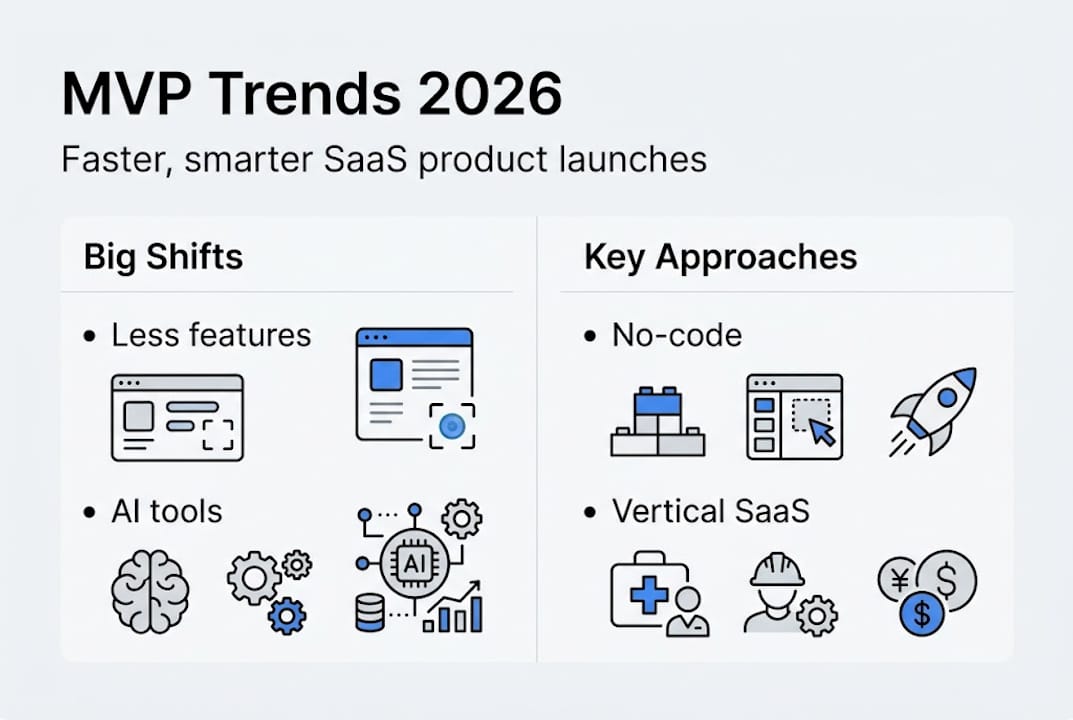
The biggest mindset shift in 2026 is moving from “feature-rich equals better” to “less is more.” The MoSCoW method, which stands for Must-have, Should-have, Could-have, and Won’t-have, has become the go-to framework for founders who want to scope ruthlessly. You define your absolute must-haves, and you cut everything else before you write a single line of code.
| Approach | 2020-2023 | 2026 |
|---|---|---|
| Typical feature count | 15-40 features | 3-7 features |
| Build timeline | 4-9 months | 8-12 weeks |
| Primary tools | Custom dev only | AI, no-code, low-code |
| Validation timing | Post-launch | Pre-build |
The numbers back this up. Failed MVPs average 25-40 features while successful ones stay in the 3-7 range. That gap is not a coincidence. Overbuilding wastes money, delays feedback, and buries your core value proposition under noise.
Agentic AI, no-code platforms, and low-code tools are now mainstream, even for founders with zero technical background. These are not experimental toys. They are production-grade tools that let you launch a SaaS MVP fast without hiring a full engineering team on day one.
Here is what the new MVP workflow looks like in practice:
- Validate first: Talk to 10-30 real users before building anything
- Scope with MoSCoW: Identify your 3-5 must-have features and cut the rest
- Choose the right tool layer: No-code for speed, custom code for scale
- Build in 8-12 weeks: Ship something testable, not something perfect
- Iterate based on data: Every feature decision after launch is driven by user behavior
The founders who understand this shift have a real competitive edge. Those who still think “more features equal more value” will burn through their runway before they find product-market fit.
AI, no-code, and vertical SaaS: Building smarter, faster MVPs
Understanding the new MVP framework, let’s look at the actual tools and strategies you can use right now.
No-code platforms like Bubble, Webflow, and Glide have matured significantly. They are no longer just for landing pages. You can build functional, multi-step SaaS workflows without touching code. For non-technical founders, this is a genuine unlock. AI and no-code tools reduce costs by 20-35% compared to traditional custom development, and they compress timelines dramatically.
But the bigger story is agentic AI. Unlike the old-school AI copilots that just suggested code completions, agentic AI can now handle entire workflows autonomously. Think automated onboarding sequences, dynamic pricing logic, or support ticket triage, all without a developer writing custom logic from scratch. This is not hype. It is already being used in production MVPs today.
| Build approach | Estimated cost | Timeline | Best for |
|---|---|---|---|
| No-code only | €3k-€8k | 4-6 weeks | Simple workflows |
| AI-assisted custom dev | €10k-€25k | 8-12 weeks | Scalable SaaS |
| Traditional custom dev | €30k+ | 4-9 months | Complex platforms |
Vertical SaaS is the other major trend worth your attention. Instead of building a horizontal tool that serves everyone, vertical SaaS targets one specific industry with deep, tailored functionality. Think practice management software for physiotherapists, or compliance tools for German accounting firms. Vertical SaaS is growing 18-32% year over year and the reason is simple: niche products command higher prices and face less competition.
Pro Tip: If you are exploring no-code MVP approaches, start with a no-code prototype to validate your idea, then bring in a developer to rebuild the core for scale. You save money early and avoid rebuilding something nobody wants.
For founders who want to understand how AI-driven SaaS MVPs are being structured in 2026, the key is treating AI as a feature layer, not a foundation. Build your core workflow first. Then layer AI capabilities on top where they add measurable user value.

Validation, scoping, and avoiding common SaaS MVP pitfalls
With the right tools in hand, it is essential to make sure your MVP solves real user problems and avoids the traps that sink most SaaS launches.
Validation is not optional. It is the single highest-leverage activity you can do before writing a line of code. Validated MVPs conduct 10-30 user interviews before building, while failed MVPs do 0-3. That gap explains most startup failures more clearly than any post-mortem ever will.
Here is a practical validation and scoping checklist for European founders:
- Define your target user precisely. Not “small businesses” but “solo accountants in the Netherlands managing 20-50 clients.”
- Run 15-20 problem interviews. Ask about current pain, not about your solution.
- Apply MoSCoW to your feature list. If a feature is not a Must-have, it does not ship in v1.
- Check GDPR requirements early. Data storage, consent flows, and user rights must be designed in from day one, not retrofitted later.
- Confirm your pricing model before launch. Freemium, per-seat, and usage-based all have different implications for your early retention data.
Use the MVP validation checklist to structure your pre-build research and the MoSCoW feature selection framework to cut scope before it cuts your runway.
“60% of MVPs gain traction or pivot successfully when pre-build validation is done right. The ones that skip it rarely recover.”
The most common pitfalls are predictable. Overbuilding is number one. Founders add features because they are afraid the product will look too simple. It will not. Simple products that solve one problem well convert better than bloated ones. Second is the missing feedback loop. Shipping without a system to collect and act on early user feedback means you are flying blind after launch. Third is ignoring GDPR, which in Europe is not a minor compliance checkbox. It is a legal requirement that can shut down your product if ignored.
MVP costs, tech stacks, and benchmarks: What to expect in Europe
You have seen how to build, now let’s get concrete about what it actually costs and which tech choices work best in Europe.
Cost expectations vary widely depending on your approach. Simple SaaS MVPs range from €3k to €15k, with the median custom build sitting around $28,000. AI and no-code tools can pull that number down by 20-35% when used strategically.
| MVP type | Cost range | Timeline | Scalability |
|---|---|---|---|
| No-code (Bubble, Glide) | €3k-€8k | 4-6 weeks | Limited |
| Freelance custom dev | €8k-€20k | 8-14 weeks | Moderate |
| Senior dev (full-stack) | €15k-€40k | 8-12 weeks | High |
For European founders, EU funding programs like Horizon Europe and national innovation grants can offset early build costs. These programs favor technically credible proposals, so having a solid founder tech checklist and a defined architecture helps when applying.
On the tech stack side, Next.js, PostgreSQL, and Stripe are the dominant combination for scalable SaaS in 2026. They are well-supported, widely understood, and integrate cleanly with modern auth and payment systems. Multi-tenancy, meaning the ability to serve multiple separate customers from one codebase, should be designed in from day one. Retrofitting it later is expensive and painful.
Key technical decisions to make before you build:
- Authentication: Use a managed auth provider like Auth0 or Clerk to avoid building it yourself
- Database: PostgreSQL for relational data; consider Supabase for faster setup
- Payments: Stripe handles European VAT and multi-currency out of the box
- Hosting: Vercel or Railway for speed; AWS or GCP if you need EU data residency for GDPR
If you are considering a mobile component, review the mobile MVP benchmark before committing. Mobile adds cost and complexity. For most B2B SaaS MVPs, a responsive web app is enough to validate.
What most MVP guides miss: Why ‘less features, more feedback’ wins in 2026
Most MVP guides still tell you to launch fast and figure it out later. That advice made sense in 2015. In 2026, it is actively harmful.
User expectations have risen sharply. AI-powered tools have set a new baseline for what “good enough” looks like. If your MVP feels rough and unfinished, users will not give you the benefit of the doubt. They will just leave. Traditional “launch fast” thinking no longer accounts for how competitive the SaaS landscape has become.
The founders I see succeed are not the fastest launchers. They are the most focused ones. They do 20 user interviews before writing a spec. They apply MoSCoW and cut features that feel important but are not essential. They validate startup ideas before they spend a cent on development.
Here is the uncomfortable truth: a non-technical founder with 20 good user interviews and a 4-feature MVP will outperform a technical team that ships a 30-feature product nobody asked for. Feedback is the actual competitive advantage in 2026. Not speed. Not features. Feedback.
Get expert help to launch your SaaS MVP in 2026
Ready to put these trends to work and avoid costly mistakes? Here is your next step for a winning MVP in 2026.
Building a production-ready SaaS MVP is faster and more achievable than most founders realize, but only when you have the right technical partner guiding the decisions. At hanadkubat.com, I work directly with non-technical founders to scope, build, and ship MVPs in 4-12 weeks. No agency overhead, no project managers in the middle, just senior engineering applied to your specific product. If you want to launch without a tech co-founder and avoid the overbuilding trap, let’s talk about what your MVP actually needs to ship and succeed.
Frequently asked questions
How long does it take to build an MVP in 2026?
Most SaaS MVPs can be built in 8-12 weeks thanks to AI tools and no-code platforms that have dramatically compressed development timelines.
What is the average MVP cost for SaaS founders in Europe?
Costs range from €3k to €15k for simple SaaS MVPs, with no-code and AI-assisted builds sitting at the lower end of that range.
What are the most important MVP features to include?
Focus on just 1-3 core features that solve your user’s primary problem. Successful MVPs stay at 3-7 features and validate the core value before adding anything else.
Should I use no-code tools for my SaaS MVP?
Yes, especially if you are non-technical. No-code and AI tools can reduce build costs and cut development time by 20-35%, making them a smart starting point for most early-stage founders.