

TL;DR:
- Non-technical founders can launch profitable SaaS products in as little as 45 to 90 days through founder agility.
- Practicing rapid decision-making, adaptation, and continuous validation helps avoid common failures like overbuilding and role ossification.
- Using no-code tools and maintaining a hands-on, iterative approach accelerates MVP development and market fit discovery.
Non-technical founders are launching profitable SaaS products in as little as 45 to 90 days. That number surprises most people. The assumption is that building software takes years of planning, a full engineering team, and a bloated budget. But that assumption is wrong. Founder agility is the force behind these fast launches. It is not just about moving quickly. It is about making sharp decisions, adapting when reality does not match your plan, and executing without waiting for perfect conditions. This guide breaks down what founder agility means, why the data behind it is hard to ignore, and exactly how you can apply it to get your SaaS MVP off the ground faster.
Table of Contents
- What is founder agility?
- Why founder agility matters: Data, benchmarks, and edge cases
- Founder agility in practice: Mindset, culture, and frameworks
- Tools and tactics: How non-tech founders can achieve agility fast
- A fresh perspective: Why non-tech founder agility is more than a buzzword
- Take the next step toward founder agility
- Frequently asked questions
Key Takeaways
| Point | Details |
|---|---|
| Agility defined | Founder agility means quickly adapting, executing, and iterating to seize early SaaS opportunities. |
| Fast MVP launches | Non-technical founders can launch and validate SaaS products in under 90 days using the right tools and agility mindset. |
| Prevent failures | Most failed MVPs result from slow moves, misreading markets, or overbuilding features—agility fixes these issues. |
| Practical frameworks | Quarterly audits, iterative feedback, and leveraging no-code or AI enable ongoing agility as startups scale. |
What is founder agility?
Founder agility is not a soft concept. Founder agility refers to the speed, adaptability, and rapid execution ability of startup founders, especially when responding to market changes. Think of it as your ability to stay sharp and responsive when conditions shift, which they always do in early-stage SaaS.
For non-technical founders, this matters even more. You are already navigating a steep learning curve around product, technology, and go-to-market strategy at the same time. Without agility, you get stuck waiting for engineers to interpret your vision, or worse, you build something nobody wants before you realize it.
Agile founders share a specific set of attributes:
- Speed: They make decisions fast, with incomplete information, and correct course when needed.
- Adaptability: They pivot when feedback demands it, not when their ego allows it.
- Execution: They ship things. Imperfect things. Then improve them.
- Flexibility: They hold their strategy loosely and their customer insights tightly.
One of the most underrated aspects of agility is cultural. Strategic flexibility and cultural adaptability define truly agile founders. The best way to think about this is what some call the chameleon mindset: the ability to look at your role, your product, and your market through fresh eyes, repeatedly, without clinging to what worked six months ago.
“The founders who scale are not the ones with the best initial plan. They are the ones who recognize fastest when the plan is wrong.”
In early SaaS, this shows up during MVP validation. You build something small, put it in front of users, get uncomfortable feedback, and adapt. Founders who treat that feedback as a threat fail. Founders who treat it as intelligence win.
Agility is not chaos. It is structured responsiveness. You still need a direction. You still need a plan. But you hold both loosely enough to change them when reality gives you better information.
Why founder agility matters: Data, benchmarks, and edge cases
The numbers tell a clear story. Non-tech founders can reach 100 customers in 45 days and $100K in revenue. AI-powered MVPs now ship 10x faster and 70 to 80% cheaper than traditional builds. That is not a minor efficiency gain. That is a structural change in what is possible for non-technical founders who move with intent.
Here is how agile SaaS launches compare to sluggish ones:
| Metric | Agile founder approach | Rigid founder approach |
|---|---|---|
| Time to first user | 30 to 60 days | 6 to 18 months |
| Cost to validate | $5K to $20K | $100K+ |
| Feedback loops | Weekly | Quarterly |
| Product-market fit attempts | Multiple, fast | One big bet |
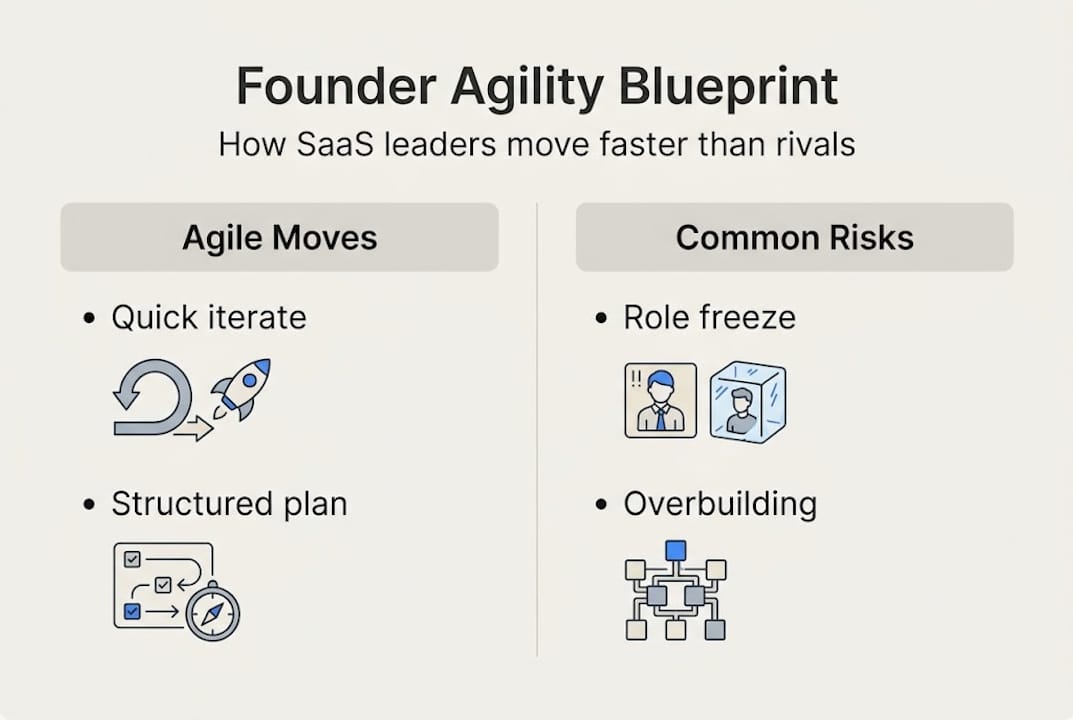
But agility is not just about opportunity. It is also a defense against very specific and very common failure patterns. Role ossification causes 78% of scaling failures. Overbuilding delays launch. And 90% of MVPs built without proper validation fail. These are not edge cases. They are the default outcome when founders move slowly and without discipline.
Role ossification is worth unpacking. It happens when a founder keeps acting like a scrappy startup operator after the business needs something different, or vice versa. You were the right person for month one. You might not be the right version of yourself for month twelve. Agile founders audit this continuously.

Overbuilding is the other silent killer. Most founders add features because they are afraid. Afraid the product is not enough. Afraid users will leave. The irony is that overbuilding is what actually pushes launch further away and burns runway faster. It also makes avoiding MVP pitfalls much harder when you have already tangled your codebase with unvalidated features.
Pro Tip: Your MVP validation checklist should ask one question first: does this feature help me learn something critical about my users, or am I building it because it feels safe? If it is the latter, cut it.
Founder agility in practice: Mindset, culture, and frameworks
Knowing the risks and rewards is only useful if you actually change how you operate. Agility has to be designed into your daily behavior, not just declared in a slide deck.
Start with the cultural agility and quarterly audits approach. Founders should reinvent their approach every 6 to 9 months in the AI era, not every 18 to 24 months like traditional business thinking suggests. The market is moving faster than that. Your habits need to keep up.
Here is how to build agility into your actual workflow:
- Run a monthly assumptions audit. Write down your three biggest assumptions about your product and users. Actively try to break them with data or user conversations.
- Create short feedback loops. Talk to users every week. Not quarterly. Weekly. Even a 15-minute call once a week changes how fast you course-correct.
- Schedule a personal role audit every quarter. Ask yourself: what does the company need from me right now that it did not need three months ago? What should I stop doing?
- Reinvent your stack and approach regularly. Founder agility is about evolving beyond rigid frameworks. Striking a balance between hands-on leadership and adaptive delegation is the actual skill.
- Kill decisions that are hard to reverse. Move fast on reversible decisions. Slow down only on the ones you cannot undo.
The danger of not doing this is very real. Founders who do not audit their own habits become the ceiling of their own company. They make decisions based on who they were, not who the business needs them to be. You can find more structure around this in MVP best practices that are built specifically for fast-moving founders.
Pro Tip: Block 90 minutes at the end of every quarter specifically for your role audit. Ask one question: what would a new, unbiased founder do differently if they stepped into my shoes today? That gap is your agility work. For more on building habits that support this, product development best practices for non-technical founders is a good starting point.
Tools and tactics: How non-tech founders can achieve agility fast
Mindset without tools is motivation without traction. You need practical ways to move fast, especially if you are not a developer yourself.
The first move is using no-code and AI tools strategically. Leverage no-code and AI for direct technical support bypass, then transition to code-based architecture when you need to scale. Think of no-code as your agility engine in the early stage. It lets you validate, iterate, and ship without waiting on engineering queues.
Here is how the two approaches compare:
| Factor | No-code / AI approach | Traditional development |
|---|---|---|
| Speed to first version | Days to weeks | Months |
| Cost | Low ($0 to $500/month) | High ($50K to $200K+) |
| Scalability | Limited at volume | High |
| Technical risk | Low early on | High if wrongly scoped |
| Founder control | High | Often low |
Key tools worth knowing for rapid MVP building:
- Webflow or Framer for landing pages and design-heavy frontends
- Bubble for full-stack no-code apps with logic and databases
- Zapier or Make for connecting tools and automating workflows
- Airtable as a fast backend substitute for early data management
- Notion for internal wikis, roadmaps, and product specs
The critical insight here is what founder deep product involvement actually does: it enhances agility without full delegation. When you stay close to the product, you catch bad decisions before they get expensive. You notice when users are confused. You feel the friction before it becomes a churn problem.
You can explore no-code MVP building strategies in depth, or look at MVP trends for 2026 to understand where the tooling landscape is heading. When you are ready to go beyond no-code, understanding the mechanics of launching SaaS apps will close the gap between prototype and production.
A fresh perspective: Why non-tech founder agility is more than a buzzword
Here is what most agility guides will not tell you: overdelegating early is one of the most expensive mistakes a non-technical founder can make. The instinct is understandable. You feel out of your depth technically, so you hand things off. But early overdelegation severs you from the feedback loops that would make your product sharper and your decisions faster.
Founders who stay hands-on, even imperfectly, build market fit faster because they feel the product through their users’ experience. They are not reading a summary of a summary. They are in the conversation.
The other thing most guides get wrong: agility is not about moving without direction. It is about removing friction between what you learn and what you change. The founders who win in early SaaS are not the chaotic ones. They are the ones with short cycles. Learn something Monday. Change something Wednesday. Measure it Friday.
Solid MVP architecture supports this loop. When your technical foundation is clean, iteration is fast. When it is tangled, every change costs double. Agility is not just a mindset. It is a system. And that system needs to be built correctly from day one.
Take the next step toward founder agility
You now have the map. Founder agility is not a personality trait reserved for ex-engineers or serial founders. It is a set of behaviors, frameworks, and tools that any non-technical founder can apply starting this week.
If you are serious about moving from idea to production-ready SaaS without wasting six months on the wrong build, support for SaaS founders is what hanadkubat.com is built for. You get direct access to a senior engineer who has shipped his own SaaS products and knows what actually matters at the early stage. Before you build anything, make sure you are building the right things by reviewing the must-have MVP features every startup founder needs. Stop planning. Start shipping.
Frequently asked questions
How does founder agility differ from general business agility?
Founder agility refers to rapid execution and market response by startup founders, while business agility typically describes how established companies adapt at scale with existing systems and teams.
Can I be agile as a non-technical founder without coding skills?
Yes. No-code and AI drastically speed up early MVP development for non-technical founders, letting you test and validate ideas without writing a single line of code.
What are the biggest risks if I lack founder agility?
Overbuilding and skipping validation cause 90% of MVPs to miss product-market fit, and slow-moving founders risk losing market windows entirely.
How often should a founder reevaluate their role or company direction to stay agile?
Reinventing every 6 to 9 months in the AI era prevents ossification. Traditional 18 to 24 month review cycles are too slow for the pace at which early SaaS markets shift today.
Recommended
- SaaS MVP: Launch fast without a technical co-founder | HK
- Lean product creation guide: fast-track your SaaS MVP | HK
- How to launch a SaaS app: a practical guide for founders | HK
- Mobile app development for SaaS founders: ship faster in 2026 | HK
- Smart SaaS hiring strategies: Your… | GENTY recruitment